
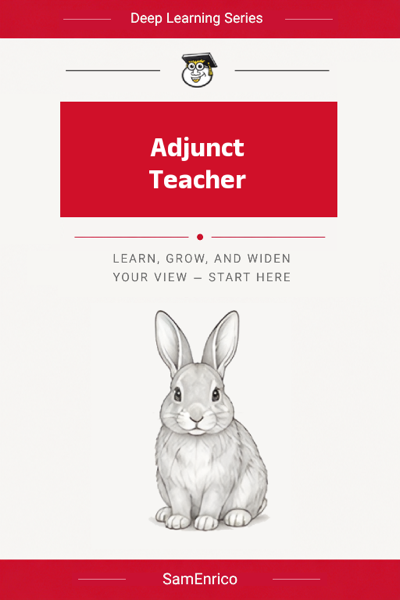
Non-FictionInformativeEducational
Adjunct Teacher eBook
A Coursebook on Adjunct Teacher
A Coursebook on Adjunct Teacher
Formats
Free sample
Chapter 1: The Seventy-Six Percent--–- You have been invited to join the largest workforce in higher education that nobody talks about. The invitation will not come with a fanfare. There will be no signing bonus, no welcome reception, no office with your name on the door. Instead, you will receive an email—usually three weeks before the semester starts—asking if you are “still available to teach ENG 101 on Tuesdays and Thursdays from 11:00 to 12:15.” The pay will be somewhere between 1,800and1,800 and 1,800and3,500 per course, depending on the institution and your willingness to negotiate. You will be told that this is a “great opportunity” and that “students love your energy.” What you will not be told is that you are about to join the seventy-six percent.
And the seventy-six percent changes everything.Let us start with the number because the number is the foundation of every conversation, every frustration, and every strategy in this book. According to the American Association of University Professors, the U.S. Department of Education, and every major study of academic labor conducted in the past fifteen years, over seventy-six percent of all faculty positions in American higher education are contingent. That means they are not on the tenure track. They are not permanent.
They are not salaried in the way that most professionals understand salary. They are adjunct, part-time, non-tenure-track, or some other variation of the word “temporary.” The tenured professor with the corner office, the sabbatical every seventh year, and the graduate assistant who grades their papers is now the exception, not the rule. You are the rule. You are the seventy-six percent.This chapter is not designed to depress you. It is designed to immunize you.
Most adjuncts enter the classroom with the wrong mental model. They think they are apprentices, that they are paying dues, that if they work hard enough and teach well enough, the institution will reward them with something more permanent. That is the myth. The reality is that most institutions have no intention of converting adjunct positions into tenure-track lines. The adjunct model is not a pipeline to permanent employment.
It is the permanent model. Understanding this distinction is the difference between strategic career planning and years of quiet desperation.The History You Were Never Taught The seventy-six percent did not appear overnight. It was built, decision by decision, over fifty years. In the 1970s, states began reducing their per-student funding for public universities. At the same time, college enrollment was rising as the baby boom generation reached college age and as more women and first-generation students entered higher education.
Institutions faced a simple problem: more students, less money per student, and no political will to raise taxes or tuition. Something had to give.What gave was the faculty. Administrators discovered that they could hire part-time instructors to teach individual courses at a fraction of the cost of full-time faculty. A full-time professor cost salary plus benefits, which in many states added thirty to forty percent to the base salary. An adjunct cost a flat fee per course, no benefits, no retirement contribution, no office, no travel budget, no committee assignments.
The savings were irresistible, especially to budget-conscious deans and provosts.By the 1990s, adjunctification had become standard practice. Community colleges led the way, as they always had relied on part-time faculty to teach specialized courses. Then regional public universities followed. Then even elite private institutions, though they were slower and more discreet about it. By the 2000s, the tenure track was no longer the default career path for Ph Ds.
It was a shrinking island in a growing sea of contingency. Today, the seventy-six percent is the water you swim in. The tenure track is the boat that most people will never board.The Arithmetic of Adjunct Pay Let us do the math together. It is uncomfortable, but you need to see the numbers. A typical adjunct contract pays between 2,000and2,000 and 2,000and5,000 per three-credit course.
The national average as of the most recent data is approximately $3,000 per course. That sounds like a reasonable amount of money until you break it down by the hour.A three-credit course meets for three hours per week over fifteen weeks. That is forty-five contact hours. But contact hours are only the time you spend standing in front of students. Preparation for each class meeting adds at least one to two hours, sometimes more for new course preps.
Grading adds another one to three hours per week, depending on the type of assignments. Answering student emails, holding office hours, and managing the learning management system add another hour. A conservative estimate puts the total time commitment at six to eight hours per week, or ninety to one hundred twenty hours per course.Now divide 3,000byonehundredtwentyhours.Youareearning3,000 by one hundred twenty hours. You are earning 3,000byonehundredtwentyhours.Youareearning25 per hour. That is above minimum wage, certainly, but it is less than what a skilled plumber charges, less than what a dog walker in a city earns, and far less than what the institution pays the full-time professor for the same teaching work.
And 3,000percourseisgenerousbynationalstandards.Inmanystates,adjunctsearn3,000 per course is generous by national standards. In many states, adjuncts earn 3,000percourseisgenerousbynationalstandards.Inmanystates,adjunctsearn1,800 per course, which works out to 15perhouratthehighendofthetimeestimate.Insomestates,adjunctsearnaslittleas15 per hour at the high end of the time estimate. In some states, adjuncts earn as little as 15perhouratthehighendofthetimeestimate.Insomestates,adjunctsearnaslittleas1,200 per course, which drops below minimum wage in several jurisdictions.Now multiply that reality by the number of courses you need to survive. Rent, food, transportation, health insurance, student loan payments, and the occasional unexpected expense add up to at least 3,000permonthinmost Americancities.Toearn3,000 per month in most American cities. To earn 3,000permonthinmost Americancities.Toearn3,000 per month at 3,000percourse,youwouldneedtoteachonecoursepermonth.Butcoursesaresemester−based,notmonthly.Youcanteachamaximumoffourorfivecoursespersemesterbeforetheworkloadbecomesimpossibletosustain,andmanyinstitutionscapadjunctloadsatthreecoursespersemestertoavoidtriggeringbenefitrequirements.Thatmeansyouareearning3,000 per course, you would need to teach one course per month.
But courses are semester-based, not monthly. You can teach a maximum of four or five courses per semester before the workload becomes impossible to sustain, and many institutions cap adjunct loads at three courses per semester to avoid triggering benefit requirements. That means you are earning 3,000percourse,youwouldneedtoteachonecoursepermonth.Butcoursesaresemester−based,notmonthly.Youcanteachamaximumoffourorfivecoursespersemesterbeforetheworkloadbecomesimpossibletosustain,andmanyinstitutionscapadjunctloadsatthreecoursespersemestertoavoidtriggeringbenefitrequirements.Thatmeansyouareearning9,000 to 15,000persemester,or15,000 per semester, or 15,000persemester,or18,000 to $30,000 per year, for work that consumes forty to sixty hours per week during the semester. You cannot live on that in most American cities without a second job, a working spouse, or family money. Most adjuncts have at least one of those three.
Many have all three, and they are still struggling.The Freeway Flyer Life This is where the term “Freeway Flyer” enters the conversation. A Freeway Flyer is an adjunct who teaches at multiple institutions to cobble together a living wage. Instead of teaching three courses at one college, they teach two courses at Community College A, two courses at Regional University B, and one online course at Private College C. They spend their days driving from campus to campus, eating granola bars in parking lots, and maintaining separate email accounts, separate learning management system logins, and separate gradebooks. They are the circulatory system of higher education, moving from institution to institution, delivering instruction wherever it is needed, and then disappearing…
This is the end of the free sample. Get the eBook to keep going. Buy now
About this book
Details
- Author
- Loveday Fernanda
- Publisher
- SamEnrico
- Language
- English
- Genre
- Non-Fiction, Informative, Educational
- Released
- 2026-05-11
- Pages (approx.)
- 142
- Available as
- eBook, Audiobook

Read better in the ZLOADR app
Your eBooks on your phone or tablet. Sign in with your SamEnrico account and start reading.
More by Loveday Fernanda
 DevOps Incident CommanderLoveday Fernanda$11.99
 The Factory Workers' PactLoveday Fernanda$11.99
 Combat Photographer MemoriesLoveday Fernanda$11.99
 Pro Athlete Performance PressureLoveday Fernanda$11.99
 The Day the Sky Turned Black: The 1980 Mount St. Helens CatastropheLoveday Fernanda$11.99
 Mobile Money Freemium PaymentsLoveday Fernanda$12.99
 How to Produce Binder AccessoriesLoveday Fernanda$11.99
 Ultimate Handbook Guide to Cixi : (China) Travel GuideLoveday Fernanda$11.99
You may also like
 Hong Kong Handover 1997Dunn Johnnie$11.99
 Zumba For Postnatal Recovery CourseNeal Christian$11.99
 Zumba for BeginnersLadner Nikia$11.99
 YouTube Comment Mining GuideHumes Pandora$12.99
 Worry Box MeditationCarlin Rudy$11.99
 Workplace Stress MeditationNguyen Lynn$11.99
 Workplace Stress and Sleep RepairHawley Ivory$11.99
 Workplace Perfectionism CureDelaney Jeffry$11.99
 Workplace Injustice Anger GuideWallen Isabelle$11.99
 Work Addiction and Burnout LinkGreenwood Ester$11.99
 Women in Yoga and WellnessBeattie Galina$11.99
 Women in Stand Up ComedyChun Evangeline$11.99