
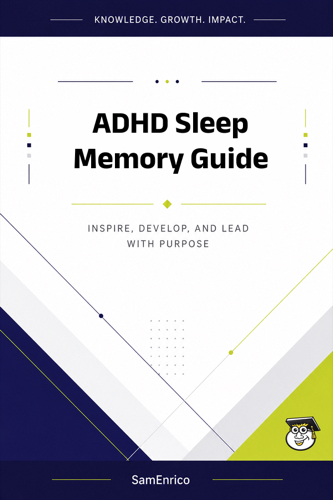
ADHD Sleep Memory Guide eBook
Improves recall with routine.
Improves recall with routine.
Formats
Free sample
Chapter 1: The Revenge Clock--–- The clock on your nightstand reads 1:47 AM. You are exhausted in the way that feels like your bones have been replaced with lead. Your eyes burn. Your brain is a fog of half-finished thoughts and vague self-loathing. You told yourself at 10 PM that you would go to bed early.
Then at 11 PM, you compromised on "just one more episode." At midnight, you swore you would close your laptop after checking "one last thing." Now, at nearly 2 AM, you are not doing anything important. You are not working on a deadline or responding to an emergency. You are scrolling through the same social media feed you already scrolled ten minutes ago. You are reorganizing a drawer that did not need reorganizing. You are watching a You Tube video about how to sharpen knives, even though you have never sharpened a knife in your life and do not own knives that require sharpening.You are not lazy.
You are not broken. You are not lacking in discipline.You are engaging in something that sleep scientists and ADHD researchers have given a deceptively dramatic name: Revenge Bedtime Procrastination.The term sounds like a vigilante movie, but the reality is quieter and more painful. Revenge bedtime procrastination is the act of sacrificing sleep in order to reclaim a sense of control over a day that felt completely beyond your control. The "revenge" is not against another person. It is against the hours of the day that were stolen from you by demands, distractions, transitions, and the exhausting labor of simply trying to function with an ADHD brain.
You stay up late not because you are not tired, but because the hours between midnight and 2 AM are the only hours of the day that belong to you. No one is asking you for anything. No email requires a response. No child needs attention. No boss is monitoring your productivity.
The world is quiet, and for the first time all day, you can breathe.The tragedy is that you are paying for those precious, quiet hours with the very biological process that could make tomorrow easier: sleep.This chapter is not going to tell you that staying up late is a moral failure. It is not going to scold you about willpower or suggest that you simply "try harder" to go to bed earlier. If you have ADHD, you have likely heard those well-intentioned but useless pieces of advice your entire life. What you have not heard is the biological explanation for why bedtime feels like a battle, why your internal clock runs on a different schedule than the rest of the world, and why willpower is structurally incapable of solving this problem.By the end of this chapter, you will understand three things. First, why the ADHD brain treats bedtime as a dangerous transition rather than a natural end to the day.
Second, what Delayed Sleep Phase Syndrome is and why it might be the real reason you cannot fall asleep before 2 AM. Third, how to stop fighting your biology and start working with it using a concept called "chronotype-aligned scheduling."Let us begin with the most important sentence in this entire book: You are not failing at sleep. Sleep has been failing to accommodate you.The Transition Trap: Why Your Brain Treats Bedtime Like a Cliff Imagine that you are driving a car at highway speed. The road is straight, the music is playing, and your foot is steady on the gas pedal. Now imagine that someone tells you to stop the car immediately, get out, and start riding a bicycle in the opposite direction.
No warning. No gradual slowdown. Just an abrupt, jarring shift from one mode of operation to a completely different one.For the neurotypical brain, the transition from wakefulness to sleep is more like a gentle off-ramp than a cliff. The brain gradually produces melatonin, body temperature drops slightly, heart rate slows, and a cascade of biological signals says, "It is time to rest." The transition feels natural, even pleasant.For the ADHD brain, the off-ramp is missing.ADHD is fundamentally a disorder of executive function, and executive function is the brain's project manager. It is the system responsible for task initiation, task switching, inhibition, working memory, and planning.
When you have ADHD, the project manager is understaffed, easily distracted, and often goes on break without telling anyone. One of the most difficult tasks for the ADHD brain is task switching—the ability to stop doing one thing and start doing another.This is not a metaphor. Neuroimaging studies have shown that people with ADHD have reduced activation in the prefrontal cortex during task-switching demands. The brain literally has to work harder to disengage from an ongoing activity, even a boring or unrewarding one. This is why you can spend forty-five minutes watching a television show you do not even like instead of getting up to brush your teeth.
The cost of switching is higher than the cost of staying.Bedtime is the ultimate task switch. You are asking your brain to stop doing everything—stop thinking, stop scrolling, stop worrying, stop planning, stop feeling—and enter a state of unconscious vulnerability. For a brain that already struggles with transitions, this is not a gentle off-ramp. It is a cliff.The revenge bedtime procrastination cycle works like this. During the day, you exhaust your already-limited executive function reserves on tasks that neurotypical people find automatic: getting dressed, responding to emails, remembering to eat lunch, switching between meetings, resisting the urge to check your phone, filtering out background noise, and regulating your emotional responses to frustration.
By the time evening arrives, your executive function tank is empty. You have no resources left to initiate the transition to sleep. Instead, you drift into a state that researchers call "intention-action gap"—you intend to go to bed, but you cannot translate that intention into action.So you stay up. Not because you want to, but because the alternative requires a level of executive function you no longer possess.Delayed Sleep Phase Syndrome: When Your Clock Is Set to a Different Time Zone Now let us add a second biological factor that makes everything worse. Many people with ADHD do not simply struggle with the transition to sleep.
They also have a circadian rhythm that is fundamentally shifted later than the general population. This condition is called Delayed Sleep Phase Syndrome (DSPS), and it affects an estimated 73 to 78 percent of adults with ADHD, compared to roughly 10 to 15 percent of the general population.Here is what DSPS means in practical terms. Your body has an internal clock, located in a tiny cluster of neurons called the suprachiasmatic nucleus, that regulates when you feel alert and when you feel sleepy. For most people, this clock runs on a roughly 24-hour cycle, with peak alertness in the late morning and natural sleepiness beginning around 10 or 11 PM. For people with DSPS, the clock runs longer than 24 hours, or it is less responsive to the environmental cues (called "zeitgebers," German for "time-givers") that normally keep the clock synchronized.The result is that your body genuinely wants to fall asleep…
This is the end of the free sample. Get the eBook to keep going. Buy now
About this book
Details
- Author
- Driver Marcelina
- Publisher
- SamEnrico
- Language
- English
- Genre
- Non-Fiction, Self-Help, ADHD
- Released
- 2026-06-05
- Pages (approx.)
- 137
- Available as
- eBook, Audiobook

Read better in the ZLOADR app
Your eBooks on your phone or tablet. Sign in with your SamEnrico account and start reading.
More by Driver Marcelina
 The Financial Boundaries WorkbookDriver Marcelina$11.99
 Governor's Labor Strike StandoffDriver Marcelina$11.99
 Caffeine Nap Strategy HandbookDriver Marcelina$11.99
 Thyroid and Heat IntoleranceDriver Marcelina$11.99
 Async Communication RatioDriver Marcelina$11.99
 Buy Me a Coffee TrapDriver Marcelina$11.99
 Tech Platform Outage GuideDriver Marcelina$11.99
 Amazon Global Selling GuideDriver Marcelina$11.99
 The Northern Socratics: Canada’s Philosophical Pioneers in the WildernessDriver Marcelina$11.99
 The Golden Scalpel: Surgeons of the Nile and BeyondDriver Marcelina$11.99
 Operation Midnight Sun: The Spy Who Fooled the KGBDriver Marcelina$11.99
 How to Become a Hydroelectric-plant MaintainerDriver Marcelina$11.99
You may also like
 Hong Kong Handover 1997Dunn Johnnie$11.99
 Zumba For Postnatal Recovery CourseNeal Christian$11.99
 Zumba for BeginnersLadner Nikia$11.99
 YouTube Comment Mining GuideHumes Pandora$12.99
 Worry Box MeditationCarlin Rudy$11.99
 Workplace Stress MeditationNguyen Lynn$11.99
 Workplace Stress and Sleep RepairHawley Ivory$11.99
 Workplace Perfectionism CureDelaney Jeffry$11.99
 Workplace Injustice Anger GuideWallen Isabelle$11.99
 Work Addiction and Burnout LinkGreenwood Ester$11.99
 Women in Yoga and WellnessBeattie Galina$11.99
 Women in Stand Up ComedyChun Evangeline$11.99