
Non-FictionSelf-HelpTask Management
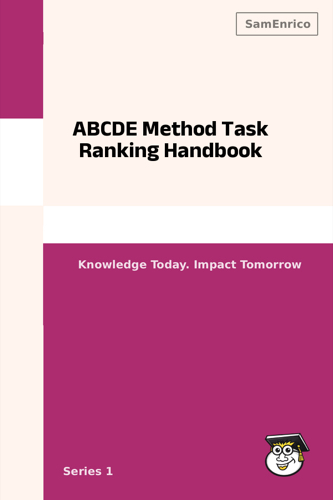
ABCDE Method Task Ranking Handbook eBook
Label tasks A through E by importance using this p
Label tasks A through E by importance using this practical prioritization technique for daily productivity.
Formats
Free sample
Chapter 1: The Lie of "Busy"--–- On a Tuesday afternoon in a cramped office outside Chicago, a senior project manager named Diane did something that would later make her cringe in embarrassment. She opened her task management app, scrolled past forty-seven uncompleted items, closed the app, and announced to her team, "I'm too busy to think about what I'm busy doing." Then she spent ninety minutes reorganizing her folder structure—a task she had labeled "urgent" but which had no deadline, no stakeholder, and no consequence if left undone. At 5:00 PM, she realized she had not touched the one task that would determine her annual bonus: a client proposal due the next morning. She stayed until 9:30 PM, missed her daughter's violin recital, and submitted the proposal with three typos. The client noticed.
She did not get the bonus.Diane's story is not unusual. It is not even remarkable. It is the default operating mode of millions of professionals who mistake activity for achievement. The lie of "busy" is one of the most seductive and destructive forces in modern work culture. When someone asks how you are doing, "busy" has become a badge of honor—a signal that you are in demand, that you matter, that you are working hard enough.
But busy is not the same as effective. A hamster on a wheel is busy. A firefighter running into a burning building is effective. The difference is not effort. The difference is prioritization.This chapter is not about working harder.
It is about working on the right things. Before you can use the ABCDE method, before you can label a single task with a letter, you need to understand why your brain constantly betrays you by prioritizing the wrong things. You need to see the invisible architecture of urgency, importance, and decision fatigue that shapes every workday. Most importantly, you need to confront a uncomfortable truth: your current to-do list is probably lying to you.The Flat List Fallacy Let us begin with a simple experiment you can perform right now. Think of everything you need to do today or this week.
Write down ten tasks on a piece of paper, in whatever order comes to mind. Do not rank them. Do not label them. Just list them. Now look at that list.
Which task will you do first? If you are like ninety-three percent of the professionals studied by the Dominican University of California, you will choose the easiest, quickest, or most immediately satisfying task—not the most important one.This is called the flat list fallacy. A flat list is a list without hierarchy, without ranking, without any signal about what matters most. When presented with a flat list, the human brain defaults to what psychologists call "the law of least effort": we choose the path that requires the least cognitive load, the least friction, the least immediate discomfort. That means answering easy emails before drafting a difficult proposal.
That means reorganizing files before making a tough phone call. That means doing the ten-minute task before starting the three-hour project.The flat list fallacy is not a character flaw. It is a neurological feature. Your brain's default mode network is wired to seek closure, quick wins, and dopamine hits from completing small tasks. Every time you check a box on a to-do list, your brain releases a small amount of dopamine—the same neurotransmitter involved in pleasure and reward.
This creates a feedback loop: do small task, get dopamine, feel productive, repeat. The problem is that this loop actively prevents you from doing large, important, uncomfortable tasks that do not provide immediate dopamine rewards.Diane's forty-seven-item list was a flat list. Every item looked equally important because nothing told her otherwise. The folder reorganization offered a quick dopamine hit. The client proposal offered delayed gratification at best, and anxiety at worst.
Her brain chose the folder reorganization not because she was lazy but because she was human. The ABCDE method exists precisely to interrupt this default wiring.Urgency Versus Importance: The Great Deception To understand why flat lists fail, you need to understand one of the most powerful distinctions in all of productivity science: the difference between urgency and importance. These two words are often used interchangeably, but they describe fundamentally different forces.Urgency is about time. An urgent task screams for your immediate attention. It has a ticking clock, a looming deadline, a sense of pressure.
Urgent tasks often produce physiological responses: increased heart rate, narrowed focus, the release of stress hormones like cortisol and adrenaline. Urgency feels important because it triggers your fight-or-flight response. But here is the deception: urgency is not a signal of importance. It is a signal of time pressure, nothing more.Importance is about consequences. An important task has significant, lasting, meaningful consequences if it is done poorly or not at all.
Importance is not about speed; it is about impact. A task can be urgent but unimportant (most emails, many meeting requests, many "quick questions"). A task can be important but not urgent (strategic planning, relationship building, skill development, health maintenance). The most dangerous tasks are those that are urgent but unimportant because they masquerade as critical while delivering little long-term value.The Eisenhower Matrix, named after President Dwight D. Eisenhower, visualizes this distinction in a simple two-by-two grid:Quadrant 1: Urgent and Important (do these immediately)Quadrant 2: Not Urgent but Important (schedule these deliberately)Quadrant 3: Urgent but Not Important (delegate or minimize these)Quadrant 4: Not Urgent and Not Important (eliminate these entirely)The ABCDE method is a practical translation of the Eisenhower Matrix.
A tasks correspond to Quadrant 1. B tasks often straddle Quadrants 2 and 3. C tasks are Quadrant 4 with a pulse. D tasks are Quadrant 3 tasks you hand off. E tasks are Quadrant 4 tasks you kill.
But here is the crucial insight that most productivity books gloss over: the vast majority of people spend their days in Quadrants 3 and 4 because those tasks feel urgent. They answer emails (urgent, often unimportant). They attend back-to-back meetings (urgent on the calendar, rarely important). They react to Slack messages (urgent by notification, unimportant by consequence). Meanwhile, Quadrant 2 tasks—the important but not urgent ones—get postponed indefinitely.Parkinson's Law and the Time Trap There is another psychological force working against you, and it has a name: Parkinson's Law.
Originally formulated by British historian Cyril Northcote Parkinson in a 1955 essay for The Economist, the law states that "work expands so as to fill the time available for its completion." In simpler terms, if you give yourself three hours to write an email, it will take three hours. If you give yourself fifteen minutes, it will take fifteen minutes.Parkinson's Law interacts destructively with flat lists. When you have no clear ranking, every task expands to fill whatever time you allocate to it. That quick folder reorganization becomes a ninety-minute deep dive. That email response becomes a thirty-minute essay.
That "quick check" of social media becomes an hour-long scroll. Without a ranking system to tell you when a task is "done enough," your brain will continue working on tasks long past the point of diminishing returns.The ABCDE method fights Parkinson's Law by forcing you to decide…
This is the end of the free sample. Get the eBook to keep going. Buy now
About this book
Details
- Author
- Waggoner Regenia
- Publisher
- SamEnrico
- Language
- English
- Genre
- Non-Fiction, Self-Help, Task Management
- Released
- 2026-06-06
- Pages (approx.)
- 146
- Available as
- eBook, Audiobook

Read better in the ZLOADR app
Your eBooks on your phone or tablet. Sign in with your SamEnrico account and start reading.
More by Waggoner Regenia
 Habit Formation for Low MotivationWaggoner Regenia$11.99
 GAD Catastrophizing Stop GuideWaggoner Regenia$11.99
 Mindfulness For Grief WorkbookWaggoner Regenia$11.99
 Customer Service PositioningWaggoner Regenia$11.99
 The Dragon’s Last Roar: The Beast of Mont Saint-MichelWaggoner Regenia$11.99
 The Last Telegram: A Love Story Across War-Torn EuropeWaggoner Regenia$11.99
 Understanding Growth Delay, ConstitutionalWaggoner Regenia$17.99
 Non Resident Member Disclosure TrapWaggoner Regenia$12.99Non Resident Member Disclosure TrapWaggoner Regenia$12.99
 BPO Social Media SupportWaggoner Regenia$12.99
 A Beginners Guide to Chess (Volume 1)Waggoner Regenia$11.99
 Store Customer Experience CoordinatorWaggoner Regenia$11.99
You may also like
 Hong Kong Handover 1997Dunn Johnnie$11.99
 Zumba For Postnatal Recovery CourseNeal Christian$11.99
 Zumba for BeginnersLadner Nikia$11.99
 YouTube Comment Mining GuideHumes Pandora$12.99
 Worry Box MeditationCarlin Rudy$11.99
 Workplace Stress MeditationNguyen Lynn$11.99
 Workplace Stress and Sleep RepairHawley Ivory$11.99
 Workplace Perfectionism CureDelaney Jeffry$11.99
 Workplace Injustice Anger GuideWallen Isabelle$11.99
 Work Addiction and Burnout LinkGreenwood Ester$11.99
 Women in Yoga and WellnessBeattie Galina$11.99
 Women in Stand Up ComedyChun Evangeline$11.99