
Non-FictionSelf-HelpDaily Planning
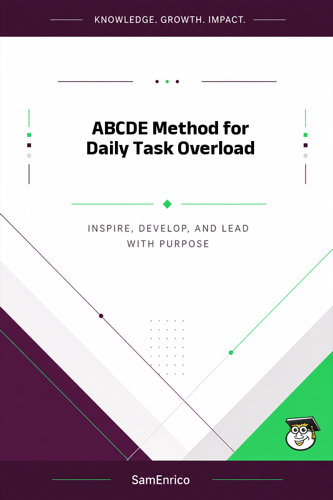
ABCDE Method for Daily Task Overload eBook
Prioritizes A level tasks before allowing yourself
Prioritizes A level tasks before allowing yourself to work on B or C items.
Formats
Free sample
Chapter 1: The Busy Lie--–- You are going to die with work left on your to-do list. That is not a threat. It is not a warning. It is simply a fact. The question is not whether you will leave tasks undone—you absolutely will.
The real question is whether you will spend your limited, irreplaceable hours on work that actually matters or on work that merely feels urgent. Most people choose the latter, not because they are lazy, but because they have been seduced by the most dangerous lie in modern work culture: the belief that a long, chaotic, constantly growing to-do list is a badge of honor. This lie has a name. It is called the Busy Lie.The Busy Lie says that activity equals accomplishment. It says that if your calendar is full, your email inbox is overflowing, and you collapse into bed exhausted every night, you must be doing something right.
The Busy Lie has convinced millions of otherwise intelligent professionals that stress is a proxy for importance and that exhaustion is evidence of virtue. Nothing could be further from the truth. The Busy Lie is a trap, and if you are reading this book, you are almost certainly already inside it. This chapter is your way out.The Vertical List Disease Look at your to-do list right now. Go ahead.
Open your notebook, your phone, your project management tool, or whatever contains the sprawling record of everything you believe you must do today, this week, or this month. What do you see? If you are like 94 percent of the professionals the author has surveyed over the past decade, you see a vertical list. Item one. Item two.
Item three. All the way down to item twenty-three or thirty-seven or fifty-two. This is not a list. This is a disease, and it has a name: Vertical List Disease.The Vertical List Disease convinces you that every task on that list deserves equal consideration. When you look at a vertical list, your brain cannot instantly distinguish between a million-dollar client proposal due in four hours and a request to order more printer toner.
Both are just lines of text. Both are just items waiting to be checked off. And because your brain craves the dopamine hit of checking things off, what do you naturally do? You attack the easy items first. The quick wins.
The five-minute tasks that make you feel productive without requiring any real cognitive effort. You order the toner. You reply to the non-urgent email. You move a file from one folder to another. You check three items off your list in ten minutes, and you feel great.
Meanwhile, the client proposal sits untouched. The clock ticks. The deadline approaches. And you have just spent your most focused morning hours on tasks that could have been done at 4:30 PM—or never done at all.This is not a moral failing. It is a design flaw in the human brain combined with a design flaw in the to-do list itself.
The vertical list is a relic of a simpler time when people had ten tasks per day, not fifty. It was never designed to handle the cognitive load of modern knowledge work. And yet, we cling to it like a security blanket, reorganizing it, rewriting it, color-coding it, and transferring it from one app to another, all while the most important tasks gather digital dust at the bottom.The author has worked with executives who spend forty-five minutes every morning simply rewriting their to-do lists from yesterday onto a fresh page. Forty-five minutes. That is nearly four hundred hours per year.
Ten full workweeks. Spent on the act of reorganizing tasks rather than completing them. This is the Vertical List Disease in its most advanced stage: you are not even doing the easy tasks anymore. You are just rearranging the list of easy tasks. And you call this productivity.The Triage Principle: Emergency Medicine for Your To-Do List To cure the Vertical List Disease, we must abandon the vertical list entirely and replace it with a radically different model.
That model comes from an unexpected source: the emergency room. When a patient arrives at a hospital emergency department, the attending physician does not treat injuries in the order they were noticed. The physician does not say, "Well, the patient mentioned his headache first, so we will treat that before we address the arterial bleeding in his leg." That would be absurd. That would be malpractice. Instead, the physician uses a system called triage.Triage comes from the French word trier, meaning to sort.
In emergency medicine, triage is the process of determining the priority of patients' treatments based on the severity of their condition. Patients are sorted into categories. Those with life-threatening injuries are treated immediately. Those with serious but not immediately life-threatening conditions are treated next. Those with minor injuries—a sprained ankle, a mild fever—wait until the critical cases are stable.
No one treats the sprained ankle while the heart attack patient is dying on the gurney. That would be unthinkable.And yet, that is exactly what you do every single day with your to-do list. You treat the sprained ankle (ordering toner, replying to a non-urgent email, organizing your desktop) while the heart attack patient (the client proposal due today, the difficult conversation you have been avoiding, the strategic project that determines your bonus) lies unattended on the gurney. You are committing professional malpractice against your own time.The ABCDE method is triage for your to-do list. It forces you to sort your tasks by consequence, not by chronology.
It forces you to ask the same question an emergency room physician asks: "What happens if I do not do this right now?" The answer to that question determines everything.The Emergency Room Hierarchy Let us translate the emergency room triage categories directly into task management language. In the ER, there are three primary categories, though they are often labeled with colors or numbers. For our purposes, we will simplify them into three levels that align with the first three letters of the ABCDE system.Category One is life-threatening. The patient will die or suffer permanent harm without immediate intervention. Severe bleeding.
Cardiac arrest. Respiratory failure. In your work, Category One tasks are those with severe, immediate, and irreversible consequences if left undone. Missing a regulatory filing that carries a million-dollar fine. Failing to deliver a client deliverable that triggers a contract penalty.
Neglecting a health issue that could become critical. These are your A tasks. They are the heart attack patients on your gurney. Nothing else matters until they are stable.Category Two is serious but stable. The patient is in pain or at risk of deterioration, but they can wait fifteen or thirty minutes while the Category One patients are treated.
A fracture that needs splinting. A fever that needs monitoring. Moderate dehydration. In your work, Category Two tasks are those with minor but real consequences if delayed. A colleague is mildly annoyed because you have not responded to their non-urgent question.
A report is slightly delayed, causing a small inconvenience for your team. An internal meeting runs without an agenda. These…
This is the end of the free sample. Get the eBook to keep going. Buy now
About this book
Details
- Author
- March Stephane
- Publisher
- SamEnrico
- Language
- English
- Genre
- Non-Fiction, Self-Help, Daily Planning
- Released
- 2026-06-05
- Pages (approx.)
- 142
- Available as
- eBook, Audiobook

Read better in the ZLOADR app
Your eBooks on your phone or tablet. Sign in with your SamEnrico account and start reading.
More by March Stephane
 Priority Drift Correction GuideMarch Stephane$11.99
 French Resistance Baker CodesMarch Stephane$11.99
 Chinese Immigrant TycoonsMarch Stephane$11.99
 Formative Assessment AI DashboardsMarch Stephane$11.99
 The Dreaming Code: How a Forgotten WWII Experiment Unlocked the Secrets of the SubconsciousMarch Stephane$11.99
 Permit CoordinatorMarch Stephane$11.99
 USA Raise Negotiation ScriptsMarch Stephane$12.99
 Time Blocking for Strategic PlanningMarch Stephane$12.99
 Understanding Maumenee SyndromeMarch Stephane$17.99
 How to Become a Knitting-machine Operator HelperMarch Stephane$11.99
You may also like
 Hong Kong Handover 1997Dunn Johnnie$11.99
 Zumba For Postnatal Recovery CourseNeal Christian$11.99
 Zumba for BeginnersLadner Nikia$11.99
 YouTube Comment Mining GuideHumes Pandora$12.99
 Worry Box MeditationCarlin Rudy$11.99
 Workplace Stress MeditationNguyen Lynn$11.99
 Workplace Stress and Sleep RepairHawley Ivory$11.99
 Workplace Perfectionism CureDelaney Jeffry$11.99
 Workplace Injustice Anger GuideWallen Isabelle$11.99
 Work Addiction and Burnout LinkGreenwood Ester$11.99
 Women in Yoga and WellnessBeattie Galina$11.99
 Women in Stand Up ComedyChun Evangeline$11.99