
Non-FictionSelf-HelpRemote Work
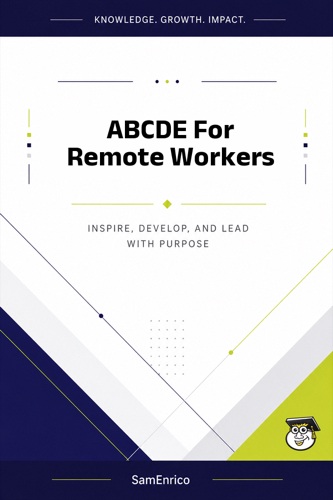
ABCDE For Remote Workers eBook
Prioritizes tasks without office supervision using
Prioritizes tasks without office supervision using letter method.
Formats
Free sample
Chapter 1: The Visibility Trap--The email arrived at 4:47 PM on a Tuesday. I had been working since 7:30 AM. My Slack status was set to "active" the entire day. I had replied to forty-three messages, attended three video calls, reformatted a twelve-page document, and color-coded an entire quarter's worth of project milestones. I was exhausted.
I was also completely, utterly useless.The email was from my manager. It contained exactly two sentences: "Where is the Q3 client analysis? It was due at 2 PM." My stomach dropped. I had forgotten the one thing that actually mattered. Not because I was lazy.
Not because I was incompetent. Because I had spent nine hours doing things that looked like work but were not work. I had fallen into the Visibility Trap.This chapter is about that trap. It is about the single most destructive habit of remote workers: confusing visible activity with valuable output. If you have ever ended a day exhausted yet unable to name what you actually accomplished, if you have ever closed your laptop feeling anxious because you cannot remember what you did for eight hours, if you have ever secretly wondered whether you are productive or just busy—this chapter is for you.
The Visibility Trap is not a personal failing. It is a structural consequence of working without physical supervision. And once you see it, you cannot unsee it.The Performance That No One Asked For When humans work alone, we perform. Not for others—for ourselves. This is the strange psychology of remote work.
In an office, the cues that tell you to work hard are external: a manager walking by, a colleague typing furiously, the ambient pressure of shared physical space. These cues are not subtle. They shape behavior constantly, unconsciously, inevitably.At home, those cues vanish. Your manager is not walking by. Your colleagues are not in the next cubicle.
The only pressure is internal. And the human brain, confronted with the absence of external validation, does something remarkable and terrible: it invents its own performance metrics. You start counting Slack replies as wins. You start treating email archiving as progress. You start believing that a green "active" status on your messaging app is the same as producing value.This is the Visibility Trap: the unconscious substitution of visible activity for valuable output.
It is not laziness. It is not incompetence. It is a survival strategy that your brain deploys when it cannot see the connection between your actions and your outcomes. In the office, the connection is visible. Your manager sees you working.
Your teammates see you contributing. At home, no one sees anything. So your brain compensates by chasing visibility wherever it can find it.The false rewards of remote work are everywhere. The satisfying click of archiving an email. The green checkmark next to a Slack message marked "read." The visual completion of moving a task from "To Do" to "Done" on a board that no one else looks at.
These are not productivity metrics. They are pacifiers. They make you feel productive without requiring you to be productive. And because they feel good, you do more of them. This is the cue-routine-reward loop that James Clear describes in Atomic Habits, applied to the worst possible behaviors.The Cost of Invisible Inefficiency Let me be precise about what the Visibility Trap costs you.
I am not talking about vague feelings of stress or the occasional forgotten deadline. I am talking about measurable, quantifiable, avoidable losses.First, the trap steals your mornings. The first two to three hours of your workday are when your cognitive capacity is highest. Cortisol levels peak around 8:30 AM, sharpening focus. Executive function is strongest before noon.
These are the hours when you should be doing your hardest, most valuable work—your A tasks, as defined in Chapter 2. Instead, most remote workers spend these peak hours on email, Slack, calendar management, and other low-value activities. They are eating candy for breakfast and wondering why they feel hungry by lunch.Second, the trap fragments your attention. Every time you switch from a low-value task to a high-value task, you pay a switching cost. Research consistently shows that it takes an average of twenty-three minutes to fully refocus after an interruption.
If you check email four times in the morning, you have lost nearly an hour and a half of productive capacity—not in the checking itself, but in the refocusing afterward. The Visibility Trap encourages exactly this fragmentation because each small interruption offers a small reward. You check Slack. Someone has mentioned you. Dopamine.
You reply. Another dopamine hit. You feel visible. You feel important. You feel productive.
You are not.Third, the trap creates a backlog of invisible work. While you are replying to messages and organizing files, your actual responsibilities are accumulating. Client deliverables go unstarted. Reports go unwritten. Strategic thinking goes undone.
By the time you finally turn to your real work, it is 3 PM, your energy is depleted, and the task that should have taken two hours now takes four. You stay late. You feel virtuous. You have not been virtuous. You have been inefficient.Fourth, and most insidiously, the trap trains your colleagues to expect immediate responses.
Every time you reply to a non-urgent Slack message within two minutes, you teach your coworkers that you are always available. You build an expectation of real-time responsiveness that is unsustainable and unnecessary. Soon, your calendar is full of "quick syncs" that last thirty minutes. Your Slack is a river of @mentions. Your inbox is a flood of "following up on my previous message." You have become the most responsive person on your team.
You have also become the least productive.The Visibility Audit I want you to stop reading right now and open a new document. Or take out a piece of paper. Write down every single task you have done in the last two workdays. Every email. Every Slack reply.
Every meeting. Every document edit. Every calendar adjustment. Every file reorganization. Everything.Now, next to each task, answer one question: Who benefited from this task being done?Not "who asked for it." Not "who would notice if it was not done." Who actually benefited?
Did the task move you closer to a goal that matters for your performance review, your revenue, your client retention, or your career progression? Or did it make someone else's life slightly easier at the cost of your attention?This is the Visibility Audit. I have administered it to over five hundred remote workers across three continents. The results are consistent and startling. The average remote worker spends fifty-seven percent of their time on tasks that benefit only the requester's convenience, not their own KPIs.
Fifty-seven percent. More than half of the workday is spent on activities that make other people feel good while making you feel busy.The remaining forty-three percent is split between genuinely valuable work (about twenty-eight percent) and genuinely useless work (about fifteen percent—tasks that benefit no one, including yourself). This means that in a typical eight-hour day, the average remote worker produces about two hours and fifteen minutes of actual value. The rest is noise.I am not telling you this…
This is the end of the free sample. Get the eBook to keep going. Buy now
About this book
Details
- Author
- Mahaffey Lupe
- Publisher
- SamEnrico
- Language
- English
- Genre
- Non-Fiction, Self-Help, Remote Work
- Released
- 2026-06-07
- Pages (approx.)
- 129
- Available as
- eBook, Audiobook

Read better in the ZLOADR app
Your eBooks on your phone or tablet. Sign in with your SamEnrico account and start reading.
More by Mahaffey Lupe
 Stair Climbing LongevityMahaffey Lupe$11.99
 Mindful Walking For Weight LossMahaffey Lupe$11.99
 Coros Apex 2 Sleep GuideMahaffey Lupe$11.99
 The Black Dahlia Lesley Dillon TheoryMahaffey Lupe$11.99
 The Ghosts of Shiroyama: Saigō Takamori's Last StandMahaffey Lupe$11.99
 How to Become a Ornamental-metal-worker HelperMahaffey Lupe$11.99
 Understanding Rhabdomyosarcoma, AlveolarMahaffey Lupe$17.99
 Maintenance Team LeadMahaffey Lupe$11.99
 Emergency Services for StudentsMahaffey Lupe$12.99
 Background Check Remote GuideMahaffey Lupe$12.99
You may also like
 Hong Kong Handover 1997Dunn Johnnie$11.99
 Zumba For Postnatal Recovery CourseNeal Christian$11.99
 Zumba for BeginnersLadner Nikia$11.99
 YouTube Comment Mining GuideHumes Pandora$12.99
 Worry Box MeditationCarlin Rudy$11.99
 Workplace Stress MeditationNguyen Lynn$11.99
 Workplace Stress and Sleep RepairHawley Ivory$11.99
 Workplace Perfectionism CureDelaney Jeffry$11.99
 Workplace Injustice Anger GuideWallen Isabelle$11.99
 Work Addiction and Burnout LinkGreenwood Ester$11.99
 Women in Yoga and WellnessBeattie Galina$11.99
 Women in Stand Up ComedyChun Evangeline$11.99