
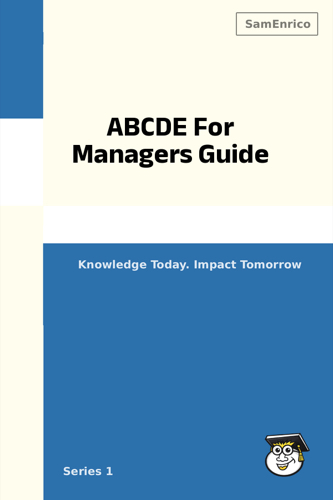
ABCDE For Managers Guide eBook
Rank team tasks, delegate lower letters, and focus
Rank team tasks, delegate lower letters, and focus your own time on A items.
Formats
Free sample
Chapter 1: The 60-Hour Lie--Most managers believe they are working hard. The truth is more disturbing: they are working dumb.You feel it every Sunday evening—that low-grade dread as you glance at your calendar and see a week already splintered into thirty-minute slots. You tell yourself this will be the week you finally get to the important work. The strategic planning. The team development.
The long-term thinking that got you promoted in the first place.Then Monday arrives. By 9:15 AM, you are answering someone else's question about a project that should have been delegated six months ago. By 10:30 AM, you are in a meeting that could have been an email. By 2:00 PM, you are manually formatting a spreadsheet because it is "faster than teaching someone else to do it." By 5:00 PM, your to-do list is longer than when you started. And the strategic work?
It did not happen. Again.You leave exhausted, convinced you worked hard. And you did. But hard work is not the same as effective work. This is the great managerial swindle: trading your time for activity rather than leverage, then calling it productivity.Let me show you what is really happening—and why the ABCDE method, properly applied to your team rather than just your personal to-do list, is the only way out.The Productivity Trap That Captures Most Managers Peter Drucker, the most influential management thinker of the twentieth century, drew a distinction that most managers have heard but few have internalized.
Efficiency, he said, is doing things right. Effectiveness is doing the right things.Most managers are ruthlessly efficient at doing the wrong things.They answer emails faster. They schedule meetings back-to-back so no minute is "wasted." They clear their to-do lists with the satisfaction of a child completing a chore chart. But if the to-do list is filled with tasks that someone else could do—or that should not be done at all—then efficiency is not a virtue. It is an accelerant for irrelevance.Here is the uncomfortable question this chapter forces you to answer: What percentage of your work this past week required your specific job title, your specific authority, and your specific expertise?
Not your effort. Not your hours. Your unique, non-delegable contribution.For most managers, the answer is shockingly low. Somewhere between 10 and 20 percent. The remaining 80 to 90 percent of their time is spent on work that could be done by a direct report, an entry-level employee, a freelancer, a piece of software—or no one at all.This is not a time management problem.
It is a task classification problem. And until you solve it, no amount of calendar optimization, morning routines, or productivity apps will save you.The Reverse ABCDE Audit: Your Diagnostic Tool You cannot fix what you cannot see. That is why the first step in this book is not a set of principles or a motivational pep talk. It is an audit.The Reverse ABCDE Audit is a five-day exercise in radical honesty. Here is how it works.For five consecutive workdays, you will log every task you touch.
Every email you send. Every meeting you attend. Every document you review. Every decision you make. Every Slack message you answer.
Every time you open your calendar, you log it.At the end of each day, you will label each task with a letter: A, B, C, D, or E. But here is the crucial twist. You are not labeling them based on how you felt about them. You are labeling them based on a definition you have likely never used before.Let me give you the full definition of an "A" task now. This is the only time in this book we will define it completely, so pay close attention.
An A task is a task that requires your unique managerial authority and cannot be delegated to another person without unacceptable risk to the team or the organization.Read that again. Requires your unique managerial authority. Cannot be delegated without unacceptable risk.Not "important." Not "urgent." Not "something I care about." Not "something my boss mentioned once." Not "something I have always done." Not "something I am good at."Non-delegable.Everything else is B, C, D, or E. And here is the hard truth that emerges from the Reverse Audit: most managers spend their weeks almost entirely on B, C, D, and E tasks. They are doing work that could be taught, delegated, automated, or eliminated entirely.
They are doing cheap work at an expensive salary. And they are telling themselves they are busy.The audit will show you the gap between your job description and your actual calendar. For some managers, the gap is a crack. For most, it is a chasm.What the Letters Actually Mean (Defined Once, Used Forever)Because this book will use these letters throughout, let me give you the full framework now. In later chapters, we will refer back to these definitions without re-explaining them.A tasks are the non-delegable work that only you can do.
Hiring and firing. Strategic planning. Crisis management. Compliance sign-off. Budget approval.
Key client retention conversations. Tasks where your judgment, authority, or relationship capital is the difference between success and failure. If you fail at an A task, the team fails. If you delegate an A task to the wrong person, you have not empowered them—you have set them up to fail.B tasks have mild consequences if delayed. They matter, but if they slip by a day or two, no catastrophe occurs.
Specific reporting. Client follow-ups. Internal meeting preparation. Draft proposals. B tasks are the sweet spot for coaching because they are safe enough to use as teaching tools.C tasks have no serious consequences for the business if they are delayed or done imperfectly.
Data entry. Scheduling. First drafts of routine documents. Note-taking. File organization.
Basic research. However—and this is important—C tasks may have consequences for the employee's development. That is why we match them carefully to the right people in Chapter 7. C tasks are low-risk for the organization but high-value for building competence.D tasks should be delegated down or out. To subordinates (with proper authority and resources).
To freelancers. To software. To automation. If a task can be done by someone cheaper, faster, or more efficiently than you, it is a D task.E tasks should be eliminated entirely. Most email.
Unscheduled interruptions. Low-stakes requests from other departments. Reports that no one reads. Meetings that could be emails. E tasks feel urgent because someone is asking for them, but they are not important because nothing bad happens if you say no.That is the framework.
A through E. Non-delegable through eliminate.Now here is what your Reverse Audit will almost certainly reveal: your week is dominated by C, D, and E tasks. You are spending your expensive, scarce time on work that requires no managerial judgment. And you are telling yourself a story about being "too busy" to do the A work that actually matters.Why You Gravitate Toward the Wrong Work (The Comfort Trap)The Reverse Audit will show you what you are doing. But to change it, you need to understand why.The answer is uncomfortable: you gravitate toward…
This is the end of the free sample. Get the eBook to keep going. Buy now
About this book
Details
- Author
- Little Stacey
- Publisher
- SamEnrico
- Language
- English
- Genre
- Non-Fiction, Self-Help, Management
- Released
- 2026-06-10
- Pages (approx.)
- 147
- Available as
- eBook, Audiobook

Read better in the ZLOADR app
Your eBooks on your phone or tablet. Sign in with your SamEnrico account and start reading.
More by Little Stacey
 The Angry Parent Time OutLittle Stacey$11.99
 The Assertive Confrontation GuideLittle Stacey$11.99
 Inositol PCOS GuideLittle Stacey$11.99
 Persuasive Hiring Request GuideLittle Stacey$11.99
 Emotion Wheel GuideLittle Stacey$11.99
 Transportation for SeniorsLittle Stacey$11.99
 Job Candidate Honesty CuesLittle Stacey$11.99
 Aging Body Esteem GuideLittle Stacey$11.99
 Windigo’s Hunger: The Curse of the Winter WoodsLittle Stacey$11.99
 The Day the Sky Turned Orange: How a Single Spark Ignited a Global CrisisLittle Stacey$11.99
 Blood and the Silk Road: The Forgotten War of the Iron CamelsLittle Stacey$11.99
 Google Display Network Media BuyingLittle Stacey$11.99
You may also like
 The OKR Execution HandbookCarney Filomena$11.99
 Manager Confidence GuideRains Millie$11.99Manager Confidence GuideRains Millie$11.99
 Time Blocking For Managers GuideClement Enedina$11.99
 Manager Employee Empathy GuideHerrick Ashley$11.99
 Group Creative Playbook For Managers ManualLowell Drew$11.99
 Call Center Manager Stress GuideMcafee Jamison$11.99
 Layoff Conversations GuideWhaley Cherly$11.99
 Difficult Conversations with EmployeesTeal Hermine$11.99
 Weekly Review for ManagersBrunner Hunter$11.99
 SMART Goals for ManagersRicks Sidney$11.99
 Relationship Building for ManagersCreamer Corrie$11.99