
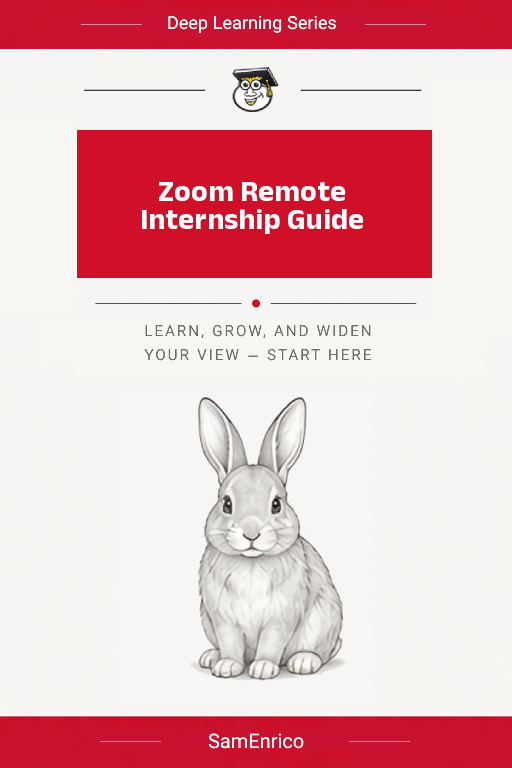
Non-FictionVirtual Work ExperienceCollaboration Guide
Zoom Remote Internship Guide eBook
Join Zoom's virtual internship program. Video tech
by Ruiz Violet
Join Zoom's virtual internship program. Video tech, remote collaboration tools, and distributed team training.
Formats
Free sample
Chapter 1: The Invisible Superpower--–- Maya had done everything right. She’d graduated summa cum laude. She’d completed two in-person internships where her managers called her “a natural leader.” She’d aced three rounds of Zoom interviews for a summer internship at Zoom itself—the company that had become synonymous with remote work. On paper, she was the perfect candidate.–- Then her first week happened.–- On Monday at 9:00 AM PT, Maya clicked the link for her team’s daily stand-up. She’d prepared: ring light positioned, background tidy, water bottle full, questions written in a notebook.
She joined five minutes early. The meeting had already started. Six faces filled the grid—colleagues who apparently knew each other from previous projects. They were laughing about something that had happened over the weekend. Maya didn’t know what.
She typed “Good morning!” in the chat. No one responded.–- When the meeting officially began, the manager, Sarah, ran through updates at what felt like double speed. “Maya, you’re our intern this summer—great to have you. We’ll get you set up in the CRM later. Any questions?” Maya had twelve questions.
She asked one: “Could you point me to the onboarding documentation?” Sarah said, “It’s in the wiki,” and moved on. Maya spent the next hour searching for a wiki that no one had ever shown her.–- By Wednesday, Maya had received exactly three Slack messages: a welcome from HR, an auto-invite to a department meeting, and a terse “please review” from a senior designer who didn’t use her name. She’d completed the compliance training. She’d read every public doc she could find. She’d introduced herself in the #general channel and received a single thumbs-up emoji.–- On Thursday, Maya cried during lunch.
Not dramatically—just a few silent tears into her oatmeal. She wasn’t sad, exactly. She was disoriented. In previous internships, someone had always shown her where to sit, introduced her around, checked in after a few days. Here, she felt like a ghost.
She was present on every channel, visible on every video call, and yet completely invisible.–- Maya’s story is not unusual. It is, in fact, the default experience for remote interns at nearly every distributed company. And it reveals the single most important truth about remote internships: visibility is not given. It is engineered.The Proximity Curse–- Before the pandemic, internships operated on a simple, unspoken contract: show up, be pleasant, work hard, and someone would notice. Physical presence did half the work for you.
When you sat at a desk in an open office, your manager could see you working. When you ate lunch in the breakroom, you bumped into colleagues from other departments. When you walked to a conference room, you passed the VP’s office and exchanged a nod. These tiny moments—what sociologists call “ambient co-presence”—created a baseline of visibility. You didn’t have to earn it.
It was automatic.–- Remote work dismantled that contract overnight. There is no breakroom. There is no hallway. There is no “passing by.” Your manager cannot see you working; they can only see your outputs. Your colleagues cannot bump into you; they can only receive your messages.
The ambient co-presence that once guaranteed a minimum level of attention has vanished, replaced by a void that requires deliberate, sustained effort to fill.–- This is what I call the Proximity Curse: the hidden disadvantage that remote workers face not because they are less capable, but because the structures that once made them visible have disappeared. For interns—who are already at the bottom of the organizational hierarchy and who lack the established relationships that full-time employees take for granted—the Proximity Curse is devastating. You are not just invisible. You are invisible in a way that the system is not designed to notice or correct.–- Consider the math. A typical in-person intern might have 10–15 unplanned interactions per day: passing someone in the hall, asking a quick question at a desk, joining a spontaneous lunch.
Each interaction is a low-stakes opportunity to be seen, to build rapport, to demonstrate competence. A remote intern, by contrast, has zero unplanned interactions. Every single interaction must be scheduled, initiated, and justified. You cannot “just ask” a quick question—you must decide whether it’s worth interrupting someone’s flow, type it out clearly, and wait for a response that may never come.–- This is not a level playing field. And pretending it is—pretending that remote internships are “just the same but on video”—is a recipe for failure.
The first step to succeeding as a remote intern is to stop expecting the old rules to apply. You are not playing the same game. You are playing a harder game with fewer safety nets. But here is the good news: the very features that make remote work difficult also make it possible for a prepared intern to stand out more dramatically than ever before.The Attention Economy of Distributed Teams–- To understand how to become visible in a remote environment, you must first understand the scarcest resource in any distributed organization: managerial attention.–- Your manager, let’s assume, is competent and well-intentioned. They want you to succeed.
They want to give you feedback, support your growth, and set you up for a return offer. But they also have their own deliverables, their own manager, their own meetings, and their own stress. In a typical week, a remote manager might receive 200–300 Slack messages, attend 15–20 hours of video meetings, and process 50–100 emails. Their attention is fractured across multiple time zones, projects, and personalities.–- Now here is the painful truth: you are not at the top of that priority list. You cannot be.
You are one of many responsibilities, and unlike an in-person intern who sits ten feet away and triggers a visual reminder of their existence every time the manager looks up, you are a name in a channel, a face in a grid, an email in an inbox. You are, in the most literal sense, easy to forget.–- This is not a failure of your manager. It is a feature of the medium. Remote work removes the ambient cues that once triggered attention. In an office, your manager might glance at your desk and think, “Oh right, I need to check in on the intern.” On a distributed team, there is no desk to glance at.
There is only the next notification, the next meeting, the next crisis.–- The implication is radical and, for many interns, uncomfortable: you cannot rely on your manager to remember you. You must become memorable. You must engineer systems that bring you to your manager’s attention without being annoying, needy, or high-maintenance. You must learn to manage up—not as a political maneuver, but as a survival skill.The 10% Rule–- Throughout this book, I will return to a single heuristic that should guide every communication decision you make. I call it the 10% Rule:–- Assume your manager has only 10% of the attention you think they do.–- If you think a message will be read carefully…
This is the end of the free sample. Get the eBook to keep going. Buy now
About this book
Details
- Author
- Ruiz Violet
- Publisher
- SamEnrico
- Language
- English
- Genre
- Non-Fiction, Virtual Work Experience, Collaboration Guide
- Released
- 2026-06-01
- Pages (approx.)
- 124
- Available as
- eBook, Audiobook

Read better in the ZLOADR app
Your eBooks on your phone or tablet. Sign in with your SamEnrico account and start reading.
More by Ruiz Violet
 Feeling Used Anger CourseRuiz Violet$11.99
 Evening Winding Down WalkRuiz Violet$11.99
 TTC With Poor Sperm MotilityRuiz Violet$11.99
 Family Walking MeditationRuiz Violet$11.99
 The Climate Change Nightmare FixRuiz Violet$11.99
 The Last Pharaoh’s Broadcast: How Cleopatra’s PR Empire Shaped the Roman WorldRuiz Violet$11.99
 How to Start a Wholesale Distribution BusinessRuiz Violet$11.99
 Edwards LifesciencesRuiz Violet$12.99
 Understanding Olmsted SyndromeRuiz Violet$17.99
 Exit Sign InspectionRuiz Violet$11.99
You may also like
 Hong Kong Handover 1997Dunn Johnnie$11.99
 Zumba For Postnatal Recovery CourseNeal Christian$11.99
 Zumba for BeginnersLadner Nikia$11.99
 YouTube Comment Mining GuideHumes Pandora$12.99
 Worry Box MeditationCarlin Rudy$11.99
 Workplace Stress MeditationNguyen Lynn$11.99
 Workplace Stress and Sleep RepairHawley Ivory$11.99
 Workplace Perfectionism CureDelaney Jeffry$11.99
 Workplace Injustice Anger GuideWallen Isabelle$11.99
 Work Addiction and Burnout LinkGreenwood Ester$11.99
 Women in Yoga and WellnessBeattie Galina$11.99
 Women in Stand Up ComedyChun Evangeline$11.99