
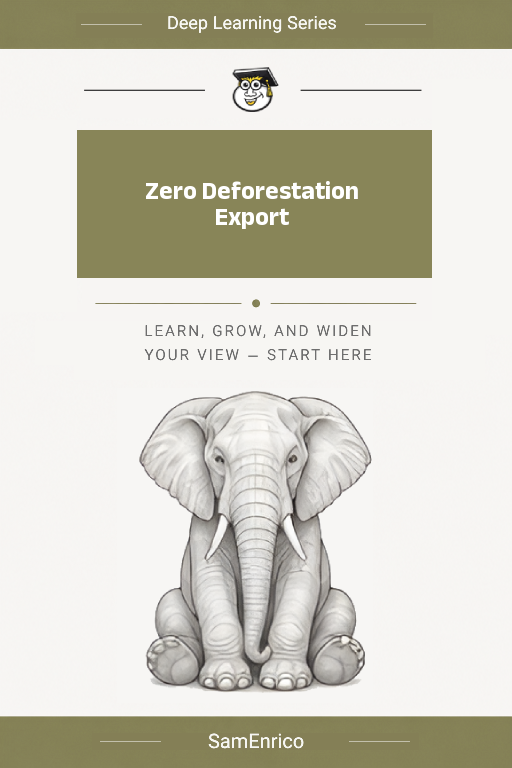
Zero Deforestation Export eBook
Get zero deforestation certification for export. S
Get zero deforestation certification for export. Supply chain without forest clearance.
Formats
Free sample
Chapter 1: The Deadline is Real...--–- For most of modern export history, deforestation was an invisible cost. It did not appear on balance sheets. It was not flagged by customs officials. It rarely ended a commercial relationship. A chocolate company could buy cocoa from a trader who bought from a cooperative that sourced from a farmer who had cleared primary forest last season, and no one would ask a single question.
The certificate on the shipping manifest – Rainforest Alliance, UTZ, Fairtrade, Organic – served as a moral passport. As long as the paper looked right, the container crossed the border.That world ended on June 29, 2023, when the European Union published Regulation 2023/1115. Most exporters did not notice. Those who did assumed it was another voluntary guideline, another multi-stakeholder initiative with weak enforcement, another round of CSR commitments that would quietly fade. They were catastrophically wrong.The EU Deforestation Regulation (EUDR) is not a guideline.
It is not a certification scheme. It is not a best-practice recommendation. It is a binding, extraterritorial, zero-tolerance law that makes deforestation a customs offense. If your product contains even a single kilogram of cocoa, soy, palm oil, coffee, cattle, rubber, or wood that originated from land cleared after December 31, 2020, that product is illegal. It cannot enter the EU.
It cannot transit through the EU. It cannot be sold in the EU. And if you try, you face fines of up to four percent of your EU annual turnover, confiscation of your goods, exclusion from public procurement, and reputational destruction that will follow you to every other market.This chapter is not an overview. It is an alarm. By the time you finish reading, you will understand why the old era of voluntary sustainability is dead, why the new era of mandatory due diligence is unforgiving, and why the only viable strategy is to start your zero deforestation certification process today – not next quarter, not after the next harvest, but now.The Illusion of Voluntary Sustainability For thirty years, the dominant model for addressing deforestation in agricultural supply chains was voluntary.
Companies made public commitments. They joined roundtables – the Roundtable on Sustainable Palm Oil (RSPO), the Roundtable on Responsible Soy (RTRS), the World Cocoa Foundation. They hired certification bodies. They printed annual sustainability reports with glossy photos of farmers standing in front of trees.None of it stopped deforestation.Between 2000 and 2020, the world lost over 100 million hectares of tropical forest – an area larger than Egypt. More than ninety percent of that deforestation was driven by agricultural expansion: cattle pasture in the Amazon, soy in the Cerrado, palm oil in Borneo, cocoa in Côte d'Ivoire and Ghana, coffee in Vietnam, rubber in Cambodia.
The voluntary system failed because it had no teeth. A company could lose its RSPO certification but still sell palm oil. A trader could be named in a Greenpeace report but still secure shipping contracts. A retailer could fall short of its 2020 deforestation-free commitment and simply move the target to 2025, then to 2030, with zero legal consequence.The fundamental flaw was structural. Voluntary sustainability relies on market incentives – consumer pressure, investor demands, reputational risk.
But these incentives are weak compared to the economics of deforestation. Clearing a hectare of forest for oil palm can generate 10,000to10,000 to 10,000to15,000 in annual revenue. The cost of that deforestation – carbon emissions, biodiversity loss, indigenous rights violations – is externalized. The farmer pays nothing. The trader pays nothing.
The consumer never sees it. The only entity that could impose a real cost – the state – was absent from the supply chain conversation.The EUDR changes that by converting deforestation from an externalized cost into a direct legal liability. Under the regulation, you cannot externalize. You cannot say "my supplier said it was clean." You cannot hide behind a certificate. The law attaches to the product itself.
If that product touched deforested land after December 31, 2020, the product is illegal, and you are responsible.The Regime Complex: Why You Cannot Ignore the EU (Even If You Sell to China or the United States)Many exporters outside Europe assume that if they do not sell directly to the EU, the EUDR does not affect them. This is dangerously wrong.The EU is the world's largest importer of agricultural commodities. It buys roughly sixty percent of global cocoa exports, forty percent of coffee, thirty percent of palm oil, and significant shares of soy, rubber, and beef. This market power creates a regime complex – a web of overlapping, reinforcing regulations that extend far beyond EU borders.Here is how it works in practice:First, the EUDR applies extraterritorially. If you are a farmer in Brazil, an exporter in Indonesia, a trader in Ghana, or a processor in Vietnam, the regulation governs your operations if you want to sell into the EU.
European customs officials will not inspect your farm. But your EU buyer – the chocolate manufacturer, the coffee roaster, the biodiesel refiner – will demand proof of compliance. That proof requires you to provide geolocation data, risk assessments, and due diligence documentation. Without it, your buyer walks. No contract.
No container. No revenue.Second, the UK is following closely. The United Kingdom's Environment Act 2021 includes a Forest Risk Commodities provision that mirrors the EUDR. While the UK version is not identical, it shares the same core requirement: commodities must come from land that was not deforested illegally. For exporters, this means you cannot simply pivot from the EU to the UK as a fallback market.
Both require deforestation-free supply chains.Third, the United States is catching up. The FOREST Act (Fostering Overseas Rule of Law and Environmentally Sound Trade) has been introduced multiple times in the US Congress. While not yet law as of early 2026, it has bipartisan support and is modeled directly on the EUDR. Major US importers – Cargill, Bunge, ADM, Starbucks, Mc Donald's – are already building EUDR-compliant supply chains because they anticipate that US law will follow. They will not maintain separate dirty and clean supply chains.
The clean supply chain becomes the default.Fourth, private sector ripple effects are already underway. Companies that sell globally cannot afford to have one supply chain for the EU and another for the rest of the world. The operational cost of segregation is too high. Instead, they are requiring all suppliers – regardless of destination market – to meet EUDR standards. Nestlé, Unilever, Mars, Ferrero, Mondelez, and IKEA have all announced that they will apply EUDR requirements to their entire global sourcing by 2027.The practical implication for you is stark: even if you have never shipped a single container to Rotterdam or Hamburg, your buyers in China, India, or the United States will soon demand EUDR-level proof.
Because their buyers – the global retailers – are demanding it. The regime complex creates a single global standard. The EU wrote the first draft. The rest of the world will adopt it, voluntarily or by legislation, within three to five years.The Four Percent Fine and Other Nightmares The enforcement provisions of the EUDR are not symbolic. They are designed to be painful enough to guarantee compliance.Maximum fine: four percent of EU annual turnover.
This is not four percent of profit. It is not four percent of the value of the non-compliant shipment. It…
This is the end of the free sample. Get the eBook to keep going. Buy now
About this book
Details
- Author
- Peachey Alona
- Publisher
- SamEnrico
- Language
- English
- Genre
- Non-Fiction, Business Brief, Eco-Compliance
- Released
- 2026-06-01
- Pages (approx.)
- 160
- Available as
- eBook, Audiobook

Read better in the ZLOADR app
Your eBooks on your phone or tablet. Sign in with your SamEnrico account and start reading.
More by Peachey Alona
 The Aggressive Voice Tone FixPeachey Alona$11.99
 Polycarp of Smyrna BishopPeachey Alona$11.99
 Pet Loss For Those AllergicPeachey Alona$11.99
 Battle Of Trafalgar Naval Defeat HandbookPeachey Alona$11.99
 The Toddler Bedtime Routine GuidePeachey Alona$11.99
 The Iron Spine of Britain: Isambard Kingdom Brunel’s Engineering OdysseyPeachey Alona$11.99
 Understanding Sutherland–haan SyndromePeachey Alona$17.99
 Ultimate Handbook Guide to Abuja : (Nigeria) Travel GuidePeachey Alona$11.99
 Franchise Valuation GuidePeachey Alona$12.99
 Enterprise Solution AnalystPeachey Alona$11.99
You may also like
 RSPO Certification ExportBeaty Hien$12.99
 WRAP Certification ExportBeaudoin Magen$12.99
 Water Neutral Export GuideEchols Seema$12.99
 UTZ Coffee Export GuideTimmons Tama$12.99
 Sprouts Certification ExportArroyo Denese$12.99
 SMETA Audit Export GuideHeath Elana$12.99
 SBTi Certification ExportMaclean Linnea$12.99
 Rainforest Alliance ExportHardin Madelyn$12.99
 Rainforest Alliance CoffeeWiseman Erasmo$12.99
 Plastic Neutral Export GuideHazel Lissa$12.99
 Organic Vegetable Export GuideRiddick Latasha$12.99Organic Vegetable Export GuideRiddick Latasha$12.99