
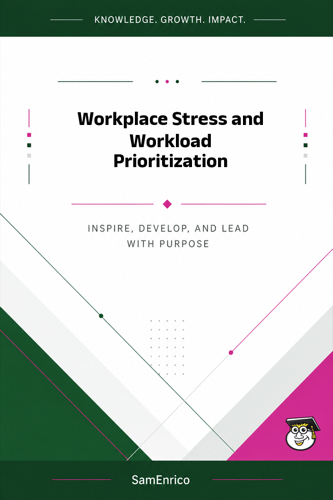
Non-FictionSelf-HelpPrioritization
Workplace Stress and Workload Prioritization
Urgent vs important matrix to reduce overwhelm.
Urgent vs important matrix to reduce overwhelm.
Formats
About this book
Free sample
Chapter 1: The Overwhelm Epidemic--You are reading this book for one of two reasons. Either you are already drowning—your inbox overflowing, your calendar a patchwork of back-to-back meetings, your weekends spent catching up on work you promised yourself you would finish on Thursday—or you can see the wave coming from a distance, and you are desperate to learn how to swim before it crashes over you. Neither path is more valid than the other. Both lead to the same destination: a quiet, persistent sense that you are failing at something fundamental, even though no one around you seems to be doing any better.This chapter is not about time management. Not yet.
Before we can talk about matrices, quadrants, delegation scripts, or any of the tactical tools that will fill the rest of this book, we must first name the thing that is actually causing your stress. And that thing is not a lack of discipline. It is not laziness. It is not that you are bad at your job. The thing that is breaking you is a system that has trained you to confuse motion with progress, urgency with importance, and busyness with effectiveness.Welcome to the overwhelm epidemic.
It is the defining psychological condition of the modern knowledge worker.The Physics of Overwhelm: Why More Tasks Create Exponential Stress Let us start with a simple experiment. Imagine you have three tasks to complete today. Write a short email. Review a one-page document. Make a five-minute phone call.
How do you feel? Probably fine. A little busy, perhaps, but not overwhelmed. Now imagine you have thirty tasks. Suddenly, the feeling changes.
Your chest tightens. Your mind begins to race. You open your task list, stare at it for thirty seconds, and then close it again to check email instead. This is not a failure of character. It is a failure of cognitive architecture.The human brain was not designed to manage the volume of inputs that a typical knowledge worker receives in a single morning.
Research in cognitive psychology suggests that the average person can hold only about four discrete items in working memory at…
This is the end of the free sample. Get the eBook to keep going. Buy now
Contents
- Chapter 1
- Chapter 2
- Chapter 3
- Chapter 4
- Chapter 5
- Chapter 6
- Chapter 7
- Chapter 8
- Chapter 9
- Chapter 10
- Chapter 11
- Chapter 12
Details
- Author
- Valles Stephaine
- Publisher
- SamEnrico
- Language
- English
- Genre
- Non-Fiction, Self-Help, Prioritization
- Released
- 2026-06-06
- Pages (approx.)
- 132
- Available as
- eBook, Audiobook

Read better in the ZLOADR app
Your eBooks on your phone or tablet. Sign in with your SamEnrico account and start reading.
More by Valles Stephaine
 Overconfidence in NegotiationValles Stephaine$11.99
 Exercise Emotional RegulationValles Stephaine$11.99
 Tobacco Withdrawal Symptom SolverValles Stephaine$11.99
 Gold and Scandal: The Fall of Middle East's Olympic HeroValles Stephaine$11.99
 How to Produce Art CharcoalsValles Stephaine$11.99
 Audit Trail Automation PrimerValles Stephaine$12.99
 AutocrossValles Stephaine$11.99
 How to Become a Stock ClerkValles Stephaine$11.99
You may also like
 Hong Kong Handover 1997Dunn Johnnie$11.99
 Zumba For Postnatal Recovery CourseNeal Christian$11.99
 Zumba for BeginnersLadner Nikia$11.99
 YouTube Comment Mining GuideHumes Pandora$12.99
 Worry Box MeditationCarlin Rudy$11.99
 Workplace Stress MeditationNguyen Lynn$11.99
 Workplace Stress and Sleep RepairHawley Ivory$11.99
 Workplace Perfectionism CureDelaney Jeffry$11.99
 Workplace Injustice Anger GuideWallen Isabelle$11.99
 Work Addiction and Burnout LinkGreenwood Ester$11.99
 Women in Yoga and WellnessBeattie Galina$11.99
 Women in Stand Up ComedyChun Evangeline$11.99