
Non-FictionSelf-HelpBusiness Communication
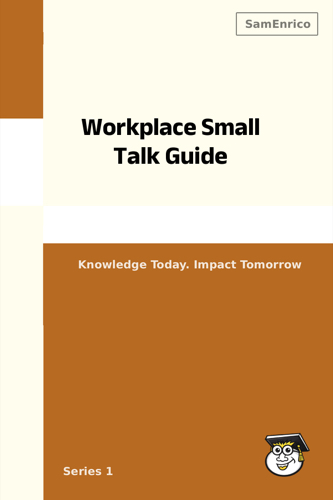
Workplace Small Talk Guide eBook
Navigates water cooler chats and office party conv
by Mull Lulu
Navigates water cooler chats and office party conversations professionally.
Formats
Free sample
Chapter 1: The Five‑Hour Favor––You are about to commit a career mistake. It will happen sometime today, probably within the next few hours. You will walk past a colleague in the hallway, wait for your coffee to brew, or log into a Zoom meeting two minutes early. In that small window of unstructured time, you will feel a familiar tension. You should say something.
Anything. But your mind will go blank. So you will look at your phone, study the floor, or pretend to read something important. The moment will pass. And you will have lost something valuable—not just for today, but for your entire career trajectory.Here is what you lost.
You lost the chance to build a bridge that could have saved you five hours of future frustration. You lost the opportunity to transform a transactional coworker into a trusted collaborator. You lost a five‑minute investment that, according to organizational network science, yields a 5,000 percent return. And you are not alone. Most professionals treat casual conversation as an optional social nicety rather than the single most underutilized career accelerator in modern work.This chapter will prove that casual conversation is not a distraction from real work.
It is the hidden engine of workplace culture, the birthplace of innovation, and the most reliable predictor of who gets promoted. More importantly, this chapter will introduce you to a measurable framework for understanding the return on investment of your small talk—a concept we will call the Five‑Hour Favor. By the end of these pages, you will never look at the water cooler the same way again.The MIT Study That Explains Everything In 2010, a team of researchers at the Massachusetts Institute of Technology’s Human Dynamics Laboratory set out to answer a question that had puzzled organizational psychologists for decades. Why do some teams consistently outperform others, even when they have identical talent, resources, and processes? The researchers equipped dozens of teams across multiple industries with sociometric badges—sophisticated wearable devices that tracked every face‑to‑face interaction, including tone of voice, body language, eye contact, and even the degree to which people talked over one another.
The badges did not measure what teams said in formal meetings. They measured something far more revealing: the invisible network of casual, unscheduled, often work‑unrelated interactions that occurred throughout the day.The results were nothing short of revolutionary. High‑performing teams did not have smarter individuals, better project management software, or more aggressive deadlines. They had one thing that low‑performing teams lacked: thirty‑five percent more informal interactions. Not formal meetings.
Not email threads. Not structured brainstorming sessions. Casual, spontaneous, frequently non‑work‑related chats by the coffee machine, in hallways, at each other’s desks, and in the minutes before and after scheduled gatherings.The researchers concluded that these informal interactions served as a form of “social lubrication.” They allowed team members to build trust quickly, resolve ambiguities before they became problems, share small bits of contextual information that never made it into official documentation, and recover from misunderstandings without escalating to management. In short, the teams that succeeded were the ones whose members talked to each other about nothing in particular—and in doing so, built the foundation for talking about everything that mattered.This finding has been replicated across industries, from software development to healthcare to financial services to education. The pattern is consistent, undeniable, and deeply inconvenient for anyone who believes that work should be purely about work.
Informal communication is not a productivity leak. It is a productivity multiplier. And the organizations that ignore it do so at their peril.The Neuroscience of Spontaneous Trust Why does casual conversation have such an outsized impact on team performance? The answer lies not in organizational theory but in neuroscience. When you share a genuine, positive interaction with another person—a laugh, a moment of mutual recognition, a small personal disclosure—your brain releases oxytocin.
Oxytocin is the same neurochemical associated with mother‑infant bonding, romantic attachment, and the warm feeling of being understood. It lowers your defenses, reduces your stress response, and increases your willingness to cooperate with the person who triggered its release.Here is the critical insight for workplace communication. Oxytocin does not require a deep personal relationship or a long history of interaction. It requires repeated, low‑stakes, positive exchanges. Exactly the kind that happen at the water cooler, in the elevator, or during the five minutes before a Zoom meeting officially starts.
Each small, positive interaction releases a tiny burst of oxytocin. Over time, those bursts accumulate, creating a neural pathway of trust that bypasses conscious evaluation. You do not decide to trust the person you chat with about weekend plans. Your brain has already decided for you.This is the mechanism behind what we will call spontaneous trust throughout this book. Spontaneous trust is the opposite of earned trust.
Earned trust requires proving yourself over time through reliable performance, delivered promises, and demonstrated competence. Spontaneous trust requires nothing more than showing up as a pleasant, curious, respectful human being. And spontaneous trust is often more powerful than earned trust in determining who gets help, who gets information, and who gets promoted.Consider the research on ambient belonging, a concept from social psychology. Ambient belonging refers to the subconscious feeling of being welcomed and included in a group. It is not created through explicit statements (“You are welcome here”) but through small, ambient cues: a friendly nod, a smile, a question about your weekend.
When you experience ambient belonging, you perform better, stay longer, and contribute more. When you do not, you withdraw, disengage, and eventually leave. The water cooler is the primary engine of ambient belonging in most organizations.The Loneliness Epidemic and the Remote Work Crisis If informal interaction is the engine of trust and belonging, then the shift to remote and hybrid work has thrown a wrench into that engine. Since 2020, millions of professionals have lost the accidental bump‑ins, the hallway chats, and the spontaneous coffee runs that once filled their days. In their place: scheduled video calls, asynchronous Slack threads, and an exhausting parade of “virtual coffee breaks” that often feel more performative than genuine.The consequences have been severe and well‑documented.
Multiple studies have reported a sharp rise in workplace loneliness, particularly among younger employees who never experienced the pre‑pandemic office. Without the ambient awareness of colleagues’ lives—the knowledge that Susan is training for a marathon, that James has a new baby, that Priya is worried about her father’s health—work becomes purely transactional. People become functions, not humans. And when people become functions, collaboration suffers, innovation stalls, and turnover rises to crisis levels.Consider the concept of ambient awareness, which we introduced briefly above and will return to throughout this book. Ambient awareness refers to the small, seemingly trivial facts we absorb about colleagues through passive exposure: their pet’s name, their love of baking, their frustration with the commute, their excitement about an upcoming vacation, their anxiety about a aging parent.
Individually, these facts are meaningless. Collectively, they form a mental map of the humans around us. That map is what…
This is the end of the free sample. Get the eBook to keep going. Buy now
About this book
Details
- Author
- Mull Lulu
- Publisher
- SamEnrico
- Language
- English
- Genre
- Non-Fiction, Self-Help, Business Communication
- Released
- 2026-06-07
- Pages (approx.)
- 141
- Available as
- eBook, Audiobook

Read better in the ZLOADR app
Your eBooks on your phone or tablet. Sign in with your SamEnrico account and start reading.
More by Mull Lulu
 Math Pattern RecognitionMull Lulu$11.99
 Emergency Savings Account BenefitMull Lulu$11.99
 Active Listening for Therapists and CounselorsMull Lulu$11.99
 Fear of Failure Treatment OptionsMull Lulu$11.99
 SAD And Gratitude PracticeMull Lulu$11.99
 Remote Task Prioritization SystemMull Lulu$11.99
 Networking for TeachersMull Lulu$11.99
 The Tongue of Empires: The Multilingual Masters of TimbuktuMull Lulu$11.99
 The Magical Menagerie of Buffon: France’s First NaturalistMull Lulu$11.99
 How to Produce Lens BagsMull Lulu$11.99
 A Collector's Handbook to the Mercedes-benz 220se CoupeMull Lulu$11.99
 US LLC Tax Obligations for Non ResidentsMull Lulu$12.99
You may also like
 Hong Kong Handover 1997Dunn Johnnie$11.99
 Zumba For Postnatal Recovery CourseNeal Christian$11.99
 Zumba for BeginnersLadner Nikia$11.99
 YouTube Comment Mining GuideHumes Pandora$12.99
 Worry Box MeditationCarlin Rudy$11.99
 Workplace Stress MeditationNguyen Lynn$11.99
 Workplace Stress and Sleep RepairHawley Ivory$11.99
 Workplace Perfectionism CureDelaney Jeffry$11.99
 Workplace Injustice Anger GuideWallen Isabelle$11.99
 Work Addiction and Burnout LinkGreenwood Ester$11.99
 Women in Yoga and WellnessBeattie Galina$11.99
 Women in Stand Up ComedyChun Evangeline$11.99