
Non-FictionSelf-HelpOccupational Psychology
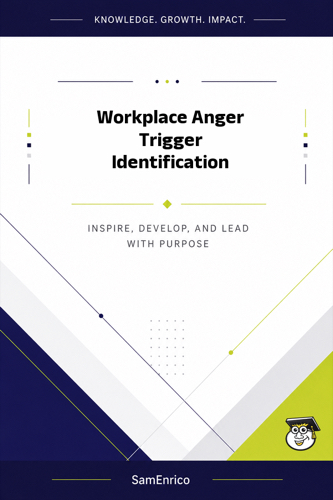
Workplace Anger Trigger Identification eBook
Focuses on common professional stressors like unfa
Focuses on common professional stressors like unfair criticism, missed deadlines, and office politics.
Formats
Free sample
Chapter 1: The Silent Detonation--You are in a meeting. The agenda is standard. The coffee is bad. You are nodding along to a quarterly update when a colleague says something that lands like a punch to the sternum. It is not what they say, exactly.
It is the tone. The slight tilt of their head. The way their eyes flick to someone else as if checking for approval. Suddenly, your face is hot. Your jaw is locked.
Your heartbeat is a bass drum in your temples. You do not explode. You do not speak. You smile—a terrible, tight, professional smile—and you make a note you will never read. The meeting ends.
You walk back to your desk. By the time you sit down, the flash has cooled into something heavier, something that will sit in your chest for the next three hours, or three days, or three weeks.You have just experienced a silent detonation.This chapter is about what happens inside you during those seconds. Not the philosophy of anger, not the morality of it, not the polite fiction that you should simply let things go. The raw biology. The split-second choices your nervous system makes before your conscious mind even knows there is a problem.
And the single most important distinction you will ever learn: the difference between a ninety-second biochemical surge and the slow-burn resentment that destroys careers, relationships, and sleep.By the time you finish reading, you will understand why you are not broken for getting angry at work. You will also understand why staying angry is a choice you have been making without realizing it.The Two Faces of Workplace Fury Anger at work wears two masks. One is theatrical. The other is invisible until it is everywhere.The first mask is the blowup. You know it when you see it—the voice that rises, the word that should not have been said, the email sent at 11:47 PM that cannot be unsent.
This is hot anger. It arrives like a flash flood. It feels terrible, but it is also honest. Everyone knows you are angry because anger is written across your face, your posture, your suddenly too-loud laugh.The second mask is the slow freeze. You do not yell.
You do not send the email. Instead, you go quiet. You become efficient, clipped, professionally pleasant in a way that is worse than silence. You stop volunteering in meetings. You stop saying good morning first.
You do your work and you go home and you tell yourself you are fine. But you are not fine. You are building a ledger of small betrayals, tiny cuts that will eventually become a wound that cannot heal.This is cold anger. And it is far more dangerous than the blowup.Here is what almost every book gets wrong, and what this chapter will make unmistakably clear: cold anger is not a separate emotion. It is the accumulated residue of hot anger spikes that were never resolved.Every single anger event begins as a hot spike.
The spike lasts approximately ninety seconds. What happens after those ninety seconds determines whether you return to baseline or add another layer of sediment to the cold anger that is slowly burying you.The Ninety-Second Lie Let me tell you something that will change how you see every angry moment you have ever had.The biochemical surge of anger—the adrenaline, the cortisol, the racing heart, the flushed face—lasts approximately ninety seconds.Ninety seconds.That is it. That is the entire physiological event. After ninety seconds, your body has processed the initial threat response. Your parasympathetic nervous system (the calming branch) has begun to reassert itself.
Your heart rate starts to return to baseline. The cortisol that flooded your system begins to clear.What happens after ninety seconds is not biology. It is rumination.Rumination is the mental rehearsal of the offense. You replay what they said. You imagine what you should have said.
You compose the email you will never send. You catalog every previous time they did something similar. Each time you replay the event, you trigger another small cortisol spike. You are not angry because your body is still flooded. You are angry because you are choosing—and it is a choice, though it never feels like one—to stay angry.This is the ninety-second rule, discovered by neuroanatomist Jill Bolte Taylor and confirmed by decades of research.
It is the single most liberating fact about anger that you will ever learn. You do not have to stay angry. The anger does not have to last for hours. The only thing keeping it alive is your own mental replay.Try this right now. Think of a recent annoyance.
Feel it for a moment. Notice the physical sensations. Now stop. Take a breath. Count to ten.
What happened? The anger did not vanish, but it changed. It became something you were looking at rather than something you were inside. That distance is the beginning of mastery.The Amygdala Hijack: Your Ancient Brain in a Modern Office To understand why anger feels so automatic and uncontrollable, you need to meet your amygdala. It is a small, almond-shaped cluster of neurons deep in your brain's temporal lobe.
It has one job: threat detection.Your amygdala does not care about quarterly reports. It does not care about career advancement or professional courtesy or the fact that you are a reasonable adult who would prefer to handle conflict gracefully. It cares about survival. And it has a hair trigger.Here is what happens in the first three seconds of any perceived threat:Your senses detect something. The words "Let's not overcomplicate this" hit your eardrums.
Your thalamus, the brain's relay station, sends raw sensory data along two pathways simultaneously. The low road goes straight to your amygdala. This road is fast, automatic, and stupid. It does not process nuance. It does not consider context.
It only asks one question: does this pattern match any previous threat?The high road goes to your prefrontal cortex—your thinking brain. This road is slower. It processes language, social context, the probability that your manager is actually trying to help. But by the time the high road arrives, the amygdala has already sounded the alarm.Your amygdala cannot reliably distinguish between a physical threat and a social threat. A manager's sarcastic comment activates the same circuitry as a predator stepping onto your path.
Your body does not know the difference. It only knows that something dangerous is happening.This is the amygdala hijack. It is automatic, ancient, and completely beyond your conscious control. You did not choose to feel angry. Your biology chose for you.Do not fight this fact.
Accept it. The goal is not to prevent the hijack. The goal is to recognize it when it happens and refuse to let it dictate your actions.The Cortisol Trap Once the amygdala sounds the alarm, your hypothalamus activates the sympathetic nervous system. Your adrenal glands release two hormones: adrenaline and cortisol.Adrenaline is the sprinter. It spikes fast, burns hot, and fades within minutes.
Adrenaline is what makes your heart race and your palms sweat. It is uncomfortable, but it is not the real…
This is the end of the free sample. Get the eBook to keep going. Buy now
About this book
Details
- Author
- Espinal Daniell
- Publisher
- SamEnrico
- Language
- English
- Genre
- Non-Fiction, Self-Help, Occupational Psychology
- Released
- 2026-06-06
- Pages (approx.)
- 140
- Available as
- eBook, Audiobook

Read better in the ZLOADR app
Your eBooks on your phone or tablet. Sign in with your SamEnrico account and start reading.
More by Espinal Daniell
 Binge Eating Recovery GuideEspinal Daniell$11.99
 Gaming Relationship RepairEspinal Daniell$11.99
 Cambodian Labor Migration OutlookEspinal Daniell$11.99
 Workaholism In Corporate CultureEspinal Daniell$11.99
 The 72-Hour Standoff: The Untold Siege of the Japanese Embassy in LimaEspinal Daniell$11.99
 Echoes of the Ark: The Forgotten Mission of the Genesis-7Espinal Daniell$11.99
 YouTube Channel Validation GuideEspinal Daniell$12.99
 Cross Border Buyer MappingEspinal Daniell$12.99
 Probabilistic Turing Machine OperatorEspinal Daniell$11.99
 Understanding Chromosome 6, Deletion 6q13 Q15Espinal Daniell$17.99
 How to Start a Hobby in Pinball MachinesEspinal Daniell$11.99
You may also like
 Hong Kong Handover 1997Dunn Johnnie$11.99
 Zumba For Postnatal Recovery CourseNeal Christian$11.99
 Zumba for BeginnersLadner Nikia$11.99
 YouTube Comment Mining GuideHumes Pandora$12.99
 Worry Box MeditationCarlin Rudy$11.99
 Workplace Stress MeditationNguyen Lynn$11.99
 Workplace Stress and Sleep RepairHawley Ivory$11.99
 Workplace Perfectionism CureDelaney Jeffry$11.99
 Workplace Injustice Anger GuideWallen Isabelle$11.99
 Work Addiction and Burnout LinkGreenwood Ester$11.99
 Women in Yoga and WellnessBeattie Galina$11.99
 Women in Stand Up ComedyChun Evangeline$11.99