
Non-FictionSelf-HelpSelf Tracking
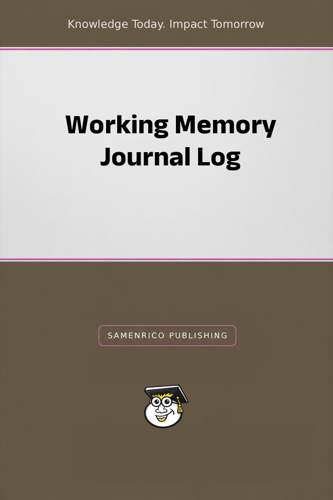
Working Memory Journal Log eBook
Track your span, speed, and accuracy improvements
Track your span, speed, and accuracy improvements over weeks.
Formats
Free sample
Chapter 1: The Invisible Bottleneck--–- Every morning, you wake up with a silent partner. It works for you without thanks, processes everything you think and do, and yet you have probably never measured its performance. This partner is your working memory – not a vague “memory” in the traditional sense, but an active, limited workspace inside your mind where information is held, manipulated, and used in real time. When it functions well, you feel sharp, quick, and capable. When it fails, you forget why you walked into a room, lose your train of thought during conversations, or make simple errors that require embarrassing corrections.
Most people assume these are random glitches – bad days, aging, or simple distraction. But the truth is far more useful. Your working memory operates on predictable patterns, responds to specific interventions, and can be tracked, trained, and improved over weeks. The problem is that nobody has ever given you a way to measure it – until now.The chapter you are about to read will fundamentally change how you understand your own cognitive performance. Unlike generic self-help books that offer motivational platitudes, this chapter establishes the scientific foundation for a practical, self-tracking system.
You will learn precisely what working memory is (and what it is not), why it acts as an invisible bottleneck on your intelligence, focus, and productivity, and how traditional approaches to “improving memory” have missed the most important targets entirely. By the end of this chapter, you will understand why span, speed, and accuracy are the only three metrics that matter, why most people never track them, and how the Working Memory Journal Log method transforms vague complaints into measurable, improvable data.The Hidden Engine of Everyday Thinking Close your eyes for a moment – but keep reading first. Imagine you are following a recipe while a child asks you a question and your phone buzzes with a text message. To succeed, your brain must hold the last step you completed (three tablespoons of flour), process the child’s question (where are my shoes?), and inhibit the urge to check the phone immediately – all simultaneously. That is working memory in action.
Not storage, not long-term recollection of your childhood birthday, but the active, real-time manipulation of information that is happening right now.Cognitive psychologists define working memory as the system that temporarily holds and manipulates information during complex cognitive tasks. This is distinct from short-term memory, which simply stores information passively for a few seconds (like repeating a phone number you just heard), and long-term memory, which archives information for years (like your mother’s face or how to ride a bicycle). Working memory is the workbench of the mind – the place where you build ideas, solve problems, and make decisions with whatever raw materials are currently available.The problem is that this workbench is tragically small. In 1956, psychologist George Miller published a famous paper titled “The Magical Number Seven, Plus or Minus Two,” suggesting that the average person could hold about seven items in active memory. Subsequent research using more rigorous methods has revised that number downward.
Current cognitive science places the average working memory capacity closer to four to five items for most adults, and sometimes less under stress, fatigue, or divided attention. To put this in perspective, you can hold roughly the same amount of information as a sticky note – not a filing cabinet, not a computer hard drive, but a small, easily smudged, and quickly fading sticky note.Yet you ask this tiny system to perform extraordinary feats every day. Following a conversation requires holding the last few sentences while formulating a response. Reading comprehension requires keeping the subject of a sentence in mind while processing the verb. Decision-making requires comparing options before all details fade.
When your working memory reaches its limit, you experience what psychologists call cognitive overload – that unmistakable feeling of your brain being full, accompanied by errors, frustration, and the strange sensation of rereading the same sentence three times without understanding it.This is the invisible bottleneck that determines more of your daily effectiveness than IQ, education, or experience. And unlike those fixed traits, working memory is trainable – but only if you start measuring it.Why Most People Never Track Working Memory (And Suffer for It)If working memory is so important, why do almost no one track it? The answer reveals something profound about human nature and the self-help industry. Consider what people typically measure: weight, steps taken, calories consumed, hours slept, money spent. These are concrete, visible, and socially validated.
But cognitive performance feels internal, subjective, and somehow shameful – as if having a bad memory day is a personal failing rather than a measurable biological fluctuation.The self-help and productivity industries have exploited this discomfort for decades. They sell you memory improvement courses that teach mnemonics without ever measuring baseline performance. They promote brain training apps that claim to boost cognition but provide no individualized tracking of real-world gains. They offer meditation and nootropic supplements with glowing testimonials but zero data on whether your specific working memory responds to them. This is like trying to improve your physical fitness without ever stepping on a scale, timing a run, or counting repetitions.
It is performance improvement in the dark.Even in academic and clinical settings, working memory assessment remains surprisingly rare. Neuropsychological evaluations include digit span tests – where you repeat increasingly long sequences of numbers – but these are typically one-time snapshots, not longitudinal tracking. Schools do not measure working memory growth. Employers do not track it. Most people go through entire lives without ever establishing a baseline for their own cognitive capacity, let alone monitoring how sleep, stress, nutrition, or training affect it.The cost of this ignorance is staggering.
Research published in the Journal of Experimental Psychology demonstrates that working memory capacity predicts academic achievement more strongly than IQ scores alone. Studies in organizational behavior show that working memory overload explains a significant portion of workplace errors, from spreadsheet mistakes to misheard instructions to forgotten deadlines. Clinical research links working memory deficits to everything from ADHD symptoms to age-related cognitive decline to post-infection brain fog. Yet because these effects are diffuse and cumulative – a missed detail here, a slow reaction there, a forgotten commitment somewhere else – they rarely get traced back to the true cause.This book exists to end that blindness. The Working Memory Journal Log method transforms working memory from an invisible, shameful weakness into a measurable, improvable system.
You will track three specific metrics – span, speed, and accuracy – over weeks and months. You will discover exactly how your lifestyle factors affect your cognition. You will learn which interventions actually work for your unique brain. And you will finally have data to replace guesswork.The Three Essential Metrics: Span, Speed, Accuracy Before you can track something, you must define what you are measuring. Working memory is not a single, unified thing.
It has multiple components, but research consistently identifies three independent dimensions that predict real-world performance: capacity (how much you can hold), processing speed (how quickly you can access and update information), and fidelity (how accurately you manipulate information without errors). This book calls these three metrics span, speed, and accuracy.Span refers to the…
This is the end of the free sample. Get the eBook to keep going. Buy now
About this book
Details
- Author
- Dockery Elfreda
- Publisher
- SamEnrico
- Language
- English
- Genre
- Non-Fiction, Self-Help, Self Tracking
- Released
- 2026-06-09
- Pages (approx.)
- 147
- Available as
- eBook, Audiobook

Read better in the ZLOADR app
Your eBooks on your phone or tablet. Sign in with your SamEnrico account and start reading.
More by Dockery Elfreda
 Imposter Syndrome Recovery CourseDockery Elfreda$11.99
 Sleep Spindle Aging MemoryDockery Elfreda$11.99
 Second Generation EntrepreneurshipDockery Elfreda$11.99
 Low Income Subscription ChurnDockery Elfreda$11.99
 The Two Minute Distraction RuleDockery Elfreda$11.99
 Dividend Portfolio GuideDockery Elfreda$11.99
 Process Analysis Essay PromptsDockery Elfreda$12.99
 Paleo For Families WorkbookDockery Elfreda$11.99
 The Phantom of the Danube: Vienna’s Vanishing Heiress (1934)Dockery Elfreda$11.99
 Love and Siege: The Fall of Constantinople's Last DefendersDockery Elfreda$11.99
 Understanding FaintingDockery Elfreda$11.99
 How to Become a Marine EngineerDockery Elfreda$11.99
You may also like
 Hong Kong Handover 1997Dunn Johnnie$11.99
 Zumba For Postnatal Recovery CourseNeal Christian$11.99
 Zumba for BeginnersLadner Nikia$11.99
 YouTube Comment Mining GuideHumes Pandora$12.99
 Worry Box MeditationCarlin Rudy$11.99
 Workplace Stress MeditationNguyen Lynn$11.99
 Workplace Stress and Sleep RepairHawley Ivory$11.99
 Workplace Perfectionism CureDelaney Jeffry$11.99
 Workplace Injustice Anger GuideWallen Isabelle$11.99
 Work Addiction and Burnout LinkGreenwood Ester$11.99
 Women in Yoga and WellnessBeattie Galina$11.99
 Women in Stand Up ComedyChun Evangeline$11.99