
Non-FictionSelf-HelpDigital Boundaries
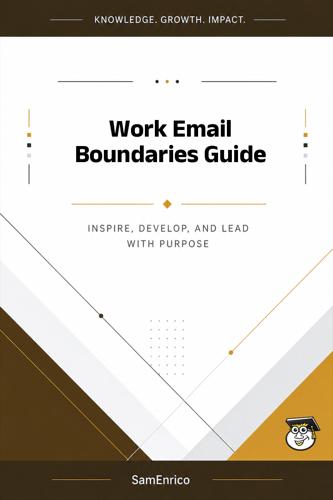
Work Email Boundaries Guide Audiobook
Stop checking email after hours to reclaim evening
Stop checking email after hours to reclaim evenings.
Formats
Free sample
Chapter 1: The Slot Machine at Dinner--–- The email arrives at 7:14 PM on a Tuesday. You are sitting at the dinner table. Your child is telling you about their day. Your partner is reaching for the salt. Your phone buzzes face-down on the table.
You do not look at it. You are proud of yourself for not looking at it. Then you think about it. You think about who it might be from. You think about whether it is a problem you need to solve.
You think about whether it is praise or criticism or just another newsletter you will never read. By 7:16 PM, you have not touched your phone, but you have also not heard a single word your child said. You are not present. You are not absent either. You are in a third state—a kind of digital limbo where your body is at the table but your brain is already inside that unread message.
This is not weakness. This is not a lack of discipline. This is neurology. And until you understand how that neurology works, no amount of “just put your phone away” advice will ever help you.The Dopamine Trap You Didn't Know You Set Every time you check your work email and find something—a solved problem, a compliment from your boss, even an angry message that requires your attention—your brain releases a small amount of dopamine. Dopamine is not the “pleasure chemical” that pop psychology has made it out to be.
It is the anticipation chemical. It is the molecule of wanting, not liking. Dopamine is what makes you reach for the phone, not what makes you happy once you have it. This distinction is critical because it explains why you can check email fifty times in an evening and feel worse after each check, yet still reach for the phone again sixty seconds later. You are not seeking pleasure.
You are seeking relief from the itch of anticipation.Drawing from Daniel Levitin’s The Organized Mind and Jocelyn Glei’s Unsubscribe, this chapter dismantles the myth that after-hours email checking is a neutral or productive act. It is neither. It is a low-grade behavioral addiction that exploits the same neurological machinery as gambling, social media scrolling, and even substance use. The mechanism is called variable ratio reinforcement, and it is the most powerful behavioral conditioning tool ever discovered. Here is how it works…
This is the end of the free sample. Get the Audiobook to keep going. Buy now
About this book
Details
- Author
- Rutherford Ingrid
- Publisher
- SamEnrico
- Language
- English
- Genre
- Non-Fiction, Self-Help, Digital Boundaries
- Released
- 2026-06-06
- Pages (approx.)
- 144
- Available as
- eBook, Audiobook

Listen in the VoxFlicks app
Audiobooks and audio dramas wherever you go. Sign in with your SamEnrico account and press play.
More by Rutherford Ingrid
 Distraction-Free Writing Workflow GuideRutherford Ingrid$11.99
 Self Hypnosis for Adaptive AthletesRutherford Ingrid$11.99
 Work Addiction Self AssessmentRutherford Ingrid$11.99
 The Poisoned Coachman: The Dark Legacy of Dr. William PalmerRutherford Ingrid$11.99
 How to Produce Air SanitizerRutherford Ingrid$11.99
 FX Spread Reduction Tactics WorkbookRutherford Ingrid$12.99
 Software Development ManagerRutherford Ingrid$11.99
 How to Become a Maintenance Data AnalystRutherford Ingrid$11.99
You may also like
 Hong Kong Handover 1997Dunn Johnnie$11.99
 Zumba For Postnatal Recovery CourseNeal Christian$11.99
 Zumba for BeginnersLadner Nikia$11.99
 YouTube Comment Mining GuideHumes Pandora$12.99
 Worry Box MeditationCarlin Rudy$11.99
 Workplace Stress MeditationNguyen Lynn$11.99
 Workplace Stress and Sleep RepairHawley Ivory$11.99
 Workplace Perfectionism CureDelaney Jeffry$11.99
 Workplace Injustice Anger GuideWallen Isabelle$11.99
 Work Addiction and Burnout LinkGreenwood Ester$11.99
 Women in Yoga and WellnessBeattie Galina$11.99
 Women in Stand Up ComedyChun Evangeline$11.99