
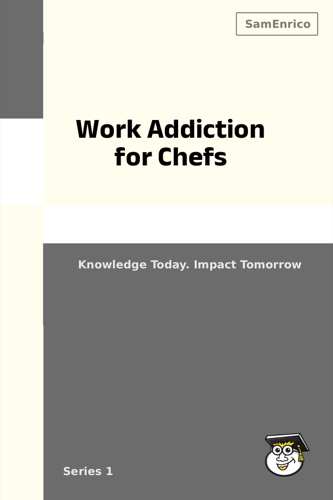
Work Addiction for Chefs eBook
Kitchen culture and 80 hour weeks.
Kitchen culture and 80 hour weeks.
Formats
Free sample
Chapter 1: The Bite of the Heat--The ticket machine screams. Not a polite beep—a mechanical shriek that cuts through the clatter of pans and the hiss of steam. You hear it even in your sleep. You hear it in the shower. You have heard it so many times that your body now responds before your brain does: heart rate climbs, pupils dilate, palms find their grip, and the world outside the pass dissolves into irrelevant static.The first ticket of the night lands on the rail.
Four tops, two allergies, one modifier so absurd it borders on blasphemy—"well-done filet, extra ketchup." Your hand reaches for the protein without conscious instruction. The sauté pan finds the flame. The oil shimmers. The shallots hit the butter. This is not cooking anymore.
This is something closer to possession.Welcome to the rush. Welcome to the only place in the world where you feel truly alive. Welcome to the bite of the heat.The Geography of the High There is a reason why chefs describe the perfect service in the language of drugs. "I was flying." "That was a rush." "I'm still buzzing." These are not metaphors. They are biochemical reports.The human brain is designed to reward survival behaviors.
Eat food? Dopamine. Win a fight? Adrenaline and endorphins. Successfully reproduce?
A whole cocktail of reward chemicals. But somewhere in the evolution of the restaurant industry, we stumbled upon a hack: the dinner rush triggers the exact same neurological cascade as combat, famine, and victory all at once.Here is what happens inside your skull during a Saturday night service.The moment the first ticket prints, your amygdala—the brain's alarm system—activates. This is the same region that fires when a predator appears. But in a kitchen, there is no predator. There is only the expo's voice and the growing stack of paper.
Your body does not know the difference. Cortisol floods your system. Your blood sugar spikes. Your non-essential systems—digestion, reproduction, rational long-term planning—shut down to preserve energy for the immediate threat.Then the rush begins in earnest. The tickets come faster than you can fire them.
Your hands move at a speed that would seem impossible if you watched it on video. And your brain, recognizing that you are performing a high-stakes task under extreme pressure, releases dopamine. Not a little. A surge. This is the same neurotransmitter that cocaine artificially amplifies.
The difference is that you have earned yours through genuine competence.When the board finally clears—the last ticket plated, the last call shouted, the silence that falls like a blessing—your brain releases endorphins. These are the body's natural opioids. They are why exhausted chefs feel euphoric rather than dead. They are why you can work a fourteen-hour shift and still have enough energy to drink until 3:00 AM.This is the bite of the heat. It is not a feeling you can replicate anywhere else.
Not at a desk. Not on a vacation. Not in a therapist's office. Only on the line, during the rush, with the tickets flying and the expo screaming and every single dish leaving the pass exactly on time.The Chemistry of the Crash But what goes up must come down. And in the case of the kitchen high, the crash is brutal.The same cortisol that sharpened your reflexes during service now lingers in your bloodstream long after the last customer has paid.
In a healthy stress response, cortisol spikes and then falls within an hour. But the 80-hour work week keeps the tap open. Chronic cortisol elevation does not feel like stress. It feels like normal. You have forgotten what it is like to be truly relaxed.The endorphins fade.
The dopamine settles. And what remains is a hollow ache that you cannot quite name. You are not sad. You are not tired—not exactly. You are empty.
And because you are a chef, you have been trained to fill emptiness with work.So you pour yourself a shift drink. Or you line up a post-service bump. Or you smoke a joint on the loading dock with the dishwashers. And for a moment, the emptiness recedes. But the next morning, it is back, deeper than before.This is the cycle that work addiction hides inside the romance of the rush.
The high is real. But so is the crash. And the crash is what keeps you coming back for more.Dedication Versus Addiction Before we go any further, we need to draw a line that the industry has deliberately blurred for decades.Dedication sounds like this: "I love making this sauce perfectly. The process brings me joy, and the result feeds people. I choose to work hard because I care about my craft."Addiction sounds like this: "If I am not on the line, I do not exist.
When I am not working, I feel anxious, worthless, and invisible. The only time I feel like myself is during the rush."These are not the same thing. They share the same behaviors—long hours, intense focus, high standards—but they come from radically different places. Dedication is a love affair with the work itself. Addiction is a desperate attempt to outrun the self.Here is the test: take a week off.
Not a sick day where you spend the whole time worrying about the walk-in. A real week. Phones off. No checking in. No reviewing recipes in your head.If the thought of this fills you with dread because you will miss the food, that is dedication.If the thought of this fills you with dread because you will not know who you are, that is addiction.Most chefs fail this test.
Not because they are weak, but because the industry has systematically trained them to confuse the two. The myth of the martyr chef—the one who sleeps in the office, never sees their family, and dies young with a whisk in their hand—has been sold as nobility. It is not. It is a slow suicide dressed in chef whites.The Flow State Lie The psychologist Mihaly Csikszentmihalyi spent decades studying "flow"—the state of total immersion in an activity where time disappears, self-consciousness evaporates, and performance peaks. His research found that flow is associated with happiness, creativity, and fulfillment.Chefs experience flow.
That Friday night service where everything clicks? That is textbook flow. And because flow feels good, chefs assume that more flow is better. Therefore more hours, more services, more rushes.But Csikszentmihalyi also discovered something the industry ignores: flow requires recovery. The brain cannot sustain flow indefinitely.
After a flow state, the mind needs rest, reflection, and low-stakes activity. Without recovery, flow degrades into anxiety. The immersion becomes hypervigilance. The loss of self-consciousness becomes dissociation. The pleasure becomes compulsion.You have felt this shift.
Remember when you first started cooking? The rush was exciting. Now it is the only time you feel anything at all. Remember when you stayed late because you wanted to learn? Now you stay late because leaving early feels like failure.The flow state did not change.
You did. Or rather, the absence of recovery changed you.The Monday Morning Void Let us describe something that every chef…
This is the end of the free sample. Get the eBook to keep going. Buy now
About this book
Details
- Author
- Gillette Bret
- Publisher
- SamEnrico
- Language
- English
- Genre
- Non-Fiction, Self-Help, Culinary
- Released
- 2026-06-06
- Pages (approx.)
- 115
- Available as
- eBook, Audiobook

Read better in the ZLOADR app
Your eBooks on your phone or tablet. Sign in with your SamEnrico account and start reading.
More by Gillette Bret
 Alcoholism and Social Anxiety WorkbookGillette Bret$11.99
 Parenting Stress Journal WorkbookGillette Bret$11.99
 Fund Waterfall DatabaseGillette Bret$11.99
 The Vanishing Don: How a Mafia Boss Escaped the ImpossibleGillette Bret$11.99
 Ghana Address Format ManualGillette Bret$12.99
 How to Produce Aluminum FoilGillette Bret$11.99
 Supplier Quality EngineerGillette Bret$11.99
 How to Become a Stock-parts InspectorGillette Bret$11.99
You may also like
 Hong Kong Handover 1997Dunn Johnnie$11.99
 Zumba For Postnatal Recovery CourseNeal Christian$11.99
 Zumba for BeginnersLadner Nikia$11.99
 YouTube Comment Mining GuideHumes Pandora$12.99
 Worry Box MeditationCarlin Rudy$11.99
 Workplace Stress MeditationNguyen Lynn$11.99
 Workplace Stress and Sleep RepairHawley Ivory$11.99
 Workplace Perfectionism CureDelaney Jeffry$11.99
 Workplace Injustice Anger GuideWallen Isabelle$11.99
 Work Addiction and Burnout LinkGreenwood Ester$11.99
 Women in Yoga and WellnessBeattie Galina$11.99
 Women in Stand Up ComedyChun Evangeline$11.99