
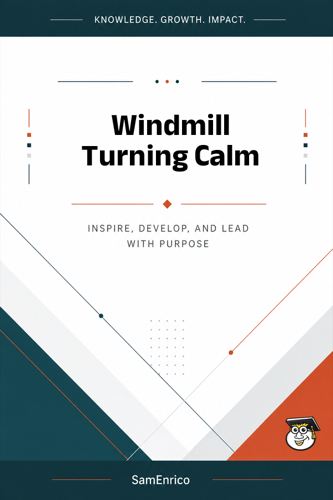
Windmill Turning Calm eBook
Watch wooden windmill blades turn slowly against a
by Wendt Leena
Watch wooden windmill blades turn slowly against a blue sky.
Formats
Free sample
Chapter 1: The Weight of Wood...--–- The first time I pressed my palm against a century-old oak beam, still warm from the afternoon sun, something in my nervous system shifted that I could not yet name. It was not a dramatic event—no lightning bolt, no sudden tears, no mystical vision. I was simply standing inside the abandoned windmill’s base, having ducked through a doorway missing its door, and I placed my hand on the wood because that is what you do when you encounter something ancient. You touch it. You hope, secretly, that some of its patience will transfer to you.The oak was rough-grained, dark with age and dust, crossed by hairline cracks that had opened and closed over decades of wet winters and dry summers.
A line of wood-borer holes ran along the grain like morse code. The beam had been holding up the mill’s upper structure since 1887, which meant it had outlasted the farmers who built it, the generations who maintained it, and the abandonment that had followed. It would probably outlast me, too.What I felt in that moment—standing there, palm on wood, hearing the creak of blades turning far above—was not relaxation exactly. It was something closer to permission. Permission to stop rushing.
Permission to stop optimizing. Permission to simply be in the presence of something that did not care about my productivity, my deadlines, my carefully curated digital self. The beam did not know or care that I had three unanswered emails and a to-do list with seventeen items. The beam had watched horses walk past this doorway. It had felt the vibration of steam engines on nearby roads.
It had witnessed the invention of radio, television, the internet, and the smartphone—and it had continued, quietly, to hold up the windmill.That was the first lesson, though I did not understand it as a lesson then. The first lesson was this: wood grounds attention because wood does not perform.The Material Difference: Why Your Eyes Rest on Wood Before we go any further, I want you to perform a small experiment. Do not skip this. The entire premise of this book rests on what you are about to feel in your own body.First, find a stainless steel appliance in your home—a refrigerator, a dishwasher, a toaster oven. Stand in front of it.
Look at it for two minutes. Do nothing else. Do not read text on it. Do not open it. Just look at the surface.
Notice what happens in your eyes, your breath, your shoulders.Most people, when I have guided them through this exercise in workshops, report the same cluster of sensations. Their eyes feel a mild strain, as if trying to focus on a surface that offers no texture to land on. Their breathing becomes slightly shallower. Their shoulders inch upward toward their ears. They feel a low-grade urge to do something else—to check a phone, to walk away, to find a task.
The stainless steel surface is not unpleasant exactly. It is simply unrestful. It offers no invitation to dwell. It reflects back a distorted version of your own image. It asks nothing of you and gives nothing back except a blank, sterile shine.Now find a piece of raw, unfinished wood.
A cutting board that has not been oiled into glassy smoothness. An unpainted wooden table leg. A fence post. A fallen branch from a tree. Hold it in your hands or stand before it.
Look at it for two minutes. Again, do nothing else.Almost everyone reports the opposite set of sensations. Their eyes soften. They find themselves tracing the grain, following a knot’s contour, noticing how the light catches a slight ridge where summer wood meets spring wood. Their breathing deepens without conscious effort.
Their shoulders drop. They feel no urge to leave. In fact, they often feel a mild reluctance to stop looking.This difference is not subjective. It is measurable, replicable, and deeply rooted in human evolutionary history.The Neuroscience of Natural Materials The Japanese practice of Shinrin-yoku—forest bathing—emerged in the 1980s as a direct response to the technological acceleration of urban life. Researchers at the Nippon Medical School in Tokyo began studying what happened to people who spent time walking slowly in forests, looking at trees, touching bark, breathing air infused with wood-released compounds called phytoncides.
The results were striking.In a landmark 2009 study, participants who spent two hours walking in a forest showed a 12.4% reduction in salivary cortisol—the primary stress hormone—compared to a control group who walked through a city. Their heart rates dropped by an average of 4.2 beats per minute. Their parasympathetic nervous system activity (the “rest and digest” branch) increased significantly, while sympathetic activity (the “fight or flight” branch) decreased.But here is what most summaries of that research miss: the effect did not require walking. Subsequent studies isolated the visual component. Participants who simply looked at photographs of forest scenes showed smaller but still significant reductions in stress markers.
Participants who looked at real wood—not photographs, not video, but physical wood—showed effects nearly as strong as walking through the forest itself.Why? Because the human visual system evolved over hundreds of thousands of years in environments dominated by organic materials: wood, bark, leaves, stone, soil, water, sky. Our eyes learned to extract information from irregular, textured, non-repeating surfaces. That is what the visual system is optimized for.A stainless steel surface, by contrast, is evolutionarily novel. It has existed for barely a century.
Your eyes have no deep evolutionary programming for looking at it. The surface is uniform, reflective, and devoid of the fractal complexity that natural materials possess. When you stare at stainless steel, your visual system keeps searching for information that is not there. It keeps expecting texture, grain, variation. When it finds none, it remains in a state of alert scanning—not quite threat detection, but not rest either.Wood provides what the visual system craves: structured complexity at multiple scales.Fractals, Grain, and the Resting Eye Look at a piece of wood.
Notice that the grain is not random. It has patterns: swirls around knots, straight runs where the tree grew evenly, subtle waves where wind stressed the trunk. These patterns repeat at different scales. At arm’s length, you see the overall flow of the grain. At six inches, you see individual tracheids (the tube-like cells that transport water).
Under magnification, you see cell walls and pits. The pattern is self-similar—it looks roughly the same whether you are close or far, large or small.This property is called fractality. Natural surfaces—tree bark, clouds, coastlines, river networks, mountain ranges—are fractal. Human-made smooth surfaces (steel, glass, polished plastic, drywall) are not.The neuroscientist Richard Taylor at the University of Oregon has spent two decades studying how the human brain responds to fractal patterns. His research shows that exposure to mid-range fractal complexity (the kind found in natural scenes) reduces physiological stress by 60% compared to viewing low-fractal (blank) or high-fractal (chaotic) patterns.
The brain enters a state he calls “fractal fluency”—it processes the pattern effortlessly, without the metabolic cost of figuring out…
This is the end of the free sample. Get the eBook to keep going. Buy now
About this book
Details
- Author
- Wendt Leena
- Publisher
- SamEnrico
- Language
- English
- Genre
- Non-Fiction, Self-Help, Rural
- Released
- 2026-06-07
- Pages (approx.)
- 142
- Available as
- eBook, Audiobook

Read better in the ZLOADR app
Your eBooks on your phone or tablet. Sign in with your SamEnrico account and start reading.
More by Wendt Leena
 Letting Go of Resentment JournalWendt Leena$11.99
 Chunking for High SchoolWendt Leena$11.99
 Geo Arbitrage Vietnam HandbookWendt Leena$11.99
 Visual Interruption BlockersWendt Leena$11.99
 Resume Kuwait Specific GuideWendt Leena$11.99
 Commercial Real Estate DemographicsWendt Leena$11.99
 Self Esteem After Weight GainWendt Leena$11.99
 Navigating Parental Narcissism GuideWendt Leena$11.99
 The Relativity Detective: How a Young Scientist Proved Einstein Right in the JungleWendt Leena$11.99
 The Fires of Axum: How an African Kingdom Tamed the EarthWendt Leena$11.99
 Fury from the Deep: The Night the Sea Stole ChristmasWendt Leena$11.99
 How to Become a Purchase-price AnalystWendt Leena$11.99
You may also like
 Hong Kong Handover 1997Dunn Johnnie$11.99
 Zumba For Postnatal Recovery CourseNeal Christian$11.99
 Zumba for BeginnersLadner Nikia$11.99
 YouTube Comment Mining GuideHumes Pandora$12.99
 Worry Box MeditationCarlin Rudy$11.99
 Workplace Stress MeditationNguyen Lynn$11.99
 Workplace Stress and Sleep RepairHawley Ivory$11.99
 Workplace Perfectionism CureDelaney Jeffry$11.99
 Workplace Injustice Anger GuideWallen Isabelle$11.99
 Work Addiction and Burnout LinkGreenwood Ester$11.99
 Women in Yoga and WellnessBeattie Galina$11.99
 Women in Stand Up ComedyChun Evangeline$11.99