
Non-FictionSelf-HelpMessaging Addiction
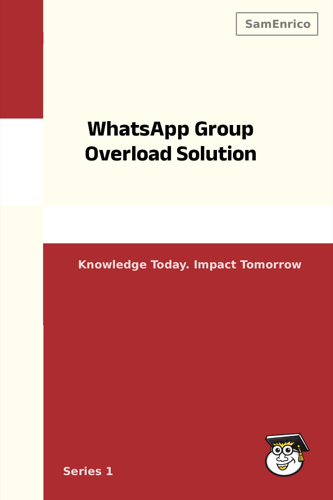
WhatsApp Group Overload Solution eBook
Manages notification anxiety and constant group ch
Manages notification anxiety and constant group chat pressure.
Formats
Free sample
Chapter 1: The Green Bubble--–- The ping arrives at 7:14 AM. You haven’t even poured your coffee yet. Your phone vibrates against the wooden nightstand—a low, insistent buzz that travels up your arm and settles somewhere behind your sternum. By the time you blink the sleep from your eyes, three more notifications have stacked on top of the first. Fourteen unread messages in the family group.
Six in the neighborhood watch. A broadcast from your cousin’s real estate side hustle. And somewhere beneath all of it, a work message that might actually matter.You tell yourself you will check them later. You set the phone face-down. But the weight of those unread bubbles—those little green badges with their accusatory numbers—follows you into the shower, sits with you at breakfast, and hovers over your shoulder as you try to read the news.
You have not opened Whats App yet today. And already, you are exhausted.This is not a failure of willpower. It is not a sign that you are weak, undisciplined, or somehow unfit for the modern world. It is a structural problem—a collision between human psychology and software designed to capture and hold your attention at any cost. And once you understand how that collision works, you can begin to dismantle it, piece by piece.Welcome to the Green Bubble.
Let us name what you have been feeling.The Problem You Cannot Quite Name Most people who suffer from Whats App overload cannot articulate what is wrong. They say things like:“I just feel… behind. All the time.”“I dread opening the app, but I also feel guilty when I don’t.”“I’ve muted almost every group, but I’m still anxious.”“I spent twenty minutes crafting a reply to a simple question. Why?”If any of these sentences sound familiar, you are not alone. Across dozens of clinical interviews, user experience studies, and digital wellness surveys, a consistent pattern has emerged.
The problem is not that Whats App users are addicted to their phones in some vague, moralistic sense. The problem is specific, mechanical, and deeply tied to the unique design features of this particular app.Unlike email, which most people understand as asynchronous and low-urgency, Whats App borrows the grammar of face-to-face conversation. The typing indicator suggests someone is waiting for you. The blue ticks announce that you have seen a message—and therefore, by social contract, you must respond. The “last seen” timestamp turns your private schedule into public data.
Together, these features create a persistent hum of low-grade obligation that never fully switches off.And groups multiply this effect exponentially. A single one-on-one conversation is manageable. But add nine other people to that chat—each with their own rhythms, expectations, and emotional needs—and the cognitive load becomes staggering. Every message is a tiny demand for attention. Every reply is a negotiation of social standing.
Every silence is potentially interpretable as rejection, laziness, or hostility.You are not imagining the pressure. It is built into the architecture.The Three Pillars of Pressure To understand why Whats App groups drain you more than other forms of communication, you need to look at three distinct sources of pressure. They are not equally weighted for everyone—some readers will struggle most with family obligations, others with workplace surveillance, others with the quiet poison of social comparison. But almost everyone experiences all three to some degree.The Family Pillar: Obligation and Guilt Family groups are uniquely difficult to leave because they are tied to real-world relationships that matter. Your mother expects you to acknowledge her good morning text.
Your sibling’s political rants cannot be ignored without consequence. The endless stream of baby photos, meal pictures, and forwarded memes from distant cousins creates a sense that you are either present and engaged or you are failing as a family member.The problem here is not love. The problem is that love has been translated into a metric of digital responsiveness. A missed message becomes a missed connection. A slow reply becomes evidence of disinterest.
The group chat turns familial affection into a performance of availability—and the stakes feel impossibly high because these are people you cannot unfriend in real life.The Work Pillar: Surveillance and Urgency Workplace Whats App groups introduce a different kind of pressure. Unlike email, which at least pretends to respect office hours, Whats App bleeds into evenings, weekends, and vacations. The expectation is often unspoken but unmistakable: you should be reachable. You should be responsive. You should not be the person who lets the team down by going offline.The blue ticks here become instruments of surveillance.
Your manager can see not only whether you have read a message but exactly when you read it. A late-night reply after 10 PM suggests dedication. But a message read at 8 PM with no reply suggests something else—laziness, perhaps, or disengagement. The ambiguity is exhausting. You find yourself typing responses while half-watching television, while cooking dinner, while lying in bed with the lights off, because the alternative feels professionally dangerous.The Social Pillar: FOMO and Performance Friend groups, alumni networks, and hobby communities create the third pillar.
These spaces are ostensibly for connection and fun. But they quickly become arenas for social comparison and performance anxiety.You see photos of a gathering you were not invited to. You watch as friends celebrate promotions, engagements, and vacations while you sit on your couch in sweatpants. You craft a witty reply to a joke, delete it, rewrite it, delete it again, and finally settle for a thumbs-up emoji because you cannot bear the risk of being unfunny. The performance is exhausting.
The comparison is corrosive. And the fear of missing out keeps you scrolling long after the pleasure has drained away.These three pillars do not stand alone. They reinforce each other. A stressful day at work (Pillar Two) makes you less patient with family messages (Pillar One). Social comparison (Pillar Three) makes you feel inadequate, which makes work pressure feel more threatening.
The system feeds on itself, and you are caught in the middle.The Good Morning Tax Let us talk about a specific phenomenon that every Whats App user knows but few have named. Let us call it the Good Morning Tax.Every day, across millions of Whats App groups, users send and receive messages that have almost no informational or emotional value. Good morning texts. Good night texts. Stickers.
GIFs. Chain messages promising bad luck if not forwarded. Blurry screenshots of quotes from obscure Instagram accounts. Videos of puppies, waterfalls, and motivational speakers you have never heard of.Individually, each of these messages costs almost nothing to send and almost nothing to ignore. But collectively, they represent a massive drain on cognitive bandwidth.
A study of average Whats App users found that approximately 40 percent of all group messages fall into this low-value category. For users in large family or community groups, the number can exceed 60 percent.The cost is not measured in data usage or battery life. It is measured in attention. Every time your phone vibrates with a good morning text, your brain must make a series of…
This is the end of the free sample. Get the eBook to keep going. Buy now
About this book
Details
- Author
- Mclemore Johnsie
- Publisher
- SamEnrico
- Language
- English
- Genre
- Non-Fiction, Self-Help, Messaging Addiction
- Released
- 2026-06-05
- Pages (approx.)
- 123
- Available as
- eBook, Audiobook

Read better in the ZLOADR app
Your eBooks on your phone or tablet. Sign in with your SamEnrico account and start reading.
More by Mclemore Johnsie
 Incompetent Cervix LossMclemore Johnsie$11.99
 Senior Learning New SkillsMclemore Johnsie$11.99
 Body Scan for MusiciansMclemore Johnsie$11.99
 The Lion of Tabriz: Shah Abbas and the Art of WarMclemore Johnsie$11.99
 How to Produce Adhesive TapeMclemore Johnsie$11.99
 Registered DietitianMclemore Johnsie$11.99
 Benefits Localization HandbookMclemore Johnsie$12.99Registered DietitianMclemore Johnsie$11.99
 How to Become a Glucose-and-syrup WeigherMclemore Johnsie$11.99
You may also like
 Hong Kong Handover 1997Dunn Johnnie$11.99
 Zumba For Postnatal Recovery CourseNeal Christian$11.99
 Zumba for BeginnersLadner Nikia$11.99
 YouTube Comment Mining GuideHumes Pandora$12.99
 Worry Box MeditationCarlin Rudy$11.99
 Workplace Stress MeditationNguyen Lynn$11.99
 Workplace Stress and Sleep RepairHawley Ivory$11.99
 Workplace Perfectionism CureDelaney Jeffry$11.99
 Workplace Injustice Anger GuideWallen Isabelle$11.99
 Work Addiction and Burnout LinkGreenwood Ester$11.99
 Women in Yoga and WellnessBeattie Galina$11.99
 Women in Stand Up ComedyChun Evangeline$11.99