
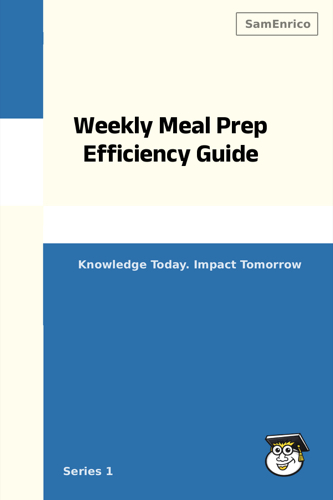
Weekly Meal Prep Efficiency Guide eBook
Batch cook proteins, grains, and vegetables on Sun
by Glass Vilma
Batch cook proteins, grains, and vegetables on Sunday for quick weekday assembly.
Formats
Free sample
Chapter 1: The 6 PM Spiral--–- The oven beeps. You haven’t taken anything out of the freezer. A small human is pulling on your sleeve asking for a snack that will definitely ruin dinner. Your partner just texted, “What’s the plan?” and you typed back a single word you’ll regret later. The half-empty jar of pasta sauce in the fridge expired eleven days ago, and the broccoli you bought with good intentions has turned into a science experiment.
This is not a failure of character. This is a failure of system.This chapter is not about recipes. It is not about organizing your pantry or learning to chop an onion faster. This chapter is about one thing: naming the enemy. The enemy is not laziness, lack of skill, or a busy schedule.
The enemy is the 6 PM Spiral—that daily collision of hunger, exhaustion, and decision fatigue that turns otherwise capable adults into people who eat cold cheese directly from the package while standing over the sink.If you have ever stood in front of an open refrigerator at 6:15 PM, hoping something edible would materialize, you already know the Spiral. If you have ever ordered takeout for the third time in a week, not because you wanted to but because you couldn’t face another round of “what’s for dinner,” you know the Spiral. If you have ever fed your children buttered noodles while eating a bowl of cereal yourself because you were too tired to make two things, you are intimately acquainted with the Spiral.Here is the good news: the Spiral is optional. It feels inevitable, like traffic or death or taxes. But it is not.
The Spiral is a predictable outcome of a predictable problem—reactive cooking—and reactive cooking can be replaced with a different approach. That approach is what this entire book will teach you. But first, you have to believe that change is possible. And to believe that, you have to understand why the Spiral happens in the first place.The Anatomy of Daily Cooking Chaos Let us walk through a typical weekday. You wake up, possibly before your alarm, possibly after.
You get yourself and perhaps other humans dressed, fed, and out the door. You work for eight to ten hours, during which you make somewhere between thirty-five and one hundred conscious decisions, depending on your job. You commute home, navigating traffic or public transit or the endless logistics of afterschool activities. You walk through your front door. And then someone asks you, “What’s for dinner?”That question is not innocent.
It is a cognitive landmine.By the time you hear those words, your brain’s executive function—the part responsible for planning, prioritizing, and making complex decisions—has already been running a marathon. Each decision you made during the day, from “which email to answer first” to “what route to take home,” drained a finite resource. Psychologists call this ego depletion. The rest of us call it being too tired to think.When you are depleted, your brain takes shortcuts. It defaults to the easiest possible option, which is rarely the healthiest or most economical.
It reaches for the takeout menu, the frozen pizza, the boxed mac and cheese. Not because you lack willpower. Because willpower is not a character trait; it is a fuel tank, and yours is empty.This is the first secret of the 6 PM Spiral: it is not a moral failure. It is a design flaw in how most people approach cooking. You have been trying to make a high-stakes decision at the exact moment your brain is least equipped to make any decision at all.The second secret is that the Spiral is expensive.
Not just in money, though takeout and convenience foods cost significantly more than home cooking. The Spiral is expensive in time, in mental energy, and in the quiet erosion of your own confidence. Every night you fail to cook feels like a small defeat. Over weeks and months, those small defeats accumulate into a story you tell yourself: “I’m just not good at this.” “I don’t have my life together.” “Other people can meal prep, but I can’t.”That story is a lie. You can.
You just haven’t been given the right tools.The True Cost of the Spiral Let us put actual numbers on this problem, because numbers have a way of clarifying things that feelings cannot. A detailed time and cost analysis conducted across hundreds of households reveals a consistent pattern. The average person spends approximately seven hours per week on dinner-related activities when cooking reactively. This includes:35 minutes per day thinking about or planning dinner (that is over 4 hours per week of low-grade mental noise)15 minutes per day searching for recipes or deciding what to make45 minutes per day actually cooking10 minutes per day cleaning up15 minutes per day dealing with “what went wrong” (burnt food, missing ingredients, last-minute substitutions)That is nearly two hours per day, five days a week. And that calculation does not include grocery shopping, which adds another sixty to ninety minutes per week of its own.Now consider what happens when you replace reactive cooking with proactive batch cooking.
Households that adopt a Sunday preparation system report spending:2 to 3 hours on Sunday cooking foundational components10 minutes per weekday assembling meals from pre-prepped ingredients30 minutes per week grocery shopping (because shopping happens once, from a list)The total weekly time investment drops from approximately ten hours to approximately five hours. You gain back five hours every week. Five hours is a movie and a half. Five hours is a yoga class, a long walk, and a nap. Five hours is the difference between feeling like you have no time and feeling like you have margin.But the time savings are only half the story.
The real transformation happens in your brain.Decision Fatigue and the Myth of Willpower In the early 2000s, a group of social psychologists conducted a now-famous experiment. They brought participants into a room filled with the smell of freshly baked chocolate chip cookies. On a table sat two bowls: one filled with warm, gooey cookies, and another filled with radishes. Some participants were told to eat only cookies. Some were told to eat only radishes.
A third group was told to eat nothing at all.After snacking, each participant was asked to complete a difficult, frustrating puzzle that was actually unsolvable. The researchers wanted to know how long each person would persist before giving up. The results were striking. Participants who had eaten radishes—who had exercised willpower to resist the cookies—gave up on the puzzle after about eight minutes, less than half the time of the cookie-eaters and the non-eaters.The radish-eaters had depleted their self-control on one task, leaving none for the next. This is decision fatigue in action.Every choice you make, from resisting a cookie to deciding what to cook for dinner, draws from the same finite reservoir.
By 6 PM, your reservoir is nearly empty. Asking yourself “What’s for dinner?” is not a simple question. It is a complex problem requiring multiple sub-decisions: What protein do I have?…
This is the end of the free sample. Get the eBook to keep going. Buy now
About this book
Details
- Author
- Glass Vilma
- Publisher
- SamEnrico
- Language
- English
- Genre
- Non-Fiction, Health & Wellness
- Released
- 2026-06-09
- Pages (approx.)
- 135
- Available as
- eBook, Audiobook

Read better in the ZLOADR app
Your eBooks on your phone or tablet. Sign in with your SamEnrico account and start reading.
More by Glass Vilma
 Fear Of Tunnels Treatment GuideGlass Vilma$11.99
 Pet Loss Legacy IdeasGlass Vilma$11.99
 Networking Ease AnchorGlass Vilma$11.99
 Men Mental Health JournalGlass Vilma$11.99
 Swedish Massage GuideGlass Vilma$11.99
 Parental Stress And FinancesGlass Vilma$11.99
 REIT Debt Maturity WallGlass Vilma$11.99
 The Wings of the Commonwealth: Poland’s Last Stand at Kircholm (1605)Glass Vilma$11.99
 Anubis: The Jackal’s WisdomGlass Vilma$11.99
 Media Law: Defamation, Prior Restraint & Press FreedomGlass Vilma$11.99
 How to Produce a Roller Cone BitGlass Vilma$11.99
 Virtual Office for Multiple StatesGlass Vilma$12.99
You may also like
 Hong Kong Handover 1997Dunn Johnnie$11.99
 Zumba For Postnatal Recovery CourseNeal Christian$11.99
 Zumba for BeginnersLadner Nikia$11.99
 YouTube Comment Mining GuideHumes Pandora$12.99
 Worry Box MeditationCarlin Rudy$11.99
 Workplace Stress MeditationNguyen Lynn$11.99
 Workplace Stress and Sleep RepairHawley Ivory$11.99
 Workplace Perfectionism CureDelaney Jeffry$11.99
 Workplace Injustice Anger GuideWallen Isabelle$11.99
 Work Addiction and Burnout LinkGreenwood Ester$11.99
 Women in Yoga and WellnessBeattie Galina$11.99
 Women in Stand Up ComedyChun Evangeline$11.99