
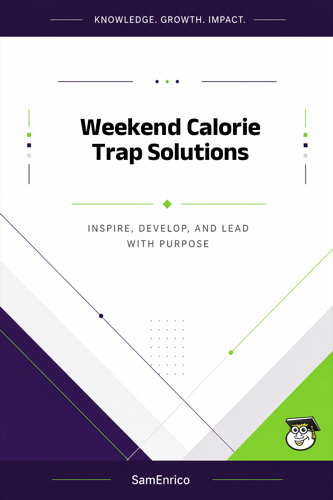
Non-FictionHealth & WellnessWeekend Habits
Weekend Calorie Trap Solutions eBook
Enjoy social events and dining out without undoing
Enjoy social events and dining out without undoing your weekday tracking progress.
Formats
Free sample
Chapter 1: The 5/2 Lie--–- Monday morning, 7:42 AM. You step on the scale, and for a split second, you feel hopeful. You tracked everything last week. You said no to the office donuts. You ate your sad desk salad while your coworkers ordered pizza.
You stayed under your calorie goal Monday through Friday, every single day. You earned this weigh-in.The number appears. It hasn't moved. Or worse—it's higher.Your stomach drops. You run through the math in your head.
How is this possible? You were so good. You did everything right. The only explanation, you conclude, is that this "calorie deficit" thing doesn't work for you. Maybe your metabolism is broken.
Maybe you're one of those people who just can't lose weight.You are not broken. And the math does work. You are simply missing the single biggest variable in almost every weight loss attempt: the weekend.This chapter will show you exactly why your weekday effort is disappearing into a black hole between Friday at 6 PM and Sunday at 10 PM. More importantly, it will give you the first critical mindset shift you need to stop the cycle—without giving up your social life, your favorite restaurants, or your sanity.The Mathematics of Self-Sabotage Let's start with the numbers, because numbers do not lie. They also do not judge.
They simply reveal the truth that our emotions want to hide.Assume you are trying to lose one pound per week. The established science of energy balance tells us that one pound of body fat equals approximately 3,500 calories. To lose one pound per week, you need a daily deficit of 500 calories. That is the standard recommendation from virtually every evidence-based weight loss organization.Now let's say you execute that deficit perfectly Monday through Friday. You eat 500 calories less than your body burns each day.
By Friday night, you have created a cumulative deficit of 2,500 calories. That is 2,500 calories your body has pulled from its fat stores. You are approximately two-thirds of the way to your one-pound goal. You should be thrilled.But then the weekend arrives.Friday night: You meet friends for dinner and drinks. You order a pasta dish you've been craving all week.
You have two glasses of wine. Maybe you share a dessert. Total for that meal: 1,800 calories, which is 800 calories more than a typical dinner.Saturday morning: You sleep in and skip breakfast. By noon, you are ravenous. You go to brunch and order the French toast with a side of bacon and a mimosa.
Total: 1,400 calories. For dinner, you order pizza delivery because you're tired and you deserve a treat. Three slices and a beer: 1,200 calories.Sunday: You feel vaguely guilty about Saturday, so you eat "normally" during the day, but by evening, the Sunday Scaries have set in. You graze on leftovers while watching television. An extra 700 calories disappears without you even noticing.Add these weekend calories to your weekday baseline, and here is what happened: You created a 2,500-calorie deficit Monday through Friday.
But you ate an extra 4,100 calories over the weekend above what your body needed. That is a net surplus of 1,600 calories. You gained nearly half a pound. And you have no idea why.This is the 5/2 Split, and it is the single most common reason people feel stuck.But here is what makes this truly insidious: You did not binge. You did not eat an entire cake or drink an entire bottle of whiskey.
You simply ate and drank what every normal, social, busy adult eats and drinks on a weekend. A nice dinner. A brunch. Some pizza. A few cocktails.
Leftover grazing. That is not a catastrophic failure. That is Tuesday in Italy and Saturday in suburban America. And yet it completely erased six days of disciplined effort.The Perfectionist's Trap If you are reading this book, there is a high probability that you are what psychologists call a "rule follower." You excel at structure. You love a checklist.
You feel genuine satisfaction when you close all the rings on your Apple Watch or hit your exact macro targets in your tracking app.This is a superpower Monday through Friday. The structure of the workweek—set meal times, predictable schedules, limited social obligations—plays directly to your strengths. You pack your lunch. You eat at your desk. You go to the gym after work because that is what the schedule says.
You are winning.But the same personality that makes you excellent during the week makes you vulnerable on the weekend. Because weekends have no structure. Weekends have variable meal times, unexpected invitations, buffets, bottomless brunches, and friends who say things like "live a little" and "you never eat anymore."Your rule-following brain tries to apply weekday rules to weekend chaos. And when that inevitably fails—because you cannot pre-log a surprise birthday dinner or measure the olive oil on restaurant bruschetta—your brain does something destructive. It says, "Well, I already broke the rules today.
I'll start again on Monday."This is called the What-the-Hell Effect, a term coined by researchers Janet Polivy and Peter Herman in their seminal work on diet psychology. In their studies, they found that dieters who consumed a high-calorie "preload" (a milkshake) subsequently ate significantly more during a taste test than dieters who had not been preloaded. The non-dieters in the study did the opposite—they ate less after the milkshake because they were full. But the dieters thought, "What the hell? I already blew my diet.
I might as well enjoy this."This single cognitive distortion is responsible for more weekend weight gain than any food or drink. It turns a 300-calorie appetizer into a 3,000-calorie weekend. It transforms one slice of pizza into an entire pizza. It makes a single cookie into six.The solution is not to become a perfect eater who never makes mistakes. The solution is to learn how to make one mistake and stop there.
That is what this book will teach you. But first, you need to understand why weekends are biologically and socially designed to defeat you.Physical Hunger vs. Social Hunger You have two different hunger systems operating in your body. They feel similar, but they are driven by completely different biology. And weekends activate the wrong one almost constantly.Physical hunger is what you feel after not eating for several hours.
It builds gradually. It is accompanied by stomach growling, a slight decrease in energy, and sometimes lightheadedness. Most importantly, physical hunger is satisfied by almost any food. When you are truly physically hungry, an apple sounds good. A hard-boiled egg sounds good.
A bowl of soup sounds good.Social hunger is different. Social hunger is triggered by environmental cues—the smell of pizza, the sight of a dessert cart, the sound of a cork being pulled from a wine bottle. It comes on suddenly and intensely. It craves specific foods, not just calories. When you are socially hungry, you do not want an apple.
You want the exact thing you can see or smell. And it is not satisfied by small portions. It wants the whole experience.Here is the cruel trick: social hunger feels exactly like physical hunger. Your brain does not…
This is the end of the free sample. Get the eBook to keep going. Buy now
About this book
Details
- Author
- Halverson Clementine
- Publisher
- SamEnrico
- Language
- English
- Genre
- Non-Fiction, Health & Wellness, Weekend Habits
- Released
- 2026-06-07
- Pages (approx.)
- 147
- Available as
- eBook, Audiobook

Read better in the ZLOADR app
Your eBooks on your phone or tablet. Sign in with your SamEnrico account and start reading.
More by Halverson Clementine
 What Does This Button DoHalverson Clementine$11.99
 Escalation Path FrameworkHalverson Clementine$11.99
 Validation for Grieving FriendsHalverson Clementine$11.99
 The Nicki Minaj Barbie WorldHalverson Clementine$11.99
 The Shadow of the Euphrates: Rome's Forgotten Wars in PersiaHalverson Clementine$11.99
 Shift LeaderHalverson Clementine$11.99
 Learn to Play the BariHalverson Clementine$11.99
 Startup Budgeting GuideHalverson Clementine$12.99
 Renewable Energy Climate InsuranceHalverson Clementine$12.99
 How to Become a Steel-pan-form-placing SupervisorHalverson Clementine$11.99
You may also like
 Hong Kong Handover 1997Dunn Johnnie$11.99
 Zumba For Postnatal Recovery CourseNeal Christian$11.99
 Zumba for BeginnersLadner Nikia$11.99
 YouTube Comment Mining GuideHumes Pandora$12.99
 Worry Box MeditationCarlin Rudy$11.99
 Workplace Stress MeditationNguyen Lynn$11.99
 Workplace Stress and Sleep RepairHawley Ivory$11.99
 Workplace Perfectionism CureDelaney Jeffry$11.99
 Workplace Injustice Anger GuideWallen Isabelle$11.99
 Work Addiction and Burnout LinkGreenwood Ester$11.99
 Women in Yoga and WellnessBeattie Galina$11.99
 Women in Stand Up ComedyChun Evangeline$11.99