
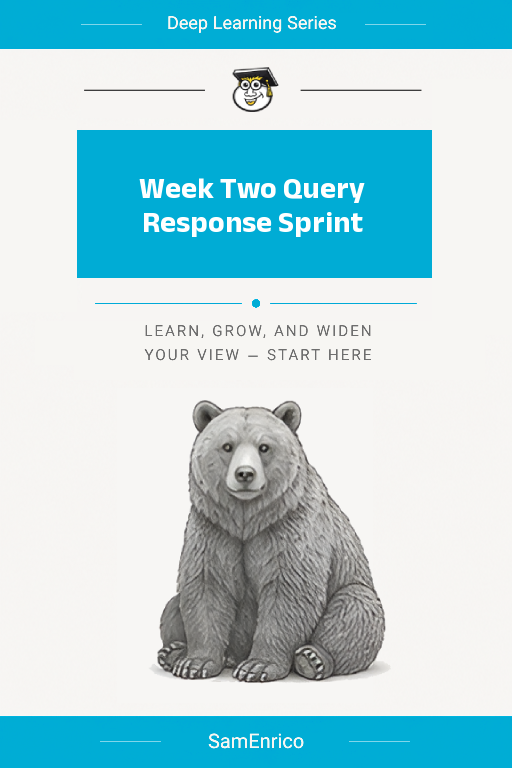
Non-FictionFirst 30 DaysWeek Two
Week Two Query Response Sprint eBook
Responds to 20+ HARO queries during second week, b
Responds to 20+ HARO queries during second week, building momentum and learning which types get journalist attention.
Formats
Free sample
Chapter 1: The Momentum Illusion--–- The email arrived at 6:47 AM on a Tuesday. Sarah, a marketing manager at a mid-sized software company, had signed up for HARO three weeks earlier after reading a blog post about "earned media for busy people." She had bookmarked the HARO website, set up email filters, and even told her boss she was "building a media strategy." In her first week, she responded to exactly two queries. The first asked for "expert tips on B2B lead generation." She spent forty-five minutes crafting 347 words of thoughtful advice, included her Linked In profile, and hit send with a rush of pride. The second query asked for "case studies of successful product launches." She spent an hour pulling data from an old client, anonymizing the results, and formatting three bullet points. Then she waited.
A week passed. No reply from the first journalist. No reply from the second. On day ten, Sarah opened her HARO digest, stared at thirty-seven unread queries, and closed her browser. She told herself she was too busy.
She told herself HARO didn't work. She told herself that journalists were ignoring her because she wasn't a "real expert." Six months later, her HARO account remained dormant, and her boss had stopped asking about the media strategy.This is not a failure of effort. This is not a failure of expertise. This is a failure of timing, expectation, and—most critically—momentum. Sarah committed the single most common error in HARO's two-decade history: she sprinted before she was warmed up, then collapsed when the finish line did not appear instantly.
She misunderstood when the real race begins.The First Week Lie Every HARO beginner receives the same implicit message from online tutorials, You Tube gurus, and well-meaning colleagues: "Sign up, respond to a few queries, and you will get links." This is technically true, in the same way that "buy a lottery ticket and you might become a millionaire" is technically true. The reality is far less glamorous. Data compiled from public case studies and interviews with journalists suggests that the average HARO beginner sends between two and four responses in their first seven days. Of those, roughly eighty percent receive no reply at all. Fifteen percent receive a polite "thanks, but we went with another source." Five percent receive a request for more information, and of that five percent, only a fraction actually result in a published link.
These numbers are not designed to discourage you. They are designed to reveal a pattern: Week One is not for winning. Week One is for surviving, learning, and shaking off the paralysis that keeps most people from ever sending response number five.Why does this happen? Three psychological barriers converge in the first week. The first barrier is perfectionism.
When you have never responded to a journalist before, every word feels like it matters. You agonize over whether to include a statistic. You rewrite your bio three times. You check your grammar so many times that you accidentally introduce new typos. This perfectionism is not a character flaw; it is a natural response to an unfamiliar, high-stakes situation.
But it kills momentum because a single response takes forty-five minutes, and after two such responses, you feel exhausted rather than energized. The second barrier is expectation mismatch. Most beginners believe that HARO works like email marketing: send a message, track the open rate, measure the conversion. But HARO is not email marketing. It is a blind audition where two hundred other people are also auditioning, the casting director has six seconds to evaluate each submission, and you never receive feedback on why you were rejected.
This uncertainty feels like failure, even when your response was perfectly adequate. The third barrier is the absence of a feedback loop. In most skill-based activities—running, coding, playing an instrument—you receive immediate feedback on your performance. You run a mile; you see your time. You write code; you see if it compiles.
You play a scale; you hear the wrong note. HARO provides no such feedback. You send a response, and then silence. That silence is not rejection. It is simply the default state of a system where journalists receive far more replies than they can use.
But to a beginner, silence feels like a verdict.The Week Two Window Now consider an alternative timeline. Sarah, the marketing manager from our opening story, receives different advice before she starts. She is told: "Your first week does not matter. Do not check for replies. Do not track results.
Simply send three to five responses to learn the mechanics. Then, in your second week, we will run a five-day sprint. You will send twenty responses. You will track what works. You will build momentum that carries you into month two." This is the Week Two Window, and it is the most underutilized opportunity in HARO's entire ecosystem.Why Week Two specifically?
Because something profound shifts between day seven and day eight. By the end of Week One, you have experienced the mechanics of HARO. You know how to open a query, read the requirements, and format a response. You have likely made one or two embarrassing mistakes—forgetting to include your phone number, addressing the journalist by the wrong name, sending a response that was too long. These mistakes feel catastrophic at the time, but they are actually essential data.
You cannot learn to write a good HARO response without writing several bad ones first. Week One provides those bad ones in a low-stakes environment. By Week Two, you have inoculated yourself against the fear of sending. The blank page no longer terrifies you because you have already filled it several times. More importantly, the journalists have not yet flagged you as anything at all.
You are still a neutral actor in their inbox—not a spammer, not a time-waster, just another source. This neutrality is valuable because it means you have not burned any bridges. You can experiment freely with different response styles, different hooks, and different query categories without the baggage of a previous bad interaction.The second reason Week Two is ideal relates to the concept of "momentum stacking." In physical training, athletes periodize their workouts: base building, then intensity, then recovery, then peak. HARO operates on a similar principle. Week One is base building.
You learn the movements, develop the habit of checking queries, and prove to yourself that you can send responses at all. Week Two is intensity. You compress as much activity as possible into five days, not because you will sustain that pace forever, but because the concentrated effort produces three specific outcomes. First, it overcomes the "cold start" problem. In physics, a stationary object requires more force to move than an already-moving object requires to stay in motion.
The same applies to your HARO practice. Sending twenty responses in five days requires significant force on day one, but by day three, the act of responding feels normal. You stop negotiating with yourself about whether a query is "good enough." You simply respond. Second, a concentrated sprint produces enough responses—twenty—to generate statistically meaningful data. If you send two responses per week, you will need…
This is the end of the free sample. Get the eBook to keep going. Buy now
About this book
Details
- Author
- Pulliam Juliana
- Publisher
- SamEnrico
- Language
- English
- Genre
- Non-Fiction, First 30 Days, Week Two
- Released
- 2026-05-30
- Pages (approx.)
- 143
- Available as
- eBook, Audiobook

Read better in the ZLOADR app
Your eBooks on your phone or tablet. Sign in with your SamEnrico account and start reading.
More by Pulliam Juliana
 Forgiveness Letter Writing GuidePulliam Juliana$11.99
 NVC For Youth Mentors WorkbookPulliam Juliana$11.99
 Loving Kindness For ElderlyPulliam Juliana$11.99
 The Breath Awareness for PTSDPulliam Juliana$11.99
 LBO CFIUS Review GuidePulliam Juliana$11.99
 Codex of the Forgotten: The AI That Deciphered the Voynich ManuscriptPulliam Juliana$11.99
 Price Communication InflationPulliam Juliana$12.99
 How to Start a Bank Note Paper Business (Beginners Guide)Pulliam Juliana$11.99
 Understanding Sohval–soffer SyndromePulliam Juliana$17.99
 Telemetry TechnicianPulliam Juliana$11.99
You may also like
 Hong Kong Handover 1997Dunn Johnnie$11.99
 Zumba For Postnatal Recovery CourseNeal Christian$11.99
 Zumba for BeginnersLadner Nikia$11.99
 YouTube Comment Mining GuideHumes Pandora$12.99
 Worry Box MeditationCarlin Rudy$11.99
 Workplace Stress MeditationNguyen Lynn$11.99
 Workplace Stress and Sleep RepairHawley Ivory$11.99
 Workplace Perfectionism CureDelaney Jeffry$11.99
 Workplace Injustice Anger GuideWallen Isabelle$11.99
 Work Addiction and Burnout LinkGreenwood Ester$11.99
 Women in Yoga and WellnessBeattie Galina$11.99
 Women in Stand Up ComedyChun Evangeline$11.99