
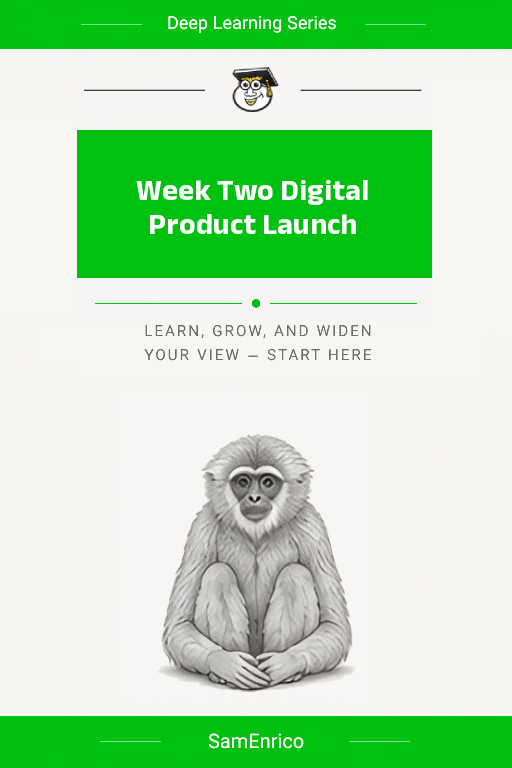
Week Two Digital Product Launch eBook
Create deliverable content record videos and launc
by Wills Emely
Create deliverable content record videos and launch to your audience in week two.
Formats
Free sample
Chapter 1: The Primer Launch...--–- Most digital product launches die in Week Two. Not Week One. Not Week Three. Week Two.You have the idea. You have the outline.
You have the eager audience waiting for what comes next. You sat down during Week One, full of caffeine and confidence, and mapped out every module, every video, every worksheet. The spreadsheet was beautiful. The landing page was almost ready. You told yourself, "This time will be different."Then came Week Two.Monday morning arrives.
You open your recording software. The cursor blinks at you. The microphone sits there, clean and accusatory. You tell yourself you need to review your outline one more time. Just to be safe.
You open the document. You read it. You close it. You open You Tube "just for five minutes" to see how someone else structures their intro. Two hours later, you have watched six videos, saved three templates you will never use, and recorded absolutely nothing.Tuesday.
You tell yourself you need better lighting. You spend $47 on a ring light on Amazon. It arrives Thursday. By then, your energy has shifted. The excitement of Week One has curdled into the anxiety of Week Two.
You start questioning the entire product. Is this really what your audience needs? Maybe you should add another module. Maybe you should cut the third video entirely. Maybe you should delay the launch by a week.
Or a month. Or until after the holidays.Wednesday. You attempt to record. You get thirty seconds in and stumble over a sentence. You stop.
You restart. You stumble again. You watch the playback and cringe at how tired you sound. You delete the file. You tell yourself you will try again tomorrow.Friday.
Nothing has been recorded. Your launch date—which felt so real and imminent seven days ago—now feels like a distant, embarrassing promise you never should have made. You send an email to your list: "Due to some technical delays, we are pushing back the launch by two weeks."Your audience is disappointed but polite. They click away. Some of them never come back.This is not a failure of talent.
It is not a failure of expertise. It is not even a failure of planning. It is a failure of one specific thing: the Week Two freeze—that liminal space between the dream of the product and the reality of recording it.And this book exists to end it forever.The Week Two Graveyard Let us walk through the graveyard of dead launches together. You have seen these tombs before. Perhaps you built some of them yourself.Tombstone #1: The Perfect Outline That Never Became a Video.
This creator spent six months refining a curriculum. Every module was aligned. Every learning objective was measured. The outline was 47 pages long. It was also, in a very real sense, imaginary.
Because there is a fundamental truth that outlines cannot teach you: a video is not a document. You can outline a course perfectly on paper and still freeze the moment the red light comes on. The outline gives you the illusion of progress without the reality of production.Tombstone #2: The $2,000 Camera Setup That Records Silence. This creator bought everything. The Sony camera.
The RØDE microphone. The Elgato Key Light. The sound panels. They spent an entire weekend configuring their "studio." Then they sat in front of it, pressed record, and realized they had no idea what to say. The gear became a substitute for action.
Every time they looked at the camera, they felt the weight of their investment—and the fear of wasting it. So they never pressed record again.Tombstone #3: The "I'll Edit It Later" Spiral. This creator recorded three videos. They were raw. They were real.
They were 90% of the way there. Then they opened editing software. They spent six hours removing "ums" and "likes." They added transitions. They color-graded. They added intro music.
They changed the intro music. They watched the final product and hated it because it no longer sounded like them. They deleted the edited files and started over. Then they froze.Tombstone #4: The Audience That Was Promised a Launch That Never Came. This is the cruelest tombstone of all.
Because this creator did something brave: they told their audience a launch was coming. They built anticipation. They teased the product. People got excited. Money was mentally committed.
Then Week Two hit. The creator went silent. Days became weeks. Weeks became months. The audience stopped asking.
They learned, quietly, that this creator does not follow through. The damage to trust is invisible but permanent.If any of these tombstones feel familiar, you are in the right place. Because the solution is not more planning. It is not better gear. It is not more confidence.
The solution is a complete reorientation of how you think about Week Two.The Primer Launch Mindset: Building the Parachute as You Jump The traditional launch methodology—the one taught in every course, every book, every webinar—follows a linear sequence:Idea Validation Outlining Production Editing Marketing Launch Delivery This sequence is a lie. Not intentionally. But it is a lie because it assumes that production happens in a vacuum, separate from the market, separate from your energy, separate from the actual humans who will buy the product.Here is what actually happens in the real world:By the time you finish editing, your initial excitement is gone By the time you launch, three competitors have released similar products By the time you deliver, your audience has moved on to the next shiny thing The traditional sequence optimizes for polish at the expense of speed. And in digital products, speed is not a nice-to-have. Speed is the competitive advantage that cannot be copied.Enter the Primer Launch Mindset.The Primer Launch is a low-stakes, high-speed methodology borrowed from two unlikely parents: agile software development and direct-response marketing.
From agile, we borrow the concept of the minimum viable product—the smallest possible version of your product that still delivers the promised transformation. From direct-response marketing, we borrow the concept of the soft launch—releasing to a small audience first, gathering feedback, then scaling.But the Primer Launch goes further than either of these. Because the Primer Launch does not just release early. It releases before you feel ready. It releases while you are still recording.
It releases while the product is half-finished.This sounds insane. Let me explain why it is actually the safest thing you can do.The Parachute Principle Imagine you are standing at the edge of a cliff. Someone tells you that you need to jump. You say, "I will jump as soon as I finish building my parachute."That is the traditional launch model. Build the entire parachute on solid ground.
Check every strap. Inspect every seam. Test the deployment mechanism three times. Then, and only then, jump.The problem is that you cannot truly test a parachute on solid ground. A parachute only reveals its flaws when it is deployed in the air, under the specific conditions of your fall.
The ground test cannot simulate wind shear. It cannot simulate the panic of deployment. It cannot simulate the actual physics…
This is the end of the free sample. Get the eBook to keep going. Buy now
About this book
Details
- Author
- Wills Emely
- Publisher
- SamEnrico
- Language
- English
- Genre
- Non-Fiction, First 30 Days
- Released
- 2026-06-01
- Pages (approx.)
- 150
- Available as
- eBook, Audiobook

Read better in the ZLOADR app
Your eBooks on your phone or tablet. Sign in with your SamEnrico account and start reading.
More by Wills Emely
 Postpartum Travel with Baby GuideWills Emely$11.99
 HRTech Investment MapWills Emely$11.99
 Beginner Barbell ProgramWills Emely$11.99
 Trigger Grounding TechniquesWills Emely$11.99
 The IBS Bloat Reduction PlanWills Emely$11.99
 Neck Wrinkle Skin Tightening GuideWills Emely$11.99
 Reagan California GovernorWills Emely$11.99
 Contempt In RelationshipsWills Emely$11.99
 Alcohol Recovery and TravelWills Emely$11.99
 Oisín and Niamh: The Forgotten Love of the Fairy King’s DaughterWills Emely$11.99
 The Codebreaker’s Gambit: How a Math Genius Outmaneuvered Wall StreetWills Emely$11.99
 Kicks & Kings: The Sneaker Heist That Shook a DynastyWills Emely$11.99
You may also like
 Website Launch For New LLCStrunk Tracee$12.99
 Shopify Market Expansion GuideGaffney Jude$12.99
 Power Backup Solutions for Philippine VAsPearce Eldon$12.99
 Feedback License Clause TemplateCrum Ashli$12.99Feedback License Clause TemplateCrum Ashli$12.99Feedback License Clause TemplateCrum Ashli$12.99Feedback License Clause TemplateCrum Ashli$12.99Feedback License Clause TemplateCrum Ashli$12.99Feedback License Clause TemplateCrum Ashli$12.99Feedback License Clause TemplateCrum Ashli$12.99Feedback License Clause TemplateCrum Ashli$12.99
 Channel Distribution On One PagePetersen Narcisa$12.99