
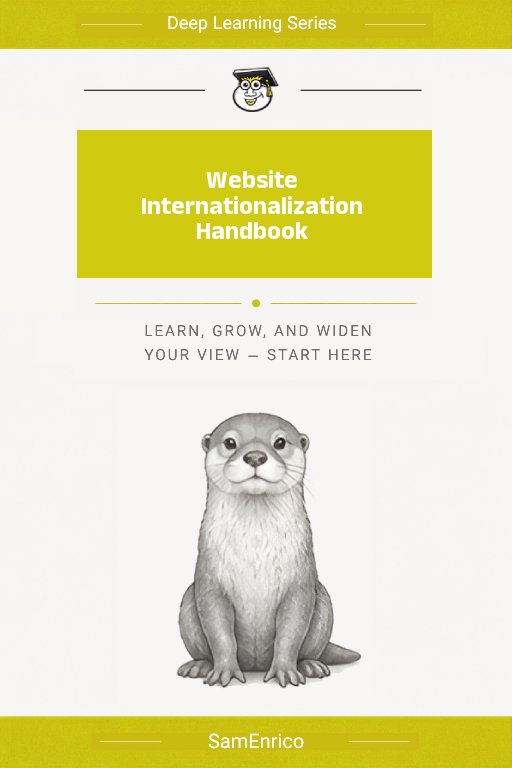
Non-FictionAI OperatorLanguage ServicesInternationalization Guide
Website Internationalization Handbook eBook
Automate hreflang tags, URL localization, and UI t
Automate hreflang tags, URL localization, and UI text translation for multilingual websites using AI. Includes RTL language support, currency conversion, and date format adaptation.
Formats
Free sample
Chapter 1: The Half-Million-Dollar Button--–- In March of 2024, a mid-sized e-commerce company called Luxe Scent (name changed by request) launched its first international expansion. The CEO had allocated $480,000 for the project—translations, local marketing, legal reviews, and technical implementation. Six months later, the site was live in France, Germany, Japan, and Brazil. The team celebrated.Three weeks after launch, the analytics told a different story.French users were landing on the German product pages. German users saw Japanese date formats.
Brazilian users clicked "Add to Cart" and nothing happened because the button's Java Script had broken during translation. Google had indexed exactly zero of the translated pages. The $480,000 had purchased a multilingual ghost town.This chapter is about why that happens, why it keeps happening to companies of all sizes, and how a fundamental shift in thinking—from translation to AI-augmented localization—can turn a half-million-dollar failure into a scalable global asset.The Translation Illusion: What Most People Get Wrong When most executives and developers hear the word "internationalization," they picture a simple pipeline: send English text to a translator (human or machine), receive translated text, paste it into the website. This mental model is wrong in three catastrophic ways.First, translation is not localization. Translation converts words from Language A to Language B.
Localization adapts an entire experience—currency, dates, units, cultural references, legal requirements, visual design, and user expectations—to a specific market. A French user doesn't want your American website translated into French. They want a website that feels French. These are not the same thing.Second, translation is not the expensive part. In the Luxe Scent case, the actual translation of 150,000 words cost $24,000—just 5% of the total budget.
The other 95% went to engineering time fixing broken layouts, debugging hreflang tags, managing separate code branches for each language, and manually updating content every time the English site changed. Translation is a one-time cost. Integration is a recurring nightmare.Third, and most dangerously, translation does not equal SEO. A perfectly translated page that Google cannot find might as well not exist. The single biggest mistake in internationalization—the one that destroyed Luxe Scent's ROI—was assuming that if the content is on your server, search engines will find it.
They won't. Not if you deliver it the wrong way.The Java Script Trap: Why Googlebot Hides Its Eyes Let me be very specific about what killed Luxe Scent, because the same mistake is being made right now as you read this sentence, probably by a company you admire.Luxe Scent used a client-side translation widget—one of the popular "one-click internationalization" plugins that injects translated text into the DOM after the page loads. The implementation was simple: add a line of Java Script to the header, and suddenly your English site appeared translated in the browser. The team loved it. Deployment took two hours.Here is what actually happened when Googlebot visited:Googlebot requested the English page URL.The server returned HTML containing English text and a Java Script snippet.Googlebot executed the Java Script (partially—this is important).The Java Script fetched translated strings from a third-party API.Googlebot did not wait for the API response or render the translated DOM.The result: Google indexed the English version of every page, even for French and German URLs.
The French site existed only in the browser of a human user who had already arrived—but it could never be found through search. Luxe Scent had built a beautiful international website that was, from Google's perspective, completely empty.This is not a bug. This is by design. Googlebot is optimized for speed and efficiency. It typically renders pages in two waves: the initial HTML (which it processes fully) and then a second pass for Java Script-heavy content—but that second pass has strict timeouts, does not guarantee execution of all scripts, and famously does not interact with third-party translation APIs.
Google's own documentation states that client-side rendering "can cause delays in indexing" and that "content loaded dynamically may not be discovered." In practice, for translation widgets, it is never discovered reliably.The critical distinction that will save you thousands of hours: The problem is not Java Script. The problem is client-side, runtime translation. Your site can use Java Script extensively for localization, as long as the translated content is present in the initial HTML response. This means:Safe approach 1 (Build-time): Generate separate HTML files for each language during your build process. English goes to /en/index.html, French to /fr/index.html, each containing pre-translated text.
Googlebot sees everything immediately.Safe approach 2 (Server-side): Use server-side rendering (SSR) or edge-side includes to inject translated strings before the HTML leaves your server. The user's browser receives fully translated HTML.Unsafe approach (Client-side widget): Inject translated text after page load using Java Script that fetches from an API. Googlebot will almost certainly miss it.Luxe Scent chose the unsafe approach. Their $480,000 mistake was, in technical terms, a single line of Java Script inserted into the wrong place in the rendering pipeline.The Real Cost of Manual Localization (A Spreadsheet You Need to See)Before we talk about the AI-augmented solution, let me show you exactly what traditional localization costs. These numbers come from anonymized data across twelve companies that I've advised over the past three years, ranging from startup to enterprise.Direct translation costs (100-page e-commerce site, 10 languages):Professional human translation: 25,000−25,000 - 25,000−50,000Machine translation post-edited: 8,000−8,000 - 8,000−15,000Raw machine translation (not recommended): 500−500 - 500−2,000Engineering integration costs (the hidden killer):URL structure implementation (cc TLD redirects, hreflang tags): 40-80 hoursi18n framework setup and string externalization: 60-120 hours RTL CSS and layout fixes: 30-60 hours Date/currency/number formatting integration: 20-40 hours Ongoing maintenance per content update: 5-15 hours per language At typical US engineering rates (150−150-150−250/hour), the integration costs alone range from 22,000to22,000 to 22,000to75,000.
Over a two-year period, with weekly content updates, maintenance adds another 50,000to50,000 to 50,000to150,000.The total: between 100,000and100,000 and 100,000and275,000 for a modestly sized site.Now here is where traditional approaches fall apart. That budget assumes everything works perfectly the first time. In reality, the most expensive cost is never line-itemed: the opportunity cost of slow time-to-market.For every week your German site is not ranking, you are losing market share to competitors who figured this out. For every month your French checkout flow has broken button text, you are training French users to buy from someone else. These costs are invisible on a spreadsheet but devastating in aggregate.AI-Augmented Localization: What Changes When the Machine Learns The term "AI translation" is dangerously misleading.
It implies that the only difference between a traditional localization workflow and an AI-powered one is that a machine does the translation faster. That is like saying the difference between a bicycle and a spaceship is that one moves faster than the other. The category has changed.Traditional machine translation (MT) —Google Translate, Deep L, Microsoft Translator—works on pattern matching. The model has seen millions of parallel sentences (English-French pairs) and learned statistical correlations. If you give it "The cat sat on the mat," it will output something statistically likely to be correct in French.
It has no understanding of context, brand voice, or user intent.AI-augmented localization —using large language models (LLMs) like GPT-4, Claude…
This is the end of the free sample. Get the eBook to keep going. Buy now
About this book
Details
- Author
- Peoples Sherryl
- Publisher
- SamEnrico
- Language
- English
- Genre
- Non-Fiction, AI Operator, Language Services, Internationalization Guide
- Released
- 2026-05-29
- Pages (approx.)
- 153
- Available as
- eBook, Audiobook

Read better in the ZLOADR app
Your eBooks on your phone or tablet. Sign in with your SamEnrico account and start reading.
More by Peoples Sherryl
 Interview Scripts Career GapPeoples Sherryl$11.99
 Pet Loss Adoption GuidePeoples Sherryl$11.99
 Body Image and Alopecia Acceptance GuidePeoples Sherryl$11.99
 CS Lewis AccountPeoples Sherryl$11.99
 Body Language for Social AnxietyPeoples Sherryl$11.99
 Automated Dropshipping Business with AI ToolsPeoples Sherryl$11.99
 Sustainable Aviation Fuel GuidePeoples Sherryl$12.99
 How to Start a Bags Made of Polyethylene Business (Beginners Guide)Peoples Sherryl$11.99
 Understanding Kuster SyndromePeoples Sherryl$17.99
You may also like
 Hong Kong Handover 1997Dunn Johnnie$11.99
 Zumba For Postnatal Recovery CourseNeal Christian$11.99
 Zumba for BeginnersLadner Nikia$11.99
 YouTube Comment Mining GuideHumes Pandora$12.99
 Worry Box MeditationCarlin Rudy$11.99
 Workplace Stress MeditationNguyen Lynn$11.99
 Workplace Stress and Sleep RepairHawley Ivory$11.99
 Workplace Perfectionism CureDelaney Jeffry$11.99
 Workplace Injustice Anger GuideWallen Isabelle$11.99
 Work Addiction and Burnout LinkGreenwood Ester$11.99
 Women in Yoga and WellnessBeattie Galina$11.99
 Women in Stand Up ComedyChun Evangeline$11.99