
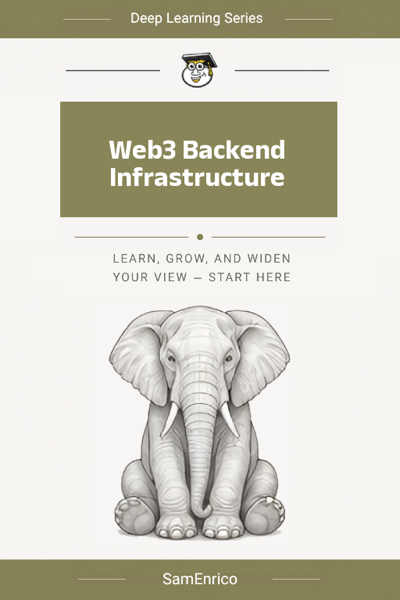
Non-FictionInformativeEducational
Web3 Backend Infrastructure Audiobook
A Coursebook on Web3 Backend Infrastructure
by Heard Anton
A Coursebook on Web3 Backend Infrastructure
Formats
Free sample
Chapter 1: The Infrastructure Revolution...--The term "Web3" has been used to describe everything from decentralized finance to non-fungible tokens to the metaverse. Venture capitalists have poured billions into the space. Twitter bios are littered with .eth domains. And yet, beneath the buzzwords and the hype, a fundamental question remains persistently, embarrassingly unanswered for most developers: What does the backend of Web3 actually look like?Ask a typical backend engineer to describe the architecture of an e-commerce website, and they will draw you a diagram within minutes. Load balancers, application servers, databases, caching layers, message queues, CDNs.
They know where the state lives (Postgre SQL), where the session data lives (Redis), and where the static assets live (S3). They understand request-response, idempotency, eventual consistency, and the CAP theorem. They have opinions about REST versus Graph QL and strong feelings about database indexing strategies.Ask that same engineer to describe the backend architecture of a Web3 application—say, a decentralized exchange or an NFT marketplace—and you will likely get a different response. They might mention "smart contracts" and "blockchain nodes" and "Meta Mask," but the coherent architecture is missing. The mental models that guided traditional web development—request-response, client-server, database-as-source-of-truth—no longer apply in the same way.
Instead, Web3 introduces new components, new trade-offs, and new infrastructure requirements that most backend engineers have never encountered.This chapter is the foundation for everything that follows. It establishes the core architectural shift from Web2 to Web3, introduces the six-layer Web3 infrastructure stack, surveys the key components you will need to understand, and outlines the unique challenges you will face building production-grade decentralized applications. By the end of this chapter, you will understand how the pieces fit together and where your infrastructure responsibilities begin and end.1.1 From Web2 to Web3: The Infrastructure Shift To understand Web3 infrastructure, you must first understand what changed. The shift is not merely technological; it is architectural and philosophical.The Web2 Backend Model In a traditional Web2 application, the backend is a collection of centralized services controlled entirely by the application owner. A typical architecture includes:Application servers running business logic (Node.js, Python, Java, Go)Relational databases storing application state (Postgre SQL, My SQL)Document or key-value stores for specialized data (Mongo DB, Dynamo DB, Redis)File storage for user-uploaded content (S3, Cloud Storage, Azure Blob)Caching layers for performance (Redis, Memcached, Cloud Front)Message queues for asynchronous processing (Rabbit MQ, Kafka, SQS)Load balancers and CDNs for…
This is the end of the free sample. Get the Audiobook to keep going. Buy now
About this book
Details
- Author
- Heard Anton
- Publisher
- SamEnrico
- Language
- English
- Genre
- Non-Fiction, Informative, Educational
- Released
- 2026-06-02
- Pages (approx.)
- 144
- Available as
- eBook, Audiobook

Listen in the VoxFlicks app
Audiobooks and audio dramas wherever you go. Sign in with your SamEnrico account and press play.
More by Heard Anton
 Napping for Seasonal Affective DisorderHeard Anton$11.99
 Spin Heart Rate TrainingHeard Anton$11.99
 Parent Loss during PregnancyHeard Anton$11.99
 Bipolar Sleep Routine GuideHeard Anton$11.99
 The Manila Street ChildHeard Anton$11.99
 Seeing Other ChildrenHeard Anton$11.99
 Evening Pain MeditationHeard Anton$11.99
 Exam Cramming CourseHeard Anton$11.99
 Boundary Setting For VolunteersHeard Anton$11.99
 Nefertem's Golden Spire: The Architect of CreationHeard Anton$11.99
 The Wolf of Wall Street’s Shadow: The Untold Story of the ‘Pump and Dump’ KingpinHeard Anton$11.99
 The Ghosts of Verdun: The Forgotten Hell of World War IHeard Anton$11.99
You may also like
 Hong Kong Handover 1997Dunn Johnnie$11.99
 Zumba For Postnatal Recovery CourseNeal Christian$11.99
 Zumba for BeginnersLadner Nikia$11.99
 YouTube Comment Mining GuideHumes Pandora$12.99
 Worry Box MeditationCarlin Rudy$11.99
 Workplace Stress MeditationNguyen Lynn$11.99
 Workplace Stress and Sleep RepairHawley Ivory$11.99
 Workplace Perfectionism CureDelaney Jeffry$11.99
 Workplace Injustice Anger GuideWallen Isabelle$11.99
 Work Addiction and Burnout LinkGreenwood Ester$11.99
 Women in Yoga and WellnessBeattie Galina$11.99
 Women in Stand Up ComedyChun Evangeline$11.99