
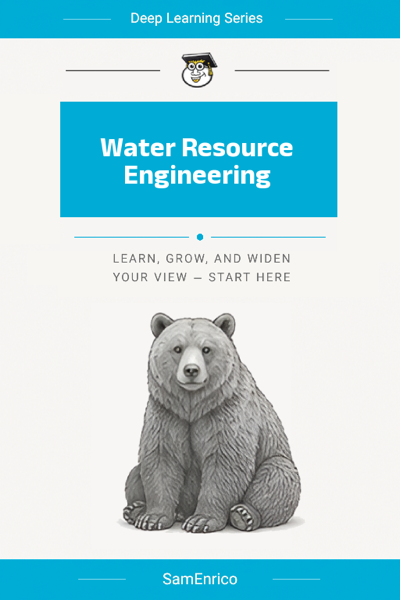
Non-FictionInformativeEducational
Water Resource Engineering eBook
A Coursebook on Water Resource Engineering
A Coursebook on Water Resource Engineering
Formats
Free sample
Chapter 1: The Engineered Cycle--Water flows downhill. This simple observation, known to every human who has ever watched a stream or felt rain on their face, contains the entire seed of water resource engineering. Gravity is both the problem and the solution. It pulls water where we do not want it—flooding our homes, eroding our fields, carrying away the fertile soil we depend upon. Yet gravity also delivers water to our taps, flushes our wastes downstream, and turns the turbines that light our cities.
The engineer’s task is not to fight gravity but to harness it, to work with the fundamental laws of physics while navigating the messy, contested, and utterly human realities of who gets water, when, and how much.Water resource engineering is often described as the application of scientific and mathematical principles to solve problems related to water. This definition, while technically accurate, misses the soul of the profession. A more honest description might be this: water resource engineering is the art and science of managing the planet’s most essential resource under conditions of deep uncertainty. It is about making choices when the future rainfall is unknown, when population growth projections are unreliable, when climate change is shifting the ground beneath every historical assumption, and when the interests of farmers, cities, ecosystems, and industries collide at the edge of a reservoir that holds only so much water.This chapter establishes the foundation upon which the entire coursebook is built. We begin not with equations but with a framework for thinking about water systems as integrated wholes rather than disconnected parts.
We will trace the historical arc of water engineering—from ancient qanats to modern digital twins—to understand how the profession arrived at its current state. We will introduce the hydrologic cycle as the organizing principle that connects every topic in this book, from precipitation to groundwater to treatment to stormwater. And we will confront the uncomfortable truth that water engineering is never purely technical; it is always political, economic, ethical, and deeply embedded in the landscapes and communities it serves.The Hydrologic Cycle: Nature’s Blueprint for Engineering Every engineering intervention in the water sector inserts itself somewhere into the hydrologic cycle. Understanding this cycle is therefore not merely background knowledge but the essential map that guides all design decisions. The hydrologic cycle describes the continuous movement of water above, on, and below the Earth’s surface.
It is powered by solar energy, which drives evaporation, and by gravity, which pulls water downward through the atmosphere, across landscapes, and into groundwater reservoirs.Water evaporates from oceans, lakes, rivers, and wet soil, converting from liquid to vapor and ascending into the atmosphere. Plants contribute to this process through transpiration, drawing water from the soil and releasing it through their leaves. Together, evaporation and transpiration are called evapotranspiration, a term that will appear repeatedly throughout this book. The water vapor condenses into clouds, and when the droplets grow heavy enough, precipitation falls—rain, snow, sleet, or hail.Upon reaching the land surface, precipitation follows one of several pathways. Some water intercepts vegetation or fills small depressions in the ground.
Some evaporates directly back to the atmosphere. Some infiltrates into the soil, where it may be taken up by plant roots, flow laterally through the unsaturated zone, or percolate downward to recharge groundwater aquifers. The remainder becomes runoff, flowing over the land surface toward streams, rivers, and eventually the ocean.This cycle appears simple in description but is maddeningly complex in practice. The fraction of precipitation that becomes runoff, for example, depends on rainfall intensity, soil type, land cover, slope, antecedent soil moisture, and a dozen other factors. An engineer designing a culvert to pass a 100-year flood must make decisions based on statistical models of rainfall that are, at best, imperfect representations of an inherently random natural process.
A water utility planning a new reservoir must forecast water demand decades into the future, knowing that climate patterns are shifting in ways that historical records cannot fully capture.The hydrologic cycle also reveals the fundamental interconnectedness of water systems. Water that infiltrates into the ground today may emerge from a spring months or years from now, supplying baseflow to a stream during a dry period. Pollution dumped into a river upstream becomes someone else’s drinking water downstream. Pumping groundwater for irrigation in one location can reduce streamflow in a completely different watershed by intercepting water that would otherwise have discharged to the surface.This interconnectedness is the central challenge—and the central opportunity—of water resource engineering. No project can be designed in isolation.
Every diversion, every dam, every well, every pipe alters the hydrologic cycle in ways that propagate through the system. The engineer who ignores these connections does so at the peril of the communities and ecosystems that depend on the resulting system.The Historical Evolution of Water Engineering Human societies have engineered water for at least eight thousand years. The earliest known dams, built in present-day Jordan around 3000 BCE, were modest earthen structures designed to divert floodwaters for agriculture. But by the height of the Roman Empire, water engineering had achieved remarkable sophistication. Roman aqueducts, such as the Aqua Claudia completed in 52 CE, stretched dozens of miles, maintaining precise gradients to carry water from mountain springs to urban centers.
The Romans understood the importance of covered channels to prevent contamination, settling tanks to remove sediment, and distribution networks to allocate water among fountains, baths, and private residences. They also built extensive sewer systems, most famously the Cloaca Maxima in Rome, which drained the Forum and carried waste to the Tiber River.After the fall of Rome, water engineering in Europe regressed. Aqueducts fell into disrepair, and urban water supplies became contaminated, contributing to the periodic plagues and diseases that afflicted medieval cities. Meanwhile, other civilizations advanced the field. Persian engineers developed qanats—underground channels that tapped groundwater sources and conveyed water by gravity over long distances, minimizing evaporation losses.
These qanats, some of which remain in use today in Iran and Afghanistan, required extraordinary skill in surveying, excavation, and maintenance. In the Indian subcontinent, stepwells provided access to groundwater while also serving as social gathering places, their intricate architecture reflecting the cultural importance of reliable water. In the Americas, the Ancestral Puebloans built check dams and diversion structures to capture scarce rainfall for maize cultivation, while the Aztecs created chinampas—artificial islands in Lake Texcoco that used an ingenious system of canals and water management to support a dense urban population.The Industrial Revolution transformed water engineering yet again. Rapid urbanization concentrated populations in cities that far exceeded the capacity of traditional water sources. London’s River Thames became an open sewer, and cholera epidemics in 1832, 1848, and 1854 killed tens of thousands.
The 1854 Broad Street cholera outbreak, which physician John Snow traced to a contaminated public well, marked a turning point. Snow’s work demonstrated that cholera was waterborne, not airborne as previously believed, and laid the groundwork for the germ theory of disease. Cities began investing in filtered and chlorinated water supplies, and the modern water treatment plant was born.The twentieth century saw an explosion of large-scale water infrastructure. The U.S. Bureau of…
This is the end of the free sample. Get the eBook to keep going. Buy now
About this book
Details
- Author
- Kidwell Cathi
- Publisher
- SamEnrico
- Language
- English
- Genre
- Non-Fiction, Informative, Educational
- Released
- 2026-06-02
- Pages (approx.)
- 155
- Available as
- eBook, Audiobook

Read better in the ZLOADR app
Your eBooks on your phone or tablet. Sign in with your SamEnrico account and start reading.
More by Kidwell Cathi
 The Shame Resilience GuideKidwell Cathi$11.99
 Survey Text Coding Automation GuideKidwell Cathi$11.99
 LGBTQ Parent Stress GuideKidwell Cathi$11.99
 Mastering Eye Contact GuideKidwell Cathi$11.99
 OCD Intrusive Thoughts WorkbookKidwell Cathi$11.99
 The Silent Witness: The Unsolved Murder of Hae Min LeeKidwell Cathi$11.99
 Breaking Chains: The Unfinished Dream of the Republic of TexasKidwell Cathi$11.99
 Strong Research Proposal Without PubsKidwell Cathi$12.99
 Digital Photo Requirements GuideKidwell Cathi$12.99
 Understanding Caffey DiseaseKidwell Cathi$17.99
 How to Become a Carbon-furnace OperatorKidwell Cathi$11.99
You may also like
 Hong Kong Handover 1997Dunn Johnnie$11.99
 Zumba For Postnatal Recovery CourseNeal Christian$11.99
 Zumba for BeginnersLadner Nikia$11.99
 YouTube Comment Mining GuideHumes Pandora$12.99
 Worry Box MeditationCarlin Rudy$11.99
 Workplace Stress MeditationNguyen Lynn$11.99
 Workplace Stress and Sleep RepairHawley Ivory$11.99
 Workplace Perfectionism CureDelaney Jeffry$11.99
 Workplace Injustice Anger GuideWallen Isabelle$11.99
 Work Addiction and Burnout LinkGreenwood Ester$11.99
 Women in Yoga and WellnessBeattie Galina$11.99
 Women in Stand Up ComedyChun Evangeline$11.99