
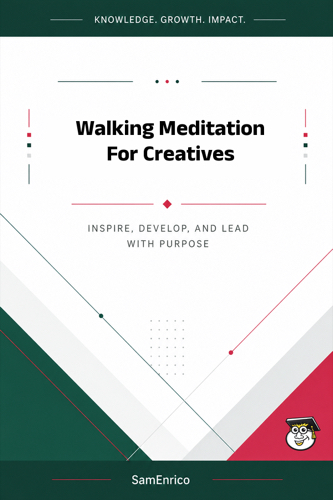
Non-FictionSelf-HelpCreativity
Walking Meditation For Creatives eBook
Unblocking ideas through mindful movement.
by Keller Tomas
Unblocking ideas through mindful movement.
Formats
Free sample
Chapter 1: The Chair Is Lying...--–- You are reading this book because you are stuck. Not the gentle, romanticized version of stuck—the one where an artist gazes wistfully out a rain-streaked window, waiting for a muse to descend like a silk scarf. No. You are experiencing the other kind of stuck. The kind that lives in your sternum like a cold fist.
The kind that makes you open the same document, stare at the same blinking cursor, close the document, check email, open Instagram, close Instagram, open the document again, and then eat something you do not want to eat because at least chewing feels like progress.The desk is supposed to be sacred. That is what they told you. The desk is where discipline meets inspiration. The desk is where you show up, day after day, and do the work. But for you—and for millions of creatives who have internalized this gospel of sedentary suffering—the desk has become a prison.
You sit in your chair. Your body locks down. Your shoulders creep toward your ears. Your jaw tightens. And your mind, sensing that your body has stopped moving, interprets this stillness not as a signal to focus but as a signal to survive.The mind thinks: If we are sitting this still, something must be hunting us.And then the voice starts.THE VOICE THAT LIVES IN YOUR CHAIRLet us name this voice.
Throughout this book, we will call it the Critic. The Critic is not your enemy—not exactly. The Critic is a protective mechanism that evolved to keep you safe from social rejection, from failure, from the terrifying vulnerability of making something new and showing it to other people. The Critic whispers: That idea is stupid. Someone else already did it better.
You are not a real artist. Who do you think you are? Wait until you have more training. Wait until you have more time. Wait until you are less tired.
Just wait.The Critic is loudest when you are still.Think about that for a moment. When are you most vulnerable to the Critic? When you are lying in bed at 3:00 AM, unable to sleep. When you are sitting in a waiting room with nothing to distract you. When you are at your desk, alone with your thoughts, facing a blank page or an empty canvas or a silent instrument.
Stillness amplifies the Critic because stillness signals to your ancient nervous system that you are in a state of vigilance. Sitting meditation, for many creatives, does not produce calm—it produces an unbearable amplification of self-judgment. You sit. You try to breathe. And the Critic says: You are even bad at sitting.
Look how restless you are. Look how you cannot keep your eyes closed. You are a failure at meditation just like you are a failure at everything else.This is not a personal failing. This is biology.The research on what we might call "kinesthetic intelligence" (a term borrowed from educational psychology but extended here to creative practice) suggests that for a significant subset of the population—perhaps the majority of people who identify as "creatives"—the body and mind do not operate in sequence. They operate in parallel.
Your thoughts are not separate from your posture. Your creative flow is not independent of your gait. When you lock your body in a chair, you do not free your mind to wander. You trap your mind in a box with the Critic.THE DESK BLOCK IS A BODY PROBLEMHere is the central argument of this chapter, and really of this entire book: The desk block is not a mind problem. It is a body problem.We have been trained to think of creativity as something that happens between the ears.
We imagine the tortured genius in the garret, the novelist chain-smoking at the typewriter, the composer hunched over the piano at 2:00 AM. These images are romantic, but they are also pathological. They teach us that suffering is necessary, that stillness is virtuous, that the body is merely a vehicle for transporting the brain to the desk.But what if the opposite were true? What if creativity is a full-body intelligence?Consider the evidence. Studies in embodied cognition have demonstrated that the act of walking—specifically, the rhythmic, bilateral stimulation of alternating footsteps—changes the brain's electrical activity.
The brain shifts from high-beta waves (associated with anxiety, rumination, and the Critic's voice) to alpha waves (associated with relaxed alertness, daydreaming, and the kind of diffuse attention that produces novel associations). This is not metaphor. This is measurable.When you walk, your brain releases a different chemical cocktail than when you sit. The neurotransmitters involved in stress (cortisol, norepinephrine) decrease. The neurotransmitters involved in exploratory behavior (dopamine, serotonin) increase.
Your body is literally telling your brain: We are moving. We are safe. We are looking for resources. It is okay to play now.Sitting tells your brain: We are hiding. We are waiting.
Stay alert. Do not make noise. Do not attract attention.One of these states is conducive to creativity. The other is conducive to survival. They are not the same thing.THE MYTH OF THE STILL MEDITATORWe must address a sacred cow early in this book: the assumption that meditation requires stillness.The Buddhist tradition from which modern mindfulness practices are derived includes a wide range of postures: sitting, standing, lying down, and walking.
In fact, walking meditation (kinhin in Zen Buddhism) is considered by many teachers to be the more advanced practice, precisely because it requires maintaining awareness while the body is in motion. Sitting meditation can become a form of dissociation—a withdrawal from the world. Walking meditation keeps you engaged with your environment while training your attention.The problem is that when mindfulness migrated to the West, it lost its walking shoes. We got the cross-legged, eyes-closed, silent retreat version. We got the app with the calming voice.
We got the expectation that if we just sat still long enough, we would achieve some kind of mental nirvana.For many creatives, this expectation sets up a cruel feedback loop:You sit to meditate.The Critic gets louder.You assume you are meditating incorrectly.You try harder to sit still.The Critic gets even louder.You conclude that you are broken.You are not broken. You are just a kinesthetic creative. You think with your feet. You process emotion through movement. You solve problems by pacing.
The chair is not your ally—it is the Critic's throne.THE POSTURE SCAN: YOUR FIRST MOVING ANCHORLet us begin with a practice. Not a philosophy. Not a theory. A practice.This first walking meditation is called the Posture Scan. It lasts five minutes.
It is deliberately simple. Its only goal is to establish what I call a moving anchor—a physical sensation you can return to when the Critic starts talking.Here is how you do it:Step One: Find a path. This can be a hallway in your apartment, a sidewalk outside your building, a parking lot, a park, a quiet office corridor, or even a large room where you can walk back and forth. The path does not need to be…
This is the end of the free sample. Get the eBook to keep going. Buy now
About this book
Details
- Author
- Keller Tomas
- Publisher
- SamEnrico
- Language
- English
- Genre
- Non-Fiction, Self-Help, Creativity
- Released
- 2026-06-09
- Pages (approx.)
- 131
- Available as
- eBook, Audiobook

Read better in the ZLOADR app
Your eBooks on your phone or tablet. Sign in with your SamEnrico account and start reading.
More by Keller Tomas
 Narrative Therapy GriefKeller Tomas$11.99
 Conversation Starters for New WidowsKeller Tomas$11.99
 GAD And Holiday StressKeller Tomas$11.99
 Desert Night Sky RelaxationKeller Tomas$11.99
 Workaholic Cardiovascular RiskKeller Tomas$11.99
 Lavender Oil AnxietyKeller Tomas$11.99
 Feedback Delivery MasteryKeller Tomas$11.99
 The Djinn’s Bargain: Lessons from the Smoke and FireKeller Tomas$11.99
 Quetzalcoatl's Celestial Spire: The Feathered Serpent's AscentKeller Tomas$11.99
 How to Start a Electronic Shopping BusinessKeller Tomas$11.99
 How to Produce HerbsKeller Tomas$11.99
 A Collector's Handbook to the Fiat Nuova 500Keller Tomas$11.99
You may also like
 Hong Kong Handover 1997Dunn Johnnie$11.99
 Zumba For Postnatal Recovery CourseNeal Christian$11.99
 Zumba for BeginnersLadner Nikia$11.99
 YouTube Comment Mining GuideHumes Pandora$12.99
 Worry Box MeditationCarlin Rudy$11.99
 Workplace Stress MeditationNguyen Lynn$11.99
 Workplace Stress and Sleep RepairHawley Ivory$11.99
 Workplace Perfectionism CureDelaney Jeffry$11.99
 Workplace Injustice Anger GuideWallen Isabelle$11.99
 Work Addiction and Burnout LinkGreenwood Ester$11.99
 Women in Yoga and WellnessBeattie Galina$11.99
 Women in Stand Up ComedyChun Evangeline$11.99