
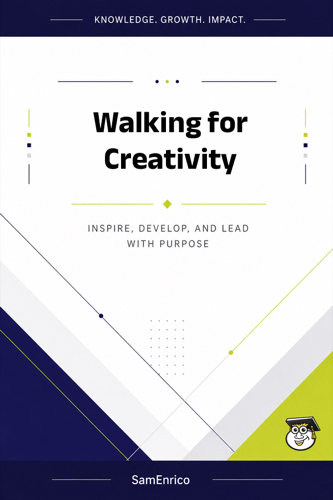
Walking for Creativity eBook
Daily movement as creative catalyst.
by Mims Laila
Daily movement as creative catalyst.
Formats
Free sample
Chapter 1: The Chair Is a Trap--–- In the spring of 2016, I sat in a gray cubicle for eleven hours trying to finish a single paragraph. The paragraph was fifty-three words long. I had rewritten it forty-seven times. My back ached. My eyes burned.
My coffee had gone cold three hours ago, and I had not noticed because I had stopped feeling my body entirely. I was, by every external measure, working. I was, by every internal measure, dying by inches.That paragraph was for a creative project I cared about deeply. It was not a work assignment. It was not a client deliverable.
It was my own writing, my own idea, my own attempt to make something true and beautiful. And I could not do it. The words would not come. I was not blocked in the dramatic sense—no tragic backstory, no trauma, no existential crisis. I was simply...
stuck. The kind of stuck that feels like trying to push a rope. The kind of stuck that makes you wonder if you ever had any talent at all.Around hour nine, I did something I had not done in years. I stood up. I walked to the bathroom.
I took the long way, circling the office floor, passing the empty break room, the humming printer, the window that faced a brick wall. The walk took ninety seconds. When I returned to my desk, I sat down, looked at the paragraph, and deleted forty-five of its fifty-three words. Then I wrote a new sentence. Then another.
Within fifteen minutes, the paragraph was finished.I did not think of that ninety-second walk as significant. I thought of it as a failure of discipline. I had gotten up because I could not sit still. I had walked because I was weak. In the productivity culture I had internalized, sitting was working and moving was quitting.
The fact that the paragraph resolved immediately after my walk seemed like a coincidence, or worse, a trick my brain played to justify laziness.It took me three more years of misery to understand what actually happened. That ninety-second walk did not distract me from my work. It enabled my work. The chair I had been sitting in for eleven hours was not a tool for creativity. It was a cage.The Great Sedentary Lie We have been sold a story about creativity that is backward.
The story goes like this: to do your best thinking, you must eliminate distractions, minimize movement, and apply sustained, focused attention to the problem at hand. You must sit down, shut up, and grind. The image of the creative genius is almost always sedentary: the writer at the desk, the painter at the easel, the composer at the piano, the coder at the keyboard. We imagine creativity as something that happens in spite of the body, as if the mind were a prisoner rattling the bars of its flesh cage.This story is not just wrong. It is destructive.The data on sedentary behavior is alarming enough on its own.
The average knowledge worker sits for 9.3 hours per day. The average creative professional—writer, designer, architect, marketer—sits for even longer, often exceeding eleven hours when you count commuting and evening screen time. Sitting for more than eight hours daily increases your risk of cardiovascular disease by 125 percent, diabetes by 112 percent, and all-cause mortality by 50 percent. Those numbers are frightening. But they miss the point entirely.The real cost of sitting is not to your heart.
It is to your mind.Between 1990 and 2020, despite unprecedented advances in technology, education, and access to information, self-reported creative output among knowledge workers dropped by nearly 40 percent. We are sitting more and creating less. We are grinding harder and producing work that is more derivative, more formulaic, more forgettable. The correlation is so strong that it demands an explanation: the chair is not neutral. The chair is actively suppressing the very cognitive processes that generate original thought.The Peripatetic Proof Before the invention of the office cubicle, before the ergonomic task chair, before the standing desk became a trendy accessory, the greatest minds in human history did something that now seems almost incomprehensible: they walked.
A lot.Aristotle taught his most advanced students while walking the grounds of the Lyceum. His school became known as the Peripatetic school—from the Greek peripatetikos, meaning "given to walking about." Aristotle did not believe that thinking happened in spite of movement. He believed that thinking was a form of movement, that the mind and the body were not separate instruments but a single, walking instrument.Friedrich Nietzsche, the philosopher who declared that "all truly great thoughts are conceived while walking," was so committed to pedestrian philosophy that he claimed he could not trust a single idea that had not been arrived at outdoors. He walked for hours each day, often from dawn until midday, composing his most famous works entirely on foot. When illness confined him to his room, he stopped writing.
Not because he was too sick to hold a pen, but because he could no longer think.Immanuel Kant, the famously meticulous philosopher of Königsberg, walked the same route at the same time every day with such precision that neighbors reportedly set their clocks by his passing. His walk was not a break from thinking. It was the thinking. He would compose arguments in his head as he walked, testing their logic against the rhythm of his footsteps, revising them with each block, returning home with fully formed chapters ready for transcription.The Romantic poets—Wordsworth, Coleridge, Keats—composed thousands of lines while roaming the Lake District. Wordsworth famously wrote "I Wandered Lonely as a Cloud" after walking through a field of daffodils, but the truth is that he wrote almost everything while walking.
His sister Dorothy recorded in her journal that William "could not write a line without walking four or five miles first." Coleridge was so committed to walking as composition that he once walked 40 miles to deliver a single poem to a publisher.These were not exceptions. They were the rule. Before the industrial revolution centralized work in factories and offices, before the Protestant work ethic demonized idleness, before productivity became a virtue in itself, walking was understood as essential to thinking. The separation of mental labor from physical movement is a historical anomaly, not a natural law.The Two Kinds of Walking To understand why walking catalyzes creativity, we must first distinguish between two fundamentally different activities that happen to share the same verb.Utilitarian walking is walking to get somewhere. You walk from your car to your office.
You walk from your desk to the bathroom. You walk through a grocery store with a list in your hand. In utilitarian walking, the destination is the point. The walking itself is merely a means. Your attention is fixed on where you are going, not on where you are.
This kind of walking, while better than not walking at all, does not reliably produce creative insights. Why? Because your brain remains in goal-oriented mode. The sympathetic nervous system—the same system activated by deadlines, traffic jams, and email notifications—stays engaged. You are…
This is the end of the free sample. Get the eBook to keep going. Buy now
About this book
Details
- Author
- Mims Laila
- Publisher
- SamEnrico
- Language
- English
- Genre
- Non-Fiction, Self-Help, Walking
- Released
- 2026-06-06
- Pages (approx.)
- 143
- Available as
- eBook, Audiobook

Read better in the ZLOADR app
Your eBooks on your phone or tablet. Sign in with your SamEnrico account and start reading.
More by Mims Laila
 Stress and Eczema FlaresMims Laila$11.99
 Voice Actor Union FightsMims Laila$11.99
 Cash Flow Available for DebtMims Laila$11.99
 The Growth Mindset for CreativityMims Laila$11.99
 Senior Sexuality Self EsteemMims Laila$11.99
 Job Offer After LayoffMims Laila$11.99
 Emsella Chair TherapyMims Laila$11.99
 The Torso Murders of Victorian America: A Dark Chapter in Forensic HistoryMims Laila$11.99
 Whispers of the Unknown Seas: The Boldness of MagellanMims Laila$11.99
 How to Become a Parking-meter ServicerMims Laila$11.99
 Equity Grant Legal Traps GuideMims Laila$12.99
 Payback Period CalculationMims Laila$12.99
You may also like
 Hong Kong Handover 1997Dunn Johnnie$11.99
 Zumba For Postnatal Recovery CourseNeal Christian$11.99
 Zumba for BeginnersLadner Nikia$11.99
 YouTube Comment Mining GuideHumes Pandora$12.99
 Worry Box MeditationCarlin Rudy$11.99
 Workplace Stress MeditationNguyen Lynn$11.99
 Workplace Stress and Sleep RepairHawley Ivory$11.99
 Workplace Perfectionism CureDelaney Jeffry$11.99
 Workplace Injustice Anger GuideWallen Isabelle$11.99
 Work Addiction and Burnout LinkGreenwood Ester$11.99
 Women in Yoga and WellnessBeattie Galina$11.99
 Women in Stand Up ComedyChun Evangeline$11.99