
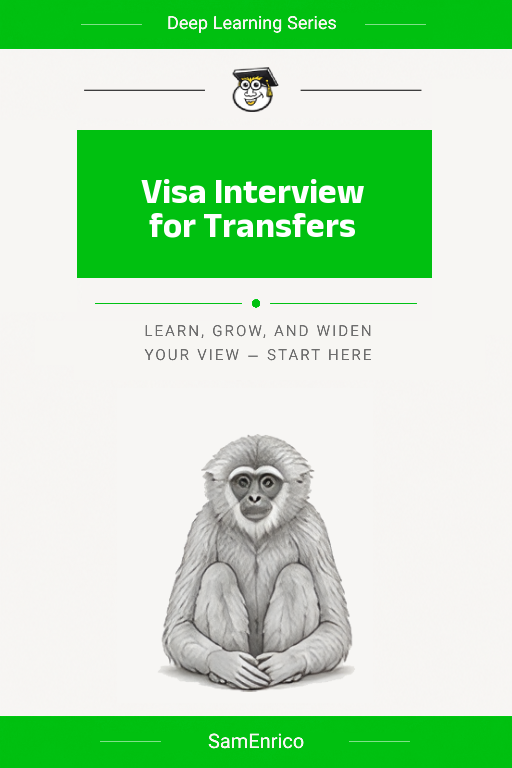
Non-FictionStudent's ShortcutTransfer
Visa Interview for Transfers eBook
Explain reasons for transferring universities or c
Explain reasons for transferring universities or countries without raising red flags.
Formats
Free sample
Chapter 1: The Narrative Trap...--Every year, tens of thousands of transfer students walk into consular interviews with perfect documents, full bank accounts, and genuine acceptance letters—only to hear three words that shatter their plans: "Not approved today." If you ask these students what went wrong, most will say the same thing: "I told the truth. I don't understand what happened."Here is what the officer saw that the student did not.The student explained that their first university was a poor fit. They talked about the large class sizes, the lack of research opportunities, the professor who left mid-semester, the city that felt isolating. Every word was true. Every word was also a red flag.
The officer did not hear a student making a strategic career move. The officer heard someone who complains when things get difficult, someone who leaves when disappointed, someone who might do the same thing again—in their country.This is the Narrative Trap. You walk in believing you are explaining a logical decision. The officer walks away believing you are describing a pattern of instability. The gap between your intention and their interpretation is where visa applications go to die.This chapter will dismantle that gap completely.
By the time you finish reading, you will understand exactly how consular officers think about transfer students, why your first visa approval actually works against you in a transfer interview, and—most importantly—how to rebuild your story so that every "I left" becomes "I advanced."Welcome to the hidden curriculum of the transfer visa interview. Nothing in this chapter is about lying. Everything in this chapter is about framing.The Three Silent Assumptions Every Officer Makes Before you say a single word, the officer already has a hypothesis about you. It is not personal. It is not fair.
It is simply the result of processing thousands of transfer files and watching the same patterns lead to the same outcomes.Consular officers are not psychologists, but they are world-class pattern recognizers. They see a transfer application and immediately test it against three silent assumptions. Learn these assumptions now, because every answer you give will either confirm or disprove them.Assumption One: The Academic Drifter The first assumption is that transfer students lack direction. The officer looks at your transcript and sees a trail of institutions. They ask themselves: Did this student start something and fail to finish?
Did they change majors without a clear through-line? Are they collecting credits like stamps rather than building toward a degree?Consider two students. Student A attended Community College for two years, transferred to a state university for one semester, then applied to a private university. Student B attended the same community college for two years, completed an Associate's degree, and transferred directly to the private university for a bachelor's program that specifically articulates with their Associate's credits.On paper, these students have similar timelines. But in the officer's mind, Student A looks like a drifter—moving without a clear reason, leaving a program unfinished.
Student B looks like a strategist—completing a milestone before advancing.The Academic Drifter assumption is not about the number of schools you have attended. It is about whether each move makes demonstrable progress toward a clear goal. If your transfer story sounds like "I wanted to try something different," you are a drifter. If it sounds like "I completed X, which qualified me for Y, which is the only path to Z," you are a strategist.The difference is narrative, not reality. Two students with identical transcripts can receive opposite outcomes based entirely on how they frame their journey.Assumption Two: The Immigration Hacker The second assumption is darker.
Officers are trained to spot applicants who use student visas as a backdoor to permanent residence. For transfer students, this suspicion is magnified because you have already demonstrated a willingness to change institutions. The officer's logic chain goes like this: If you left your home country for School A, and then left School A for School B, what is to stop you from leaving School B for a job? For a marriage? For any reason that lets you stay?This assumption is why multiple transfers within a short timeframe trigger automatic scrutiny.
The officer is not trying to punish you for moving. They are trying to determine whether your moves are academically motivated or immigration-motivated.Here is the hard truth: mentioning future work opportunities can trigger this assumption immediately. In some high-fraud consulates, even saying the words "Optional Practical Training" or "post-graduation work permit" will end the interview. The officer hears immigration intent, not academic ambition.The Immigration Hacker assumption is neutralized not by promising you will leave—everyone promises that—but by showing that your academic path has a natural, logical conclusion that is not tied to work authorization. The strongest transfer applications focus exclusively on academic resources: specific labs, particular professors, unique facilities, accreditation that the old school lacked.
When you talk about jobs, you sound like a hacker. When you talk about education, you sound like a student.Assumption Three: The Unprepared Candidate The third assumption is the most painful because it targets your competence. The officer looks at your previous institution and asks: Why did this student leave? If you had good grades and a stable record, the assumption is weaker. But if you had any academic struggles—a low grade here, a dropped class there, a semester with reduced course load—the officer assumes you are running from failure rather than running toward success.This assumption is incredibly difficult to overcome because it feels like an attack on your character.
Your instinct will be to defend yourself: "I didn't fail, the professor was unfair," or "I had personal problems that semester." Every defensive word makes you look more guilty. The officer is not asking for an excuse. They are asking for evidence that you can handle the new program.The only effective response is to redirect attention to the future. "I struggled initially in an environment without sufficient support. I have since researched the new program's resources—specifically [X, Y, Z]—and confirmed they address exactly what I needed." This answer acknowledges the past without dwelling on it and, crucially, provides concrete evidence that the same problem will not recur.The Unprepared Candidate assumption is neutralized by proof, not promises.
A letter from a professor at your previous institution stating that you have the ability to handle rigorous coursework is worth more than an hour of verbal explanation. Documents speak when your voice would sound defensive.Why Your First Visa Approval Is Working Against You Here is a paradox that most transfer applicants never consider: your first successful visa application is now evidence against you.When you first applied for a student visa, you made certain promises. You promised to study at a specific institution. You promised to maintain full-time enrollment. You promised to return home after your studies.
The officer approved you based on those promises.Now you are standing in front of a different officer, asking to change the terms of that agreement. The new officer will pull up your first application and compare your current story to your original…
This is the end of the free sample. Get the eBook to keep going. Buy now
About this book
Details
- Author
- Westmoreland Oralia
- Publisher
- SamEnrico
- Language
- English
- Genre
- Non-Fiction, Student's Shortcut, Transfer
- Released
- 2026-05-30
- Pages (approx.)
- 157
- Available as
- eBook, Audiobook

Read better in the ZLOADR app
Your eBooks on your phone or tablet. Sign in with your SamEnrico account and start reading.
More by Westmoreland Oralia
 Peach Kucha PresentationWestmoreland Oralia$11.99
 Business Credit for Salons SpasWestmoreland Oralia$11.99
 Self Esteem During RestructuringWestmoreland Oralia$11.99
 Introvert Friendship GuideWestmoreland Oralia$11.99
 Castration as Spiritual PurificationWestmoreland Oralia$11.99
 Road Rage Success StoriesWestmoreland Oralia$11.99
 Growth Mindset for ParentsWestmoreland Oralia$11.99
 Forgiveness After Job LossWestmoreland Oralia$11.99
 The Wall Street Whisperer: Ivan Boesky and the Birth of Modern Insider TradingWestmoreland Oralia$11.99
 How to Start a Coated or Cored Wire Business (Beginners Guide)Westmoreland Oralia$11.99
 How to Produce Tripods and MonopodsWestmoreland Oralia$11.99
 A Collector's Handbook to the Jaguar E-type 4.2-litre 2+2Westmoreland Oralia$11.99
You may also like
 Hong Kong Handover 1997Dunn Johnnie$11.99
 Zumba For Postnatal Recovery CourseNeal Christian$11.99
 Zumba for BeginnersLadner Nikia$11.99
 YouTube Comment Mining GuideHumes Pandora$12.99
 Worry Box MeditationCarlin Rudy$11.99
 Workplace Stress MeditationNguyen Lynn$11.99
 Workplace Stress and Sleep RepairHawley Ivory$11.99
 Workplace Perfectionism CureDelaney Jeffry$11.99
 Workplace Injustice Anger GuideWallen Isabelle$11.99
 Work Addiction and Burnout LinkGreenwood Ester$11.99
 Women in Yoga and WellnessBeattie Galina$11.99
 Women in Stand Up ComedyChun Evangeline$11.99