
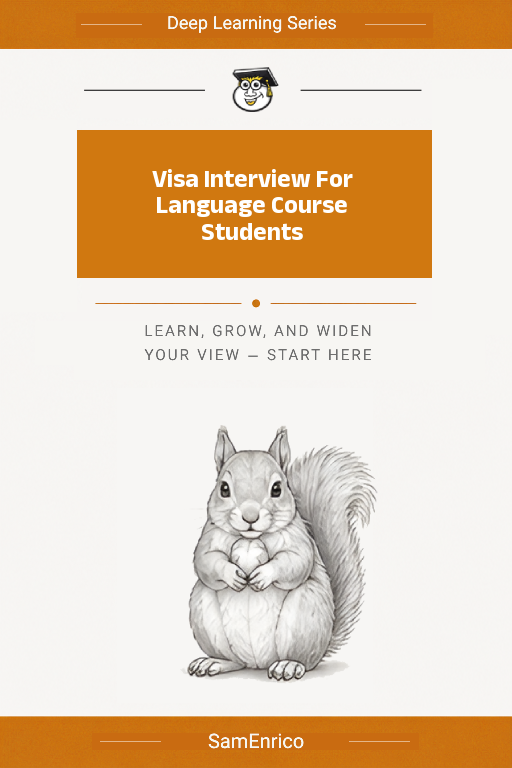
Visa Interview For Language Course Students eBook
Justify studying English in native country and sho
Justify studying English in native country and show how language school fits career goals.
Formats
Free sample
Chapter 1: The Unasked Question...--The visa officer looks up from your application. Her expression is neutral, almost bored. She has already reviewed twenty-seven files this morning. She will review forty more before lunch. Your heart is pounding.
You have practiced your answers for weeks. You know your school’s name, your course duration, your housing address. You have bank statements, enrollment letters, and a carefully rehearsed smile.Then she asks the question that ends more language course visa applications than any other.“Why do you need to go to our country to learn English? You have English schools at home, don’t you?”In that moment, everything you prepared feels useless. You stammer something about “better education” or “immersion” or “opportunities.” She nods, types for seven seconds, and hands you a refusal slip.
The entire interview lasted ninety seconds. You never even showed her your bank statements.This chapter exists because that scenario happens every single day at embassies around the world. And almost every single refusal shares the same root cause: the applicant answered the wrong question. They prepared for “Tell me about your course” when the officer was really asking “Why should I believe you will come back?”The Unasked Question Behind every visa interview question lies a deeper question that the officer never says out loud. Your job is not to answer the surface question.
Your job is to answer the unasked one.When the officer asks “Why study here?” the unasked question is: “Why are you different from the hundreds of applicants who used a language course as a cheap way to enter our country and never left?”When the officer asks “What will you do after the course?” the unasked question is: “What is pulling you back home so strongly that I can bet my career on your departure?”When the officer asks “Who is paying for this?” the unasked question is: “Is this a vacation disguised as education, or are real people investing in a real career outcome?”Every applicant who gets rejected answers the surface question. Every applicant who gets approved answers the unasked one.This entire book is built on that single distinction. But before we build anything, you must understand why most language course applicants fail before they utter a single word.The Language Course Paradox You are about to attempt something genuinely difficult. Not because you are unqualified, but because you are trying to convince a government official that you will spend thousands of dollars to learn something you could theoretically learn for free on You Tube.Think about that from the officer’s perspective.A local English tutor costs ten to twenty dollars per hour. A language course abroad costs ten to twenty thousand dollars including tuition, housing, flights, and living expenses.
The officer knows this math better than you do. So every time you say “I want to learn English,” their internal calculator starts running: “This person is paying a ten thousand dollar premium for something they could get at home. That premium is not paying for education. That premium is paying for a visa.”This is the Language Course Paradox: the very thing that makes international study valuable (immersion, cultural exposure, real-world practice) is the same thing that makes visa officers suspicious (expense, distance from home, lack of structural oversight).A university student has a four-year degree program, a campus, a graduation date, and often a home-country job market that values foreign degrees. Those are structural reasons to return home.
A language course student has none of that. A six-week or six-month program has no degree at the end. No campus is tracking your attendance after week three. No employer is waiting with a promotion unless you prove it first.You are not applying for the same visa as a university student. You are applying for a visa category that officers view as the highest-risk, lowest-accountability option available.And yet, thousands of language course students are approved every year.
What do they do differently?They answer the unasked question before it is asked.The Three Fatal Assumptions Most applicants walk into the visa interview carrying three assumptions that guarantee failure. These assumptions feel logical, even wise, but they are deadly.Assumption One: “If I show strong financial proof, they will approve me.”Money alone never convinced any officer. Bank statements prove you can afford the trip. They do not prove you will leave. In fact, a large bank account can work against you.
If an officer sees fifty thousand dollars in savings and a six-month language course, they think: “This person could easily disappear and live on that money for two years.”What officers actually want is not wealth. They want evidence that your financial life is anchored at home. A modest but steady salary from a home-country employer is more valuable than a rich uncle’s gift. A monthly rent payment on a home-country apartment is more valuable than a paid-in-full housing receipt abroad.Assumption Two: “If I show my enrollment letter and course schedule, they will see I am a serious student.”An enrollment letter proves you paid a school. It does not prove you will attend.
Officers have seen thousands of applicants who enrolled, attended for two weeks, then disappeared into the local economy. The letter is paperwork. What matters is why this specific course matters to your specific future.A serious student does not say “I want to improve my English.” A serious student says “I need to learn how to write technical reports in English because my home-country engineering firm just won a contract with a German client, and I am the only employee who can learn this skill before the deadline.”The first statement is about the course. The second statement is about a career, a deadline, and a home-country obligation. One gets approved.
The other does not.Assumption Three: “If I am honest about my plans, they will respect me.”Honesty is not the problem. Vagueness is. When you say “I plan to return home after my course and look for a job,” you are being honest. You are also being useless to the officer. “Look for a job” is not a plan.
It is a hope. Hopes do not expire. Hopes do not have flight dates. Hopes do not convince anyone.The officer needs to hear: “I will return on June 15th. On June 18th, I will restart my position as logistics coordinator at ABC Trading.
My employer has already confirmed this in writing. On July 1st, I will begin using my new English skills to handle correspondence with our UK distributor.”That is not a hope. That is a calendar. And calendars are believable.The Bridge Narrative Throughout this book, you will encounter a concept called the Bridge Narrative. It is the single most important idea in these pages, and you must internalize it before your interview.The Bridge Narrative is a simple mental model: the target country is not your destination.
It is a bridge. You are crossing that bridge to acquire something specific, and then you are crossing back to use it. Your entire life’s momentum is on the far side of the bridge – in…
This is the end of the free sample. Get the eBook to keep going. Buy now
About this book
Details
- Author
- Jacoby Cherelle
- Publisher
- SamEnrico
- Language
- English
- Genre
- Non-Fiction, Student's Shortcut
- Released
- 2026-06-01
- Pages (approx.)
- 136
- Available as
- eBook, Audiobook

Read better in the ZLOADR app
Your eBooks on your phone or tablet. Sign in with your SamEnrico account and start reading.
More by Jacoby Cherelle
 The Freelance Skill Crossover GuideJacoby Cherelle$11.99
 First Week After Job Loss GuideJacoby Cherelle$11.99
 IBS Support Group GuideJacoby Cherelle$11.99
 Conner Peterson Legal LegacyJacoby Cherelle$11.99
 Assertiveness in Text MessagesJacoby Cherelle$11.99
 The Distraction Free Phone Setup WorkbookJacoby Cherelle$11.99
 Scripting RecordingsJacoby Cherelle$11.99Scripting RecordingsJacoby Cherelle$11.99
 Cervical Radiculopathy Pain ExercisesJacoby Cherelle$11.99
 Buffett PartnershipJacoby Cherelle$11.99
 Hellfighters' Last Stand: The Forgotten Battle of Chateau-ThierryJacoby Cherelle$11.99
 The Silent Coup: How a 1973 Typo Changed the WorldJacoby Cherelle$11.99
You may also like
 Hong Kong Handover 1997Dunn Johnnie$11.99
 Zumba For Postnatal Recovery CourseNeal Christian$11.99
 Zumba for BeginnersLadner Nikia$11.99
 YouTube Comment Mining GuideHumes Pandora$12.99
 Worry Box MeditationCarlin Rudy$11.99
 Workplace Stress MeditationNguyen Lynn$11.99
 Workplace Stress and Sleep RepairHawley Ivory$11.99
 Workplace Perfectionism CureDelaney Jeffry$11.99
 Workplace Injustice Anger GuideWallen Isabelle$11.99
 Work Addiction and Burnout LinkGreenwood Ester$11.99
 Women in Yoga and WellnessBeattie Galina$11.99
 Women in Stand Up ComedyChun Evangeline$11.99