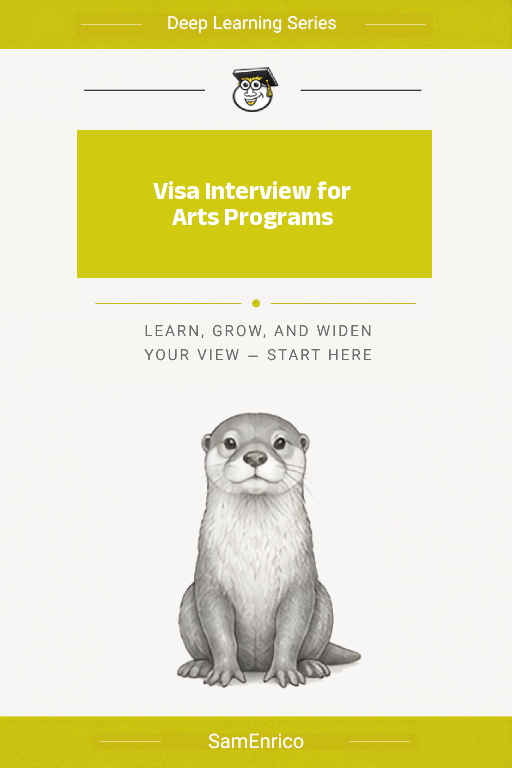
Visa Interview for Arts Programs eBook
Discuss portfolios, auditions, and creative career
Discuss portfolios, auditions, and creative career paths convincingly for arts degrees.
Formats
Free sample
Chapter 1: The 90-Second Rejection--A young pianist from Seoul sat across from me. Juilliard acceptance letter in hand. Full scholarship. Fourteen years of lessons. Her fingers had performed at Carnegie Hall's smaller stage just six months earlier.
She was, by every artistic metric, extraordinary.I asked her three questions."Tell me about your art."She said: "Music is my life. I want to share beauty with the world.""Why the United States? Why not study in Korea?"She said: "Because Juilliard is the best. Everyone knows that.""What will you do after graduation?"She said: "I hope to perform. Maybe stay.
I'm not sure yet. Whatever opportunities come."Ninety seconds after she sat down, I stamped her visa denied. She cried. I felt terrible. But I had no choice.She had given me zero evidence of ties to Korea.
Zero career logic. Zero plan to return. She spoke the language of inspiration, emotion, and hope. I was required to speak the language of intent, structure, and immigration risk. We were not having the same conversation.I am not a villain.
I was a visa officer. And I am writing this book because I have watched thousands of brilliant artists—painters, dancers, actors, designers, filmmakers—walk into interview rooms and fail for exactly the same reason. Not lack of talent. Not lack of acceptance letters. Not lack of scholarships.Lack of translation.The Myth That Destroys Artists Every year, tens of thousands of arts students apply for visas to study in the United States, United Kingdom, Canada, Australia, and the European Union.
A significant percentage of them are rejected. And almost every single one of them is shocked."But I got into Juilliard," they say. "But I have a scholarship," they say. "But my portfolio won awards," they say.None of that matters to a visa officer.Here is the truth that no admissions counselor will tell you: Art schools and embassies operate on completely opposing value systems. They are not on the same team.
They do not share the same goals. What makes you a compelling applicant to a conservatory makes you a suspicious applicant to a consulate.Let me break this down.Art schools—whether Juilliard, RISD, RADA, Cal Arts, or any other prestigious institution—reward risk. They want students who push boundaries, who experiment, who subvert expectations, who explore uncomfortable truths, who fail boldly and learn from failure. Their admissions essays ask about your "artistic journey," your "voice," your "passion." They want to hear about struggle, discovery, and transformation.Embassies reward predictability. They want students who follow rules, who have clear plans, who can demonstrate that they will not become immigration problems.
A visa officer's job is not to curate genius. It is to protect their country's borders while admitting genuine students. They are not looking for the next Picasso. They are looking for someone who will attend class, pay their bills, and leave when their degree is finished.These two value systems are not merely different. They are actively opposed.When you speak the language of art schools—"explore," "discover," "find my voice," "take risks," "see where my creativity leads"—you trigger every alarm bell in a visa officer's mind.
We hear those words and translate them automatically into visa-speak: "I have no plan. I will not leave. I am a risk."That pianist from Seoul? She was brilliant. But she answered every question as if she were still talking to the Juilliard admissions committee.
She never learned to translate.This book is the translation manual.The Three Pillars of the Arts Visa After reviewing thousands of arts visa cases across multiple countries, I have identified three and only three things that matter to a visa officer. I call them the Three Pillars of the Arts Visa. Every successful application—every single one—addresses all three pillars clearly and convincingly. Every failed application fails at least one.Let me introduce them to you now. These pillars will structure every chapter of this book.
You will see them referenced constantly. By the time you finish reading, you will be unable to look at your application without asking: "Which pillar does this serve?"Pillar One: Bona Fide Student The officer must believe you are a genuine student. Not a tourist. Not an aspiring immigrant using a student visa as a back door. Not someone who applied to a program as a formality while planning to work illegally.What proves this?
Transcripts showing educational progression. Attendance records from previous studies. A coherent story of why you chose this specific program at this specific institution. Evidence that you have the academic and linguistic preparation to succeed.For arts applicants, this pillar is surprisingly tricky. Many artists have unconventional educational backgrounds: gap years, failed programs they abandoned, self-directed study, unaccredited workshops.
These are not automatically disqualifying. But you must address them directly. Hiding a gap year or explaining away a low grade with "I'm just not good at tests" will not work.The officer does not need to be impressed by your educational history. They need to see that you are a real student, not a performance artist who bought an acceptance letter.Pillar Two: Ties to Home Country The officer must believe you will leave after your degree. This is the most common reason arts applicants are refused, and it is the pillar that artists struggle with most.Why?
Because artists often have genuinely weak ties to their home countries. They are young. They may not own property. They may not have full-time jobs waiting for them. Their families may not have businesses they are expected to inherit.
Their art might not be commercially viable at home.But "weak ties" does not mean "no ties." It means you have not documented the ties you do have. And it means you have not built a credible story about your future that requires you to return.The officer does not need to see that you have a golden handcuff to your home country. They need to see that your life, career, and future are more rooted at home than in the host country. That is a much lower bar than most applicants think—but it requires strategic documentation.Pillar Three: Career Logic The officer must believe this specific degree makes sense for your creative career. If a cheaper, shorter, or local option exists, why are you traveling across the world for this one?This pillar is where artists make the most easily fixable mistakes.
They answer with prestige: "Because Juilliard is the best." They answer with emotion: "Because I've always dreamed of studying in London." They answer with vagueness: "Because the facilities are better."None of these answer the actual question. The officer is asking: What gap exists in your home country that this specific program fills?If you cannot name a concrete resource—a specific professor, a particular piece of equipment, a unique industry connection, an accreditation that does not exist at home—then the officer will conclude you are studying abroad for immigration reasons, not educational ones.Notice what is missing from these three pillars? Talent. Creativity. Passion.
Awards. Prestige. Acceptance letters. Scholarships.None of those appear. Not one.That is not because they are irrelevant.…
This is the end of the free sample. Get the eBook to keep going. Buy now
About this book
Details
- Author
- Weathers Taryn
- Publisher
- SamEnrico
- Language
- English
- Genre
- Non-Fiction, Student's Shortcut, Arts
- Released
- 2026-06-01
- Pages (approx.)
- 138
- Available as
- eBook, Audiobook

Read better in the ZLOADR app
Your eBooks on your phone or tablet. Sign in with your SamEnrico account and start reading.
More by Weathers Taryn
 Forgiveness After GriefWeathers Taryn$11.99
 Vulnerability Connection GuideWeathers Taryn$11.99
 Self Esteem for Entry Level RolesWeathers Taryn$11.99
 Road Rage and MarijuanaWeathers Taryn$11.99
 Business Credit for IT ServicesWeathers Taryn$11.99
 Medical Conference SpeakingWeathers Taryn$11.99
 Growth Mindset for ManagersWeathers Taryn$11.99
 The Two Witnesses ProphecyWeathers Taryn$11.99
 The Dragon's Lament: Sigurd's Forgotten BalladWeathers Taryn$11.99
 Sand and Steel: The Desert Romance of Rommel and MontgomeryWeathers Taryn$11.99
 A Collector's Handbook to the Jaguar E-type Series Iii CoupeWeathers Taryn$11.99
 How to Produce TrombonesWeathers Taryn$11.99