
Non-FictionStudent's ShortcutFinances
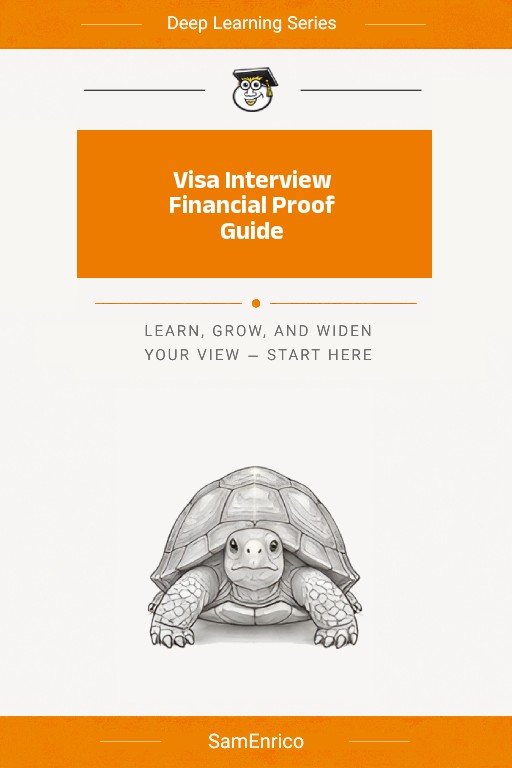
Visa Interview Financial Proof Guide eBook
Show bank statements, sponsor letters, scholarship
Show bank statements, sponsor letters, scholarships, and loan approvals to satisfy visa officers.
Formats
Free sample
Chapter 1: The Suspicion Default--–- Imagine walking into a room where everyone assumes you are guilty until proven innocent. The person behind the glass has been trained to distrust you, to look for your mistakes, to assume your documents are forged and your intentions are impure. This is not paranoia. This is the legal and psychological reality of every visa interview. Visa officers do not start neutral.
They start suspicious. And financial proof is the single most powerful tool you have to flip that default setting from “deny” to “approve.”Most applicants never understand this. They walk into their interviews believing that a large bank balance guarantees approval. They have been told by friends, relatives, and even some consultants that if they can just show enough money—50,000,50,000, 50,000,80,000, $100,000—the officer will stamp their visa without a second thought. This belief, which this chapter will call the Bank Balance Lie, causes more refusals than almost any other single misunderstanding.
A high number in an account does not prove you are trustworthy. It only proves you have access to money. And money, in the hands of a visa officer’s trained eye, can just as easily be evidence of fraud as evidence of wealth.The first step to winning your visa interview is to abandon the Bank Balance Lie and replace it with a more accurate and empowering framework. That framework is the Risk Assessment Model. Once you understand how visa officers actually think—what they fear, what they look for, and what they consider proof of legitimacy—you can structure your financial documents to address their concerns before they even ask.The Presumption of Guilt: Understanding 214(b) and Its Equivalents In the United States, the Immigration and Nationality Act Section 214(b) establishes a legal presumption that every applicant for a non-immigrant visa is an intending immigrant.
The burden of proof is on you, the applicant, to overcome this presumption. This is not a neutral standard. It is explicitly tilted against you.Canada’s Immigration and Refugee Protection Act creates a similar dynamic, though framed differently. Canadian officers are instructed to assess whether the applicant “would leave Canada by the end of the period authorized for their stay.” The default assumption is that they might not. The United Kingdom’s Immigration Rules require applicants to show that they are “genuine students” who will leave at the end of their studies, and officers are trained to scrutinize applications for signs of “contrived” financial evidence.What does this mean in practical terms?
It means the officer starts from a position of distrust. They assume you want to overstay your visa, work illegally, or never return home. Your job during the interview is to provide enough evidence to overcome that presumption. Financial proof is one of the most powerful tools for doing so—not because money itself proves intent, but because a well-documented financial picture shows that you have invested resources in your education, that you have a life and assets to return to, and that you are not desperate enough to risk illegal work.The three specific risks that every visa officer evaluates can be remembered as the Three Threats: unauthorized employment, public charge, and misrepresentation.First, the threat of unauthorized employment. Will you need to work illegally to support yourself?
If your financial proof shows exactly the minimum required amount with no buffer, the officer may conclude that any unexpected expense—a medical bill, a flight home for an emergency, a tuition increase—would force you to seek cash work off the books. Students who work illegally violate the terms of their visa and are subject to deportation. Officers see it as their job to prevent that outcome.Second, the threat of becoming a public charge. Will you run out of money and require government assistance? In the United States, this is a specific ground of inadmissibility.
In Canada and the United Kingdom, similar provisions allow officers to refuse applicants who lack sufficient resources. Your financial proof must demonstrate not just that you have enough for today, but that you have enough for the entire duration of your studies—including periods between academic terms when you cannot work.Third, the threat of misrepresentation. Are you lying about your financial situation? This is the most immediate reason for refusal and often carries the most severe consequences. If an officer spots a fabricated document, a borrowed deposit, an inconsistency between your verbal answers and your written evidence, or any other form of dishonesty, they will refuse you for fraud.
A fraud refusal typically carries a five-year ban on entering the country. In some cases, the ban can be permanent.The 3-Second Rule: How Your Documents Are Actually Reviewed One of the most important concepts in this entire book is the 3-Second Rule. Through analysis of officer training manuals, internal guidance documents obtained through Freedom of Information requests, and interviews with former consular officers from the United States, Canada, and the United Kingdom, we know that a visa officer typically spends only three seconds scanning each financial document before making an initial judgment.Three seconds. That is barely enough time to read a single sentence. It is certainly not enough time to analyze complex financial structures or read lengthy explanations written in small font.
In those three seconds, the officer’s eyes lock onto specific visual cues. Understanding what they look for—and what they ignore—allows you to design your documents for rapid approval.The officer’s eye moves in a predictable pattern. This has been confirmed by eye-tracking studies conducted by multiple immigration authorities. First, they look at the closing balance. Is the number large enough to cover the costs on your I-20, offer letter, or GIC requirement?
Is it a round number like 50,000or50,000 or 50,000or75,000, which suggests a recent deposit rather than organic savings? Is it an odd number like $47,832.47, which suggests legitimate accumulation?Second, they look at the date of the statement. Is it within the required freshness window? For bank statements, that window is 30 days before the interview. For affidavits of support, it is 60 days.
For loan sanction letters, it is 90 days. A document that falls outside these windows triggers immediate suspicion.Third, they look at the account holder’s name. Does it match the name on your passport exactly, including middle names, suffixes like Jr. or Sr., and the order of first and last names? Any discrepancy—even a missing middle initial—can be grounds for refusal.Fourth, they scan for any unusual transactions in the visible portion of the statement.
This includes large deposits made within the last 30 days, withdrawals that appear shortly before the interview date, or transactions that seem inconsistent with the account holder’s profile, such as cash deposits in a salaried employee’s account.Red flags that trigger immediate suspicion include: deposits made within 30 days of the interview, especially round numbers like 10,000,10,000, 10,000,25,000, or $50,000; statements that are more than 30 days old; mismatched names; bank statements printed on plain paper without official letterhead or stamps; statements that show a high balance but no transaction history to support it; and documents that show signs of alteration, whitewashing, or multiple photocopy generations.Green flags that signal legitimacy…
This is the end of the free sample. Get the eBook to keep going. Buy now
About this book
Details
- Author
- Lassiter Sherlene
- Publisher
- SamEnrico
- Language
- English
- Genre
- Non-Fiction, Student's Shortcut, Finances
- Released
- 2026-05-28
- Pages (approx.)
- 142
- Available as
- eBook, Audiobook

Read better in the ZLOADR app
Your eBooks on your phone or tablet. Sign in with your SamEnrico account and start reading.
More by Lassiter Sherlene
 Supplier Diversity Credit BoostLassiter Sherlene$11.99
 The Workplace Emotional RegulationLassiter Sherlene$11.99
 Drug Addiction and ADHDLassiter Sherlene$11.99
 Audiobooks for DriversLassiter Sherlene$11.99
 Self Talk For ParentsLassiter Sherlene$11.99
 Desk Workspace ReviewLassiter Sherlene$11.99
 Eddie Mabo Land RightsLassiter Sherlene$11.99
 Habit Formation for CreativesLassiter Sherlene$11.99
 The Boiler Room Scam: How Britain's Fraudsters Duped the WorldLassiter Sherlene$11.99
 The Jade Serpent’s Lament: A Dragon’s Forgotten VowLassiter Sherlene$11.99
 How to Produce Low-voc Interior PaintLassiter Sherlene$11.99
 Freemium Data Rollover IncentiveLassiter Sherlene$12.99
You may also like
 Hong Kong Handover 1997Dunn Johnnie$11.99
 Zumba For Postnatal Recovery CourseNeal Christian$11.99
 Zumba for BeginnersLadner Nikia$11.99
 YouTube Comment Mining GuideHumes Pandora$12.99
 Worry Box MeditationCarlin Rudy$11.99
 Workplace Stress MeditationNguyen Lynn$11.99
 Workplace Stress and Sleep RepairHawley Ivory$11.99
 Workplace Perfectionism CureDelaney Jeffry$11.99
 Workplace Injustice Anger GuideWallen Isabelle$11.99
 Work Addiction and Burnout LinkGreenwood Ester$11.99
 Women in Yoga and WellnessBeattie Galina$11.99
 Women in Stand Up ComedyChun Evangeline$11.99