
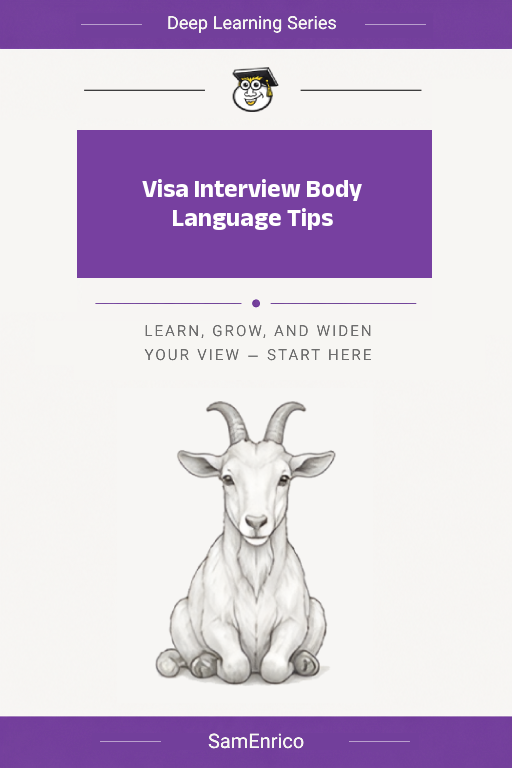
Non-FictionStudent's ShortcutBody Language
Visa Interview Body Language Tips eBook
Maintain eye contact, sit confidently, and avoid n
Maintain eye contact, sit confidently, and avoid nervous gestures during the interview.
Formats
Free sample
Chapter 1: The Seven-Second Judgment--–- You have already been judged. Not after you sit down. Not after you answer the first question. Not even after you open your mouth. Before you have spoken a single word, before you have offered a single document, before you have even reached the counter, a visa officer has formed an opinion about you.
That opinion is not final—but it is powerful. And it happens in less time than it takes to read this sentence.Seven seconds. That is all the time a trained visa officer needs to assign you a preliminary risk score. This is not speculation. It is not paranoia.
It is the documented result of decades of behavioral science applied to consular work. Every year, millions of applicants walk toward that window, and in the time it takes them to cross a small room, they have already communicated more than they will in the next five minutes of conversation.This chapter exists because most applicants never realize they are being watched the moment they stand up from their waiting room seat. They believe the interview begins with a question. It does not. The interview began thirty seconds ago, when you rose from your chair, gathered your documents, and walked toward the glass.
In that brief window, the officer has already noted your posture, your gait, your facial expression, your hand placement, and your level of eye contact. They have compared you to the thousands of applicants they have seen before you. And they have formed a hypothesis: low risk, moderate risk, or high risk.The rest of the interview, then, becomes a test of that hypothesis. If you are low risk, the officer will ask fewer questions, probe less deeply, and look for confirmation of their initial assessment. If you are high risk, the officer will ask harder questions, watch more carefully, and look for the lie they already suspect exists.
You do not want to be high risk before you say hello.This chapter will teach you exactly what happens in those first seven seconds, what the officer is looking for, and how to ensure that their preliminary judgment works in your favor rather than against you. We will cover the approach, the posture, the face, the hands, and the invisible clock that starts the moment you are called.The Science of Thin Slices Before we discuss what to do, we must understand why those seven seconds matter so much. The answer lies in a psychological concept called "thin slicing." Coined by researchers Nalini Ambady and Robert Rosenthal in the early 1990s, thin slicing refers to the ability to make remarkably accurate judgments about people based on very brief observations—sometimes as short as six seconds.In their famous studies, Ambady and Rosenthal showed that students could accurately rate college professors' teaching effectiveness after watching silent video clips of only six seconds. Those ratings correlated strongly with end-of-semester evaluations from students who had spent an entire term with those professors. Six seconds.
No sound. No content. Just body language, posture, and facial expression.Visa officers are not psychologists conducting academic studies. But they are professionals who see hundreds of applicants per week, thousands per year, and tens of thousands over a career. That repetition creates an extraordinary ability to thin-slice.
They do not need to analyze you consciously. Their brain has been trained by years of experience to flag patterns: the walk of someone hiding something, the posture of someone who is lying, the eyes of someone who is afraid.This is not infallible. Thin slicing can produce false positives—people who look nervous but are telling the truth. That is why officers do not deny visas based on seven seconds alone. But those seven seconds set the tone.
They determine whether the officer leans in or leans back, whether they ask one question or five, whether they probe your answers or accept them at face value.Consider two applicants. Both have identical documents. Both give identical verbal answers. Applicant A walks with purpose, keeps their head level, makes brief eye contact through the glass, and stands still. Applicant B shuffles, looks at the floor, touches their face twice, and shifts their weight constantly.
Who do you think the officer will trust? The answer is obvious. And that is why this chapter matters.The Walk: Your First Four Seconds The moment your name is called, you are on stage. The officer may not be looking directly at you yet—they may be finishing notes from the previous applicant or typing into their computer. But the camera above the waiting room is watching.
And within four seconds, the officer will glance up and see you walking.Your walk communicates more than you think. It is not about having a model's gait. It is about what your body unconsciously reveals.The Purposeful Walk (Low Risk): This is what you want. Walk at a moderate, steady pace—not rushed, not slow. Rushing reads as anxious.
Walking too slowly reads as entitled or reluctant. Your arms should swing naturally at your sides. Stiff arms suggest tension. Exaggerated arm swings suggest overconfidence. Natural, relaxed movement is the goal.Your head position is critical.
Keep your head level, eyes forward, chin parallel to the floor. Looking down at the floor as you walk signals submission, lack of confidence, or—in the officer's trained mind—the posture of someone who is ashamed or hiding something. Looking up at the ceiling or looking around the room excessively signals nervous distraction or, worse, casing the room for an escape route.Your shoulders should be back but not rigid. A slight, natural roll is fine. Hunched shoulders signal defensiveness or low status.
Shoulders pushed too far back signal aggression or overcompensation. The sweet spot is relaxed openness.The Shuffling Walk (Moderate Risk): Dragging your feet, scuffing your shoes, or taking very small, hesitant steps signals uncertainty. Officers see this and think: "This person does not want to be here. What are they afraid of?"The Pacing Walk (High Risk): If you were already pacing in the waiting room (see Chapter 11), and you continue that energy into your approach, you will look frantic. Officers see this and think: "This person is emotionally volatile.
High scrutiny required."The Overconfident Walk (Moderate Risk): Swaggering, taking up too much space, walking with an exaggerated chest-out posture signals arrogance. Officers see this and think: "This person believes they are entitled to a visa. They may be hiding a sense of superiority that could lead to overstaying."The Drill: Practice walking toward a mirror from twenty feet away. Watch your head, your shoulders, your arms, and your feet. Do this twenty times.
Film it. Watch the video with the sound off. Does your walk look calm and purposeful? If not, adjust and repeat.The Approach: Seconds Four to Six You have now reached the counter. There is a glass barrier between you and the officer.
A small metal ledge sits at chest height. A microphone may be embedded in the counter or attached to the glass. The officer is now looking directly at you.The approach phase is where most applicants make their first mistake: they lean.The…
This is the end of the free sample. Get the eBook to keep going. Buy now
About this book
Details
- Author
- Armijo Patrice
- Publisher
- SamEnrico
- Language
- English
- Genre
- Non-Fiction, Student's Shortcut, Body Language
- Released
- 2026-05-30
- Pages (approx.)
- 150
- Available as
- eBook, Audiobook

Read better in the ZLOADR app
Your eBooks on your phone or tablet. Sign in with your SamEnrico account and start reading.
More by Armijo Patrice
 Subscription Service AuditArmijo Patrice$11.99
 Self Talk For InsomniaArmijo Patrice$11.99
 Wholesale Vendor Credit GuideArmijo Patrice$11.99
 The Substance and Emotion GuideArmijo Patrice$11.99
 Speaker Wardrobe GuideArmijo Patrice$11.99
 Cognitive Reframing DrivingArmijo Patrice$11.99
 Tarcila Rivera Zea Quechua VoiceArmijo Patrice$11.99
 Habit Formation for Weight LossArmijo Patrice$11.99
 The Silent Saboteurs: Mime and the Secret War of Ancient RomeArmijo Patrice$11.99
 Golden Arches & Iron Thrones: The Secret Wars of Fast Food DynastiesArmijo Patrice$11.99
 Service Providers Guide to Fertility ServicesArmijo Patrice$11.99
 How to Produce Travel Converters and AdaptersArmijo Patrice$11.99
You may also like
 Hong Kong Handover 1997Dunn Johnnie$11.99
 Zumba For Postnatal Recovery CourseNeal Christian$11.99
 Zumba for BeginnersLadner Nikia$11.99
 YouTube Comment Mining GuideHumes Pandora$12.99
 Worry Box MeditationCarlin Rudy$11.99
 Workplace Stress MeditationNguyen Lynn$11.99
 Workplace Stress and Sleep RepairHawley Ivory$11.99
 Workplace Perfectionism CureDelaney Jeffry$11.99
 Workplace Injustice Anger GuideWallen Isabelle$11.99
 Work Addiction and Burnout LinkGreenwood Ester$11.99
 Women in Yoga and WellnessBeattie Galina$11.99
 Women in Stand Up ComedyChun Evangeline$11.99