
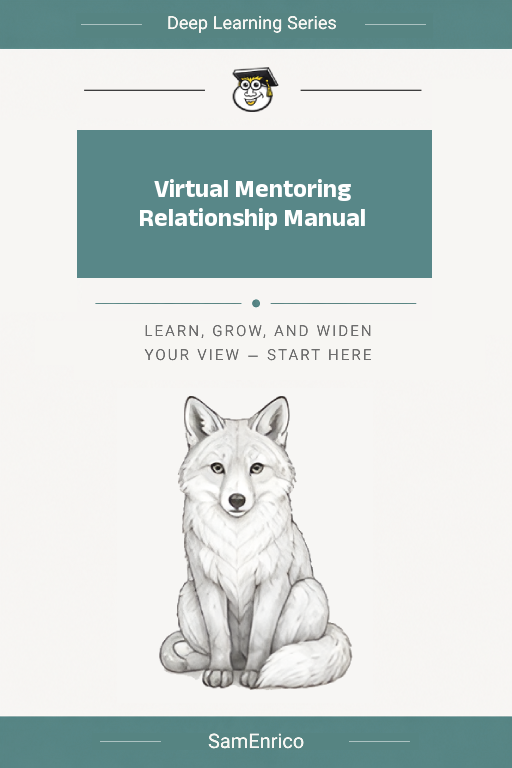
Non-FictionFirst 30 DaysNetworkingRelationship Guide
Virtual Mentoring Relationship Manual eBook
Structure monthly calls, set goals, and track prog
Structure monthly calls, set goals, and track progress with a remote mentor. Includes agenda templates, feedback frameworks, and graceful ending protocols for career pivots.
Formats
Free sample
Chapter 1: The Async Advantage–– The first time I watched a mentoring relationship die on Zoom, it took forty-seven minutes. Not forty-seven minutes of conflict or crisis—forty-seven minutes of two well-intentioned people politely destroying each other’s value. The mentee had prepared nothing. The mentor had over-prepared everything. They spent thirty minutes on “how are you” and “tell me about your week,” another fifteen minutes on a status update that could have been an email, and the final two minutes on a rushed question about a career decision that had been hanging unresolved for three months.
When the call ended, the mentor closed their laptop and muttered, “That was a waste of my time.” The mentee closed theirs and thought, “I’m not sure this is helping.” Neither said anything to the other. They scheduled another call for the same time next month. The relationship continued in this zombie state for another six months before quietly dissolving with no closure, no learning, and no accountability.I have seen this scene play out hundreds of times across Fortune 500 companies, startups, and nonprofit organizations. The tragedy is not that virtual mentoring can fail—everything can fail. The tragedy is that most people fail at virtual mentoring because they are using the wrong mental model.
They believe virtual mentoring is simply in-person mentoring conducted over video conferencing software. Add a Zoom link, subtract the coffee shop, and proceed as usual. This assumption is wrong. And it is costing you time, trust, and career momentum.This chapter dismantles that myth and introduces the foundational shift upon which this entire book is built: the async advantage. If you understand nothing else from this book, understand this: virtual environments are not a degraded version of physical proximity.
They are a different medium altogether, with unique strengths that have nothing to do with being in the same room. The job of this book—and the job of this chapter specifically—is to rewire your instincts so you stop trying to replicate in-person mentoring and start designing for the environment you actually inhabit.The Myth of the Poor Substitute Let us name the enemy clearly. The dominant cultural script for mentoring was written in an era of shared office space, watercooler conversations, and accidental hallway encounters. In that script, mentoring happens through proximity: you grab coffee, you walk to a conference room together, you read body language across a small table. The physical closeness signals trust.
The unstructured time allows relationship to develop organically. The shared context means less explanation and more intuition.When organizations moved their mentoring programs online in the early 2020s, they imported this script wholesale. The result was a generation of virtual mentoring relationships that felt like poor substitutes—because they were. You cannot replicate a coffee shop conversation on Zoom. The bandwidth is different.
The social cues are flattened. The unstructured time that worked in person becomes awkward silence or, worse, performative monologue.But here is the insight that separates successful virtual mentoring from failed attempts: you are not supposed to replicate the coffee shop. You are supposed to do something the coffee shop could never support.Consider the difference between synchronous communication (real-time, same time) and asynchronous communication (time-shifted, reflective). In-person mentoring is almost entirely synchronous because the medium demands it. You are in the same room, so you talk in real time.
This has advantages: rapid back-and-forth, immediate clarification, shared emotional experience. It also has profound disadvantages: the person with more power often dominates the airtime, complex ideas get simplified in the moment, and there is no built-in mechanism for reflection before response.Asynchronous communication—email, recorded video, shared documents with comments, collaborative boards—flips this entirely. When you are not expected to respond immediately, you can think before you speak. You can revise. You can sit with discomfort.
You can reread a question twice before answering. In mentoring relationships, where the stakes are high and the questions are often about identity and direction, this reflective space is not a nice-to-have. It is a competitive advantage.The async advantage is the principle that virtual environments, when properly leveraged, allow for higher-quality thinking, more equitable participation, and better documentation than any in-person conversation ever could. The problem is not that virtual mentoring is worse. The problem is that most people have never been taught how to use its unique strengths.The Scope Creep Epidemic: Mentoring vs.
Coaching vs. Therapy Before we go any further, we must draw a line that will save you months of frustration. One of the most common failure modes in virtual mentoring is scope creep—when the relationship drifts from mentoring into coaching or therapy without anyone explicitly acknowledging the shift. This is damaging because each role requires different training, different boundaries, and different outcomes. A mentor who tries to be a therapist will harm the mentee.
A therapist who tries to be a mentor will confuse the client. And a coach who tries to do both will burn out.Let me give you a concrete framework that will appear throughout this book. The same career question—“Should I take this promotion?”—would be addressed completely differently by each role:The Mentor explores long-term values, trade-offs, and career narrative. They might ask: “What does success look like for you in five years? How does this promotion fit into that story?
What would you regret more—taking it or leaving it?” The mentor brings their own experience and wisdom but does not prescribe. They help the mentee discover their own answer.The Coach practices specific skills and tactics. They might say: “Let’s role-play the negotiation conversation. I’ll be your boss. You have three minutes to make your case for a higher salary.
Go.” The coach works on observable behaviors and measurable outcomes. They are less concerned with the mentee’s identity and more concerned with their performance.The Therapist examines underlying psychological patterns, fears, and past experiences that may be driving current behavior. They might ask: “You mentioned that every time you get close to a promotion, you sabotage yourself. Where do you think that pattern comes from? What would it mean to succeed?” The therapist works on emotional healing and behavioral change at a deeper level.Here is the critical rule that every mentoring relationship must adopt: if you cannot clearly state which role you are playing at a given moment, you are probably playing the wrong one.
Mentors should never diagnose mental health conditions. Therapists should never give career advice outside their scope. Coaches should not pretend to have decades of industry experience they lack.In virtual environments, scope creep is more dangerous because the lack of physical cues makes it harder to notice when a conversation has veered into inappropriate territory. A mentee crying on Zoom might trigger the mentor’s instinct to comfort—which is appropriate for a therapist, but potentially boundary-violating for a mentor whose expertise is career strategy. The solution is not to be cold or unfeeling.
The solution is to name the boundaries explicitly in the Ways of Working document (Chapter 2) and to have a script ready for when a conversation crosses the line: “I can see this is…
This is the end of the free sample. Get the eBook to keep going. Buy now
About this book
Details
- Author
- Tuggle Michiko
- Publisher
- SamEnrico
- Language
- English
- Genre
- Non-Fiction, First 30 Days, Networking, Relationship Guide
- Released
- 2026-05-30
- Pages (approx.)
- 140
- Available as
- eBook, Audiobook

Read better in the ZLOADR app
Your eBooks on your phone or tablet. Sign in with your SamEnrico account and start reading.
More by Tuggle Michiko
 Namib Desert Solo TrekTuggle Michiko$11.99
 Body Image with Visible DifferenceTuggle Michiko$11.99
 Therapy For Drought DisplacedTuggle Michiko$11.99
 Stimulant Vocational TrainingTuggle Michiko$11.99
 The Silk Road Swindle: How a Fake Emperor Fooled an EmpireTuggle Michiko$11.99
 Echoes of the Deep: The Cosmic Symphony of Voyager's Golden RecordTuggle Michiko$11.99
 Understanding HistadeliaTuggle Michiko$17.99
 2026-2030 Legal Tech GuideTuggle Michiko$12.99
 How to Become a Trim-stencil MakerTuggle Michiko$11.99
You may also like
 Hong Kong Handover 1997Dunn Johnnie$11.99
 Zumba For Postnatal Recovery CourseNeal Christian$11.99
 Zumba for BeginnersLadner Nikia$11.99
 YouTube Comment Mining GuideHumes Pandora$12.99
 Worry Box MeditationCarlin Rudy$11.99
 Workplace Stress MeditationNguyen Lynn$11.99
 Workplace Stress and Sleep RepairHawley Ivory$11.99
 Workplace Perfectionism CureDelaney Jeffry$11.99
 Workplace Injustice Anger GuideWallen Isabelle$11.99
 Work Addiction and Burnout LinkGreenwood Ester$11.99
 Women in Yoga and WellnessBeattie Galina$11.99
 Women in Stand Up ComedyChun Evangeline$11.99