
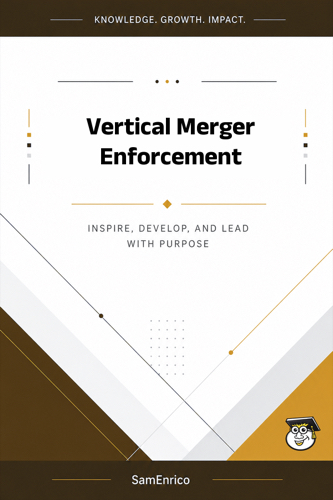
Non-FictionCompliance & Risk ArchiveVertical Integration
Vertical Merger Enforcement
Agency scrutiny of supply chain acquisitions and f
Agency scrutiny of supply chain acquisitions and foreclosure risks.
Formats
About this book
Free sample
Chapter 1: The Presumption Falls--The meeting room on the seventh floor of the Federal Trade Commission headquarters in Washington, D.C., held fifteen people, none of whom spoke for a full forty-five seconds. Outside, September sunlight glanced off the facade of the Constitution Center, but inside, the blinds were drawn. On the table lay a draft document that would, within months, transform how American businesses thought about supply chain acquisitions. The year was 2020. And the vertical merger, long considered the quiet, unobjectionable cousin of its horizontal counterpart, was about to become a target.Before that year, if you had asked most antitrust lawyers about vertical mergers, they would have shrugged.
A vertical merger—the combination of a supplier and a buyer, such as a car parts manufacturer acquiring an automaker, or a streaming platform buying a film studio—was generally considered presumptively lawful. The Chicago School, which had dominated antitrust thinking for four decades, taught that vertical integration was usually efficient. It eliminated double marginalization, reduced transaction costs, and aligned incentives. If a vertical merger harmed competition, the theory went, the merged firm would only be harming itself by foreclosing its own customers. The market would sort it out.That presumption died in 2020.
It did not die quietly.The Shift That Changed Everything The 2020 Vertical Merger Guidelines, issued jointly by the Department of Justice and the Federal Trade Commission, represented the first comprehensive rewrite of vertical merger policy in more than thirty years. For the first time, the agencies announced that vertical mergers would receive the same level of scrutiny as horizontal mergers. They introduced concepts like the "related product" market—a separate analytical construct that allowed the agencies to focus on a critical input or distribution channel even if the primary market was unconcentrated. They lowered the thresholds for concern. And they signaled, in no uncertain terms, that the era of judicial deference to vertical deals was over.But 2020 was only the beginning.
Three years later, the agencies released the 2023 Merger Guidelines, which went even further. Those guidelines ended the separate treatment of horizontal and vertical deals entirely, merging…
This is the end of the free sample. Get the eBook to keep going. Buy now
Contents
- Chapter 1
- Chapter 2
- Chapter 3
- Chapter 4
- Chapter 5
- Chapter 6
- Chapter 7
- Chapter 8
- Chapter 9
- Chapter 10
- Chapter 11
- Chapter 12
Details
- Author
- Dixon Brendan
- Publisher
- SamEnrico
- Language
- English
- Genre
- Non-Fiction, Compliance & Risk Archive, Vertical Integration
- Released
- 2026-06-10
- Pages (approx.)
- 147
- Available as
- eBook, Audiobook

Read better in the ZLOADR app
Your eBooks on your phone or tablet. Sign in with your SamEnrico account and start reading.
More by Dixon Brendan
 Wholesaling Escrow Process GuideDixon Brendan$11.99
 Mindful Stress Reduction for LawyersDixon Brendan$11.99
 Rejection Resilience at WorkDixon Brendan$11.99
 Fabric Burn Test GuideDixon Brendan$11.99
 The Third SiblingDixon Brendan$11.99
 Rib Fracture Return to SportDixon Brendan$11.99
 Low Socioeconomic Childhood WorthDixon Brendan$11.99
 Behavioral Economics ReadingDixon Brendan$11.99
 The Jungle Whisperers: Alfred Russel Wallace and the Secrets of BorneoDixon Brendan$11.99
 Fenrir's Bane: The Wolf Who Shaped the GodsDixon Brendan$11.99
 The Vanishing of the SS Marine Sulphur QueenDixon Brendan$11.99
 How to Start a Hobby in GamblingDixon Brendan$11.99
You may also like
 Hong Kong Handover 1997Dunn Johnnie$11.99
 Zumba For Postnatal Recovery CourseNeal Christian$11.99
 Zumba for BeginnersLadner Nikia$11.99
 YouTube Comment Mining GuideHumes Pandora$12.99
 Worry Box MeditationCarlin Rudy$11.99
 Workplace Stress MeditationNguyen Lynn$11.99
 Workplace Stress and Sleep RepairHawley Ivory$11.99
 Workplace Perfectionism CureDelaney Jeffry$11.99
 Workplace Injustice Anger GuideWallen Isabelle$11.99
 Work Addiction and Burnout LinkGreenwood Ester$11.99
 Women in Yoga and WellnessBeattie Galina$11.99
 Women in Stand Up ComedyChun Evangeline$11.99