
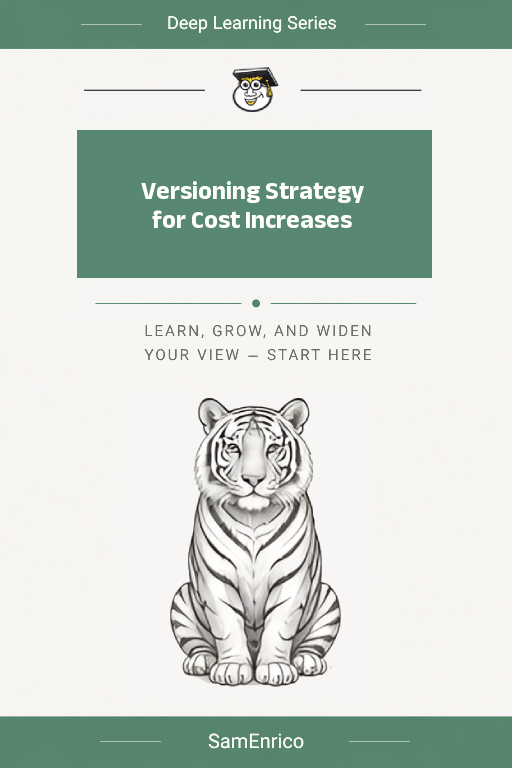
Non-FictionBusiness BriefProduct Versioning
Versioning Strategy for Cost Increases eBook
Create stripped-down lower-priced versions to reta
Create stripped-down lower-priced versions to retain budget customers without lowering core prices.
Formats
Free sample
Chapter 1: The Price Knife--–- The email arrived at 11:47 PM on a Tuesday. The subject line read: “Urgent – Board Meeting Tomorrow.” The CEO of a 47-year-old manufacturing company—let’s call him Dan—opened it to find a single sentence from his CFO: “Raw material costs up 22% since last quarter. We need to raise prices across the board by Friday, or we miss payroll in six weeks.”Dan did what most executives do. He approved a 15% across-the-board price increase. He wrote a careful email to customers explaining “unprecedented market conditions.” He braced for a few complaints.Ninety days later, he had lost 22% of his customer base.
A discount competitor he had never heard of—let’s call them Value Pro—had absorbed most of them. Dan’s premium product was now sitting in warehouses. His sales team was demoralized. And his board was asking a very simple question: “What just happened?”What happened was that Dan had committed the single most common and most destructive pricing error in business. He had raised prices on everyone equally—and in doing so, he had invited every customer to ask a question they had never asked before: “Is this still worth it?”For 78% of his customers, the answer was still yes.
They grumbled, but they stayed. For the other 22%, the answer was no. And because Dan had offered them no alternative—no stripped-down version, no lower-priced entry point, no “good” option to replace the “better” one they could no longer afford—they left. Permanently.This book is the answer to Dan’s problem. It is not a book about how to raise prices.
It is a book about how to avoid raising prices on everyone by creating a simple, elegant, and highly profitable alternative: a stripped-down version that captures the customers who would otherwise leave, while protecting the core price for everyone else.This is the art of versioning for cost increases. And it starts with understanding why the obvious solution—the flat price hike—is almost always a trap.The Loss Aversion Trap The reason flat price increases destroy customer loyalty is not complicated, but it is deeply rooted in human psychology. In the 1970s, psychologists Daniel Kahneman and Amos Tversky discovered a phenomenon they called loss aversion. In a series of experiments, they demonstrated that human beings feel the pain of a loss approximately twice as intensely as they feel the pleasure of an equivalent gain.Losing 1feelstwiceasbadasfinding1 feels twice as bad as finding 1feelstwiceasbadasfinding1 feels good.This asymmetry has enormous implications for pricing. When you raise the price of a product from 100to100 to 100to115, your customer does not process that as “a 15increase.”Theyprocessitasa∗loss∗of15 increase.” They process it as a *loss* of 15increase.”Theyprocessitasa∗loss∗of15 from their wallet.
And because loss aversion doubles the emotional weight of that loss, the 15priceincreasefeelsmorelikea15 price increase feels more like a 15priceincreasefeelsmorelikea30 emotional hit.Now consider the alternative. What if, instead of raising the price, you introduced a new version of your product at 85—aversionthatremoved85—a version that removed 85—aversionthatremoved15 worth of features? The customer who was paying 100nowhasachoice.Theycanstayat100 now has a choice. They can stay at 100nowhasachoice.Theycanstayat100 and keep everything. Or they can drop to 85andloseafewfeatures.Inthisscenario,thecustomerwhochoosesthe85 and lose a few features.
In this scenario, the customer who chooses the 85andloseafewfeatures.Inthisscenario,thecustomerwhochoosesthe85 version does not feel a loss. They feel a saving of $15. And because gains feel good (even if less intense than losses feel bad), that customer stays loyal, satisfied, and—critically—still within your ecosystem.The flat price hike triggers loss aversion in every customer. Versioning triggers loss aversion in none of them.This is not theoretical. In 2025, a major consumer packaged goods company tested both approaches across two similar product lines.
On one line, they implemented a 12% across-the-board price increase. On the other, they introduced a “value size” (20% less product at 15% lower price) while keeping the original size at the original price. The results were stark: the flat increase line lost 18% of its volume within six months. The versioned line lost less than 3%—and actually gained market share among price-sensitive segments that had previously been buying from competitors.The 2025-2026 Consumer Backlash Data The post-inflation consumer environment of 2025-2026 provides a natural laboratory for understanding the consequences of flat price increases. As inflation began to moderate, consumers did not forgive the brands that had raised prices most aggressively.
Instead, they remembered—and they punished.A comprehensive study of 2,400 US consumers conducted in early 2026 found that:67% of respondents could name at least one brand they had abandoned in the previous 12 months due to price increases.81% of those consumers said they would have stayed if the brand had offered a stripped-down alternative at a lower price—even if that alternative had fewer features.Only 12% of brands in the study had actually offered such an alternative.The most common response from consumers was not anger. It was resignation followed by action. “I understood why they raised prices,” one respondent said. “But they didn’t give me any way to stay. So I left.”The sectors most severely affected were those with the highest switching costs: software-as-a-service (Saa S), telecommunications, and premium consumer goods.
In these sectors, flat price increases triggered churn rates three to five times higher than in sectors that offered tiered options.One telecommunications company, which we will call Telco A, raised its monthly fee from 79to79 to 79to99 with no changes to service. Within 90 days, its churn rate tripled. A competitor, Telco B, responded to the same cost pressures by introducing a 69“basic”plan(slowerspeeds,nocustomersupporthotline,nostreamingbundle)whilekeepingits69 “basic” plan (slower speeds, no customer support hotline, no streaming bundle) while keeping its 69“basic”plan(slowerspeeds,nocustomersupporthotline,nostreamingbundle)whilekeepingits99 premium plan unchanged. Telco B’s churn rate increased by only 8%—and its premium plan actually saw increased adoption among customers who wanted to avoid the “basic” label.The lesson is clear: customers will accept lower quality. They will not accept a flat price increase with no alternatives.The Fighter Brand Concept – A First Look The solution to the price hike trap is a strategy that has been used successfully for decades, often under different names: the fighter brand, the entry tier, the good-better-best architecture.
At its simplest, the concept is this: create a lower-priced version of your product or service specifically designed to appeal to price-sensitive customers, while keeping your core product at its original price (or even raising it).But—and this is critical—not all fighter brands work the same way. In fact, as we will explore in depth in Chapter 3, there is a spectrum of fighter brand strategies. At one end is the separate fighter brand : a completely distinct brand name that competes directly with discounters while leaving your flagship brand untouched. At the other end is the sub-brand : a lower-priced offering that sits under your master brand and can actually enhance the flagship’s perceived value through what economists call the “halo effect.”The choice between these approaches depends on your industry, your brand equity, and your strategic goals. But the underlying principle is the same across both: you are creating a self-selection mechanism that allows price-sensitive customers to identify themselves…
This is the end of the free sample. Get the eBook to keep going. Buy now
About this book
Details
- Author
- Casey Madeline
- Publisher
- SamEnrico
- Language
- English
- Genre
- Non-Fiction, Business Brief, Product Versioning
- Released
- 2026-06-01
- Pages (approx.)
- 146
- Available as
- eBook, Audiobook

Read better in the ZLOADR app
Your eBooks on your phone or tablet. Sign in with your SamEnrico account and start reading.
More by Casey Madeline
 Keynote Speech PreparationCasey Madeline$11.99
 Caregiver Assisted ExercisesCasey Madeline$11.99
 Anchoring Calm State GuideCasey Madeline$11.99
 Body Language for DentistsCasey Madeline$11.99
 Love and Valor: The Siege of ZaragozaCasey Madeline$11.99
 How to Start a Oilseed (except Soybean) Farming BusinessCasey Madeline$11.99
 How to Produce Carbon ProductsCasey Madeline$11.99
 Linux EngineerCasey Madeline$11.99
You may also like
 Hong Kong Handover 1997Dunn Johnnie$11.99
 Zumba For Postnatal Recovery CourseNeal Christian$11.99
 Zumba for BeginnersLadner Nikia$11.99
 YouTube Comment Mining GuideHumes Pandora$12.99
 Worry Box MeditationCarlin Rudy$11.99
 Workplace Stress MeditationNguyen Lynn$11.99
 Workplace Stress and Sleep RepairHawley Ivory$11.99
 Workplace Perfectionism CureDelaney Jeffry$11.99
 Workplace Injustice Anger GuideWallen Isabelle$11.99
 Work Addiction and Burnout LinkGreenwood Ester$11.99
 Women in Yoga and WellnessBeattie Galina$11.99
 Women in Stand Up ComedyChun Evangeline$11.99