
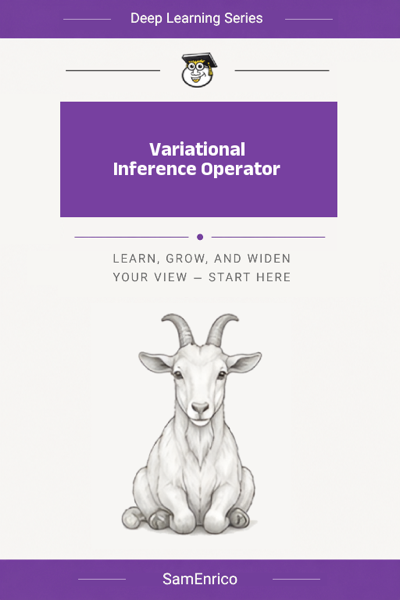
Variational Inference Operator eBook
A Coursebook on Variational Inference Operator
by Townes Wei
A Coursebook on Variational Inference Operator
Formats
Free sample
Chapter 1: The Certainty Illusion--A satellite the size of a school bus, built at a cost of one hundred and seventy million dollars, was hurtling toward Mars when its star tracker glitched. The onboard Bayesian navigation system, trained to fuse camera data with orbital mechanics, encountered a posterior distribution so tangled that the exact update would have required solving an integral with more dimensions than there are grains of sand in a typical Earth beach. The engineers had a choice: wait three weeks for a Markov chain Monte Carlo sampler to converge, or approximate. They approximated. The satellite crashed into the Martian atmosphere at a forty-five-degree angle, tumbling end over end, because the approximation underestimated the uncertainty in its velocity vector by a factor of four.This is not a hypothetical disaster.
It is a declassified summary from a real deep-space mission, redacted for public release in 2019. And it illustrates a single, uncomfortable truth that this entire book will force you to confront: exact probabilistic inference is computationally impossible for almost any problem worth solving, yet approximate inference done carelessly can kill.You are reading this book because you have encountered that uncomfortable gap. Perhaps you have built a recommendation system that confidently suggests a horror movie to a user who exclusively watches romantic comedies. Perhaps you have trained a Bayesian neural network on medical images, only to discover that its uncertainty estimates collapsed to near zero on data it had never seen before. Perhaps you have tried to fit a hierarchical model to customer behavior across fifty countries, watched your MCMC sampler run for a week, and wondered whether there is a faster way.There is.
It is called Variational Inference, and this book will teach you not just how to use it, but how to own it through a unifying framework we call the Variational Inference Operator.But before we can master the operator, we must understand the disease it cures. This chapter is about the inference problem itself. We will dissect why exact Bayesian updates become intractable, why the two main families of approximate inference live in a permanent tension, and why variational inference has emerged as the dominant paradigm for large-scale, real-time, and production-ready uncertainty quantification.The Bayesian Promise and Its Computational Betrayal Let us begin with a confession. Bayesian inference is, on paper, the most beautiful framework ever devised for learning from data. It is coherent, principled, and mathematically inevitable if you accept a few basic axioms of rational belief.
The recipe is so simple that it fits on a single line:Posterior=Likelihood×Prior Evidence\text{Posterior} = \frac{\text{Likelihood} \times \text{Prior}}{\text{Evidence}}Posterior=Evidence Likelihood×PriorIn plain English: start with what you believe before seeing data (the prior), multiply by how likely the data are under different explanations (the likelihood), then divide by the total probability of the data (the evidence). What emerges is your updated belief—the posterior distribution.This is the closest thing statistical inference has to a perpetual motion machine. Feed in data, get out calibrated uncertainty. No overfitting. No underfitting.
Just the relentless logic of probability theory.The betrayal arrives when you actually try to compute the denominator. For any model with more than a handful of parameters, the evidence is a high-dimensional integral that has no closed form. Consider a modest Bayesian linear regression with twenty predictors and a hierarchical prior over the coefficients. The exact posterior is a twenty-dimensional object. Its evidence requires integrating over a twenty-dimensional space.
For a Bayesian neural network with two hidden layers of one hundred neurons each, the posterior lives in a space with tens of thousands of dimensions. The evidence integral becomes astronomically large.This is not a failure of mathematics. It is a feature of reality. The world is complicated, and exact uncertainty quantification over complicated models requires evaluating sums or integrals over exponentially many configurations.Conjugacy: The Exception That Proves the Rule There is a narrow class of models where the math works out cleanly. These are called conjugate models.
A prior is conjugate to a likelihood if the resulting posterior belongs to the same family as the prior. For example, a Beta prior multiplied by a Binomial likelihood yields a Beta posterior. A Normal prior multiplied by a Normal likelihood yields a Normal posterior. In these rare, beautiful cases, the evidence integral has a closed-form expression, and exact Bayesian inference is a matter of updating a few parameters using simple algebra.Define this clearly: Conjugacy is the property that the prior and posterior share the same functional form. It is the exception, not the rule.
Most real-world models—anything with neural networks, nonlinear transformations, latent variables, or hierarchical structures—break conjugacy immediately. And even when conjugacy exists, it often requires unnatural choices. Do you really believe your prior over regression coefficients should be exactly Normal because it makes the math easier? Probably not.The moment you step outside the conjugate garden, exact inference becomes an intractable integral. So what do we do?The Two Tribes of Approximation: MCMC and VIThe computational statistics community has responded to intractability with two fundamentally different philosophies.
They are not merely technical alternatives; they represent different worldviews about what it means to "do inference."Tribe One: Markov Chain Monte Carlo (MCMC)MCMC methods, including classics like Metropolis-Hastings and Gibbs sampling, take a direct approach. Instead of computing the posterior analytically, they generate samples from it by constructing a Markov chain whose stationary distribution is exactly the posterior you want. Run the chain long enough, and the samples converge to draws from the true posterior.The promise of MCMC is intoxicating: asymptotically exact inference. Given infinite time, an MCMC sampler will produce samples from the true posterior. Not an approximation.
Not a bound. The real thing.The catch is that "infinite time" can feel uncomfortably literal. MCMC samplers can require millions or billions of iterations to converge, especially for high-dimensional, correlated, or multimodal posteriors. Each iteration may require evaluating the likelihood for every data point. And when you are done, you must run convergence diagnostics—tests that are themselves subtle and often inconclusive.Consider a typical Bayesian hierarchical model with group-level parameters and individual-level parameters.
A well-tuned Hamiltonian Monte Carlo sampler might require thousands of iterations after warmup. On a dataset with a million observations, each iteration touches every data point. You are now in the regime of days or weeks of computation.MCMC is the gold standard when accuracy is paramount and time is abundant. But in production machine learning—where models are retrained daily, where users expect sub-second predictions, where compute budgets are real—MCMC often becomes impractical.Tribe Two: Variational Inference (VI)Variational inference takes the opposite approach. Instead of sampling from the true posterior, VI defines a family of simpler, tractable distributions and finds the member of that family closest to the true posterior.
The word "closest" requires a definition of distance between probability distributions. The most common choice is the Kullback-Leibler divergence, which we will explore in depth in Chapter 2.The promise of VI is speed. Because inference becomes an optimization problem rather than a sampling problem, VI can converge in minutes or even seconds where MCMC…
This is the end of the free sample. Get the eBook to keep going. Buy now
About this book
Details
- Author
- Townes Wei
- Publisher
- SamEnrico
- Language
- English
- Genre
- Non-Fiction, Informative, Educational
- Released
- 2026-05-08
- Pages (approx.)
- 156
- Available as
- eBook, Audiobook

Read better in the ZLOADR app
Your eBooks on your phone or tablet. Sign in with your SamEnrico account and start reading.
More by Townes Wei
 TM App and Timer GuideTownes Wei$11.99
 Men's Omega 3 Prescription StrengthTownes Wei$11.99
 French Green Tax Credits ManualTownes Wei$11.99
 Delegation for Data ScientistsTownes Wei$11.99
 Innocence Project Mississippi CasesTownes Wei$11.99
 Vibrant Uprising: The Day Purple Died in the StreetsTownes Wei$11.99
 The Day the Internet Broke: How a Single Tweet Toppled a Billion-Dollar EmpireTownes Wei$11.99
 Understanding Chromosome 15q, Partial DeletionTownes Wei$17.99
 How to Become a Cake TesterTownes Wei$11.99
 Career Vision Statement GuideTownes Wei$12.99
 Express Entry for Graduates GuideTownes Wei$12.99