
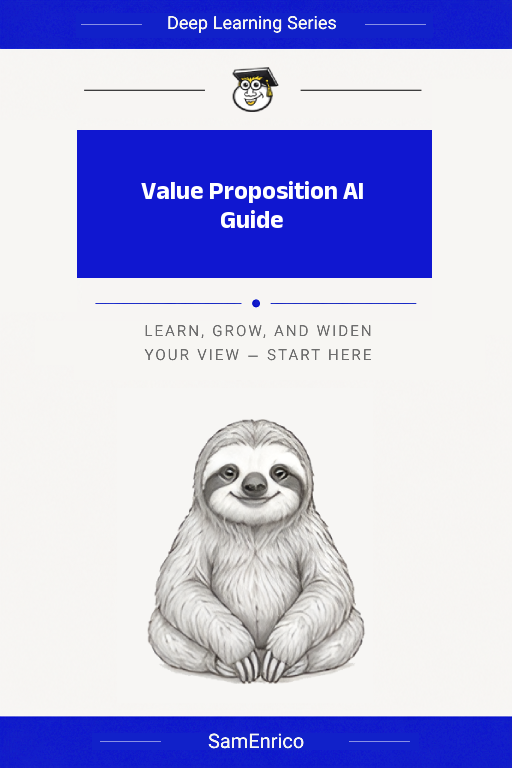
Non-FictionAI OperatorValue Prop
Value Proposition AI Guide eBook
Craft prompts that articulate clear customer value
by Putman Pilar
Craft prompts that articulate clear customer value propositions from product features.
Formats
Free sample
Chapter 1: The Feature Frankenstein--–- It starts with hope. You open Chat GPT, Claude, or Gemini. You type: "Write 10 benefits of our new project management software." You press enter. The cursor blinks. And then it happens.
The AI returns something that looks reasonable at first glance. "Saves time." "Increases productivity." "Streamlines workflows." You nod. But then you pause. You read it again. And you realize something terrible: this could describe literally any software on earth.
Your competitor could paste this onto their website tomorrow, change the logo, and no one would notice the difference. You have just built the Feature Frankenstein.This is not a failure of AI. This is a failure of the prompt. And it is happening thousands of times every day, inside companies that spend millions on product development and pennies on the one thing that actually drives revenue: translating features into value. The result is a vast graveyard of generic, forgettable, worthless marketing copy that sounds like it was written by a committee of robots who have never experienced a single human emotion.This chapter diagnoses the crisis.
It explains why your AI keeps failing you. It introduces the core frameworks that will save you. And it sets the stage for every technique, prompt, and template in the rest of this book. By the time you finish these pages, you will never again ask an AI to "write benefits." You will understand, deeply and viscerally, the difference between a feature and a value proposition. And you will be ready to build prompts that actually sell.The Anatomy of a Feature Dump Let us begin with an experiment.
Take any software product you know well. Any one. Now ask yourself: what does it do? If you are a product manager, you will list features. Real-time sync.
API access. Custom reporting. Role-based permissions. If you are an engineer, you will list technical capabilities. Low latency.
High availability. End-to-end encryption. If you are a founder, you will list strategic pillars. Enterprise readiness. Scalability.
Security.None of these are value propositions. They are features. Functions. Capabilities. And here is the brutal truth that most professionals never admit: customers do not buy features.
They never have. They never will. Customers buy outcomes. They buy relief from pain. They buy progress toward a goal.
They buy the feeling of competence, safety, status, or control. The feature is just the vehicle. The value is the destination.Yet when professionals prompt AI, they almost always ask for features dressed as benefits. "Write benefits" sounds like the right instruction. But the AI has no idea whose benefit, measured by what metric, compared to which alternative, for which persona.
So it defaults to the safest, most statistically common, most painfully generic language in its training data. The result is what this book calls the Feature Frankenstein: a creature stitched together from the corpses of a thousand boring product descriptions.Consider a real example. A Saa S company asked an AI to "write benefits of automated reporting." The AI returned: "Save time on manual data entry. Reduce errors. Generate insights faster." This is not wrong.
It is just useless. Every reporting tool on the planet makes the same claim. The customer reads it and feels nothing. They have heard it all before. They close the tab and move on with their day.Now consider what happens when you architect the prompt differently.
When you tell the AI who the customer is, what they are afraid of, what they desperately want, and what happens if they fail. The same feature, same AI, same model weights. But the output transforms. "Stop staying until 9 PM reformatting spreadsheets. Automate your weekly board report in 90 seconds and finally leave the office before your kids go to bed.
Your boss will think you hired a data team. You will know it took less time than your coffee break."That is a value proposition. It names the pain. It names the gain. It names a specific metric.
It names an emotion. And it is utterly, obviously, immediately better than "save time."Why "Write 10 Benefits" Is the Most Expensive Prompt on Earth Let us calculate the cost of this mistake. The average B2B Saa S company spends roughly forty percent of its marketing budget on content and copy. For a ten-million-dollar company, that is four million dollars. Four million dollars spent on landing pages, emails, sales decks, and case studies.
And most of that money is spent on copy that sounds exactly like every competitor. Why? Because the prompts used to generate that copy were lazy.When you type "write 10 benefits," you are not prompting. You are praying. You are hoping the AI read your mind.
You are assuming that the statistical patterns in its training data somehow align with the specific emotional reality of your specific customer. They do not. AI models are not psychic. They are mathematical engines trained to predict the next most likely word given the previous words. If you give them vague instructions, they produce vague outputs.
That is not a bug. That is the feature.The irony is that the AI is capable of so much more. The same model that returns "saves time" can also return "finally stop apologizing to your boss for missed deadlines." But it will only do so if you ask it to. And most professionals do not know how to ask. They treat AI like a junior copywriter, not a reasoning engine.
They forget that the prompt is not just a question. It is a constraint system. It is a set of boundaries within which the AI must operate. The tighter and more specific those boundaries, the better the output.This book exists because the gap between what AI can do and what most professionals ask it to do is enormous. Closing that gap is worth millions of dollars in improved conversion rates, higher renewal retention, and reduced customer acquisition costs.
It is also worth hours of your life that you will never get back from editing generic AI slop.The Jobs-To-Be-Done Bridge To understand how to fix the Feature Frankenstein, you need a framework. Fortunately, one already exists, and it has been battle-tested for decades. It is called Jobs-To-Be-Done, or JTBD. The core insight is simple: customers do not buy products. They hire products to do a job.
That job is almost never the functional task on the surface. It is the deeper progress they want to make in a specific circumstance.Clayton Christensen, the Harvard professor who popularized the framework, famously used the milkshake example. People did not buy milkshakes because they wanted a thick dairy beverage. They hired the milkshake to do a job: make a boring morning commute more enjoyable, keep them full until lunch, and fit in the cup holder of their car. The functional job was "consume breakfast." The emotional job was "survive a tedious drive without being hungry or bored." The social job was "not look weird eating a messy breakfast in traffic."The same logic applies to every product category.
When someone buys project management software, the functional job is "track tasks." But the emotional job is "stop feeling anxious that something is falling through…
This is the end of the free sample. Get the eBook to keep going. Buy now
About this book
Details
- Author
- Putman Pilar
- Publisher
- SamEnrico
- Language
- English
- Genre
- Non-Fiction, AI Operator, Value Prop
- Released
- 2026-05-30
- Pages (approx.)
- 142
- Available as
- eBook, Audiobook

Read better in the ZLOADR app
Your eBooks on your phone or tablet. Sign in with your SamEnrico account and start reading.
More by Putman Pilar
 The Apex Legends Grind RecoveryPutman Pilar$11.99
 Claustrophobia Trance WorkPutman Pilar$11.99
 Sabotage Coworker AngerPutman Pilar$11.99
 The Healthcare Body Language GuidePutman Pilar$11.99
 Weight Stigma at WorkPutman Pilar$11.99
 The Pink Panther Heist: The Untold Story of the 1964 Great Train RobberyPutman Pilar$11.99
 Circular Plastic Investment GuidePutman Pilar$12.99
 Understanding Microphthalmia CataractPutman Pilar$17.99
 Acoustic Levitation TechnicianPutman Pilar$11.99
 How to Start a Bulldozers Business (Beginners Guide)Putman Pilar$11.99
You may also like
 Hong Kong Handover 1997Dunn Johnnie$11.99
 Zumba For Postnatal Recovery CourseNeal Christian$11.99
 Zumba for BeginnersLadner Nikia$11.99
 YouTube Comment Mining GuideHumes Pandora$12.99
 Worry Box MeditationCarlin Rudy$11.99
 Workplace Stress MeditationNguyen Lynn$11.99
 Workplace Stress and Sleep RepairHawley Ivory$11.99
 Workplace Perfectionism CureDelaney Jeffry$11.99
 Workplace Injustice Anger GuideWallen Isabelle$11.99
 Work Addiction and Burnout LinkGreenwood Ester$11.99
 Women in Yoga and WellnessBeattie Galina$11.99
 Women in Stand Up ComedyChun Evangeline$11.99