
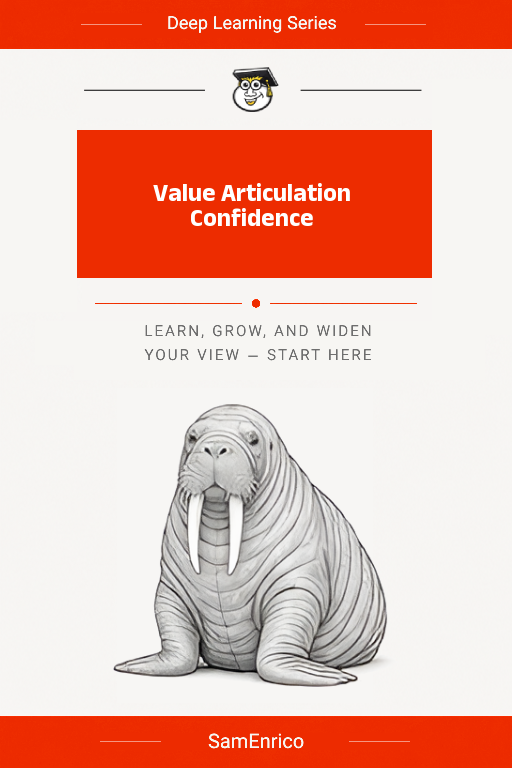
Non-FictionFirst 30 DaysValue Communication
Value Articulation Confidence eBook
Communicates your value clearly and convincingly b
Communicates your value clearly and convincingly before stating price, making higher prices feel justified.
Formats
Free sample
Chapter 1: The Value Void--The moment you say a number, the buyer’s brain changes. Not metaphorically. Neurologically. A cascade of electrochemical events begins that, within milliseconds, reorients their entire perception of you, your offering, and the conversation you were having. Before the number left your lips, they were curious.
Now they are skeptical. Before, they were open to possibility. Now they are calculating, comparing, and—most dangerously—anchoring.This is not a failure of character or a weakness in your sales skills. It is a feature of the human brain, honed over hundreds of thousands of years of evolution. And if you do not understand how it works, it will destroy your pricing power before you have said ten words.Every day, across millions of sales conversations, sellers commit the same fatal error.
They lead with features. They lead with specifications. They lead with the hours they worked or the quality of the materials they used. And then, when the buyer asks the inevitable question—“How much?”—they answer. And they lose.Not every time, of course.
Some deals close despite the seller, not because of them. Some buyers are so desperate for a solution that they will pay almost anything. But those are the exceptions. The rule is this: when you fail to define value before you state price, you invite the buyer to define value for you. And they will define it downward.This chapter is about that moment.
About the space between the buyer’s question and your answer. About what must occupy that space if you are to command the prices you deserve. And about the single most destructive force in all of selling: the Value Void.The Price of Silence Let me tell you about a consultant named Sarah. Sarah had been in business for twelve years. She was good—genuinely good—at helping mid-sized manufacturing companies optimize their supply chains.
She had case studies. She had testimonials. She had a ninety-two percent client retention rate. But she had a problem. She was leaving money on the table.
Hundreds of thousands of dollars over the course of her career.I sat in on one of her discovery calls. The prospect was a regional bakery chain with fifty locations. They were losing inventory to spoilage, struggling with uneven delivery schedules, and watching their margins shrink as ingredient costs rose. The call started well. Sarah asked smart questions.
She listened. She took notes. She demonstrated expertise.Then came the moment.The prospect said, “This sounds like exactly what we need. What would something like this cost?”And Sarah said, “Our fees typically start around fifteen thousand dollars for an engagement of this scope.”The prospect paused. Then: “That’s more than we were hoping to spend.”The conversation never recovered.
Sarah spent the next fifteen minutes justifying her price, listing her qualifications, and explaining her process. The prospect became quieter and quieter. At the end of the call, they said they would “think about it.” Sarah never heard from them again.What happened? Did the prospect lack budget? Possibly.
But more likely, Sarah committed the sin that this entire book is designed to prevent: she created a Value Void, and the buyer’s brain rushed in to fill it with the only number available.Here is what the prospect heard: “Fifteen thousand dollars.” That was the first number. That was the anchor. Every subsequent word—every credential, every case study, every assurance of quality—was evaluated against that anchor. “Is this fifteen-thousand-dollar solution worth the money?” Not “How much value will I receive?” Not “What is the return on this investment?” Just “Is this too expensive?”By the time Sarah finished speaking, the prospect had already decided. The price felt high because the value had never been established.The Neurological Crime Scene To understand why this happens, we need to look inside the brain.
The work of psychologist Daniel Kahneman, who won the Nobel Prize in Economics for his research on decision-making, revealed a phenomenon he called anchoring. In study after study, Kahneman and his colleague Amos Tversky showed that the first number a person encounters in a decision context exerts a disproportionate influence on their final judgment.In one famous experiment, participants were asked to spin a wheel of fortune that was rigged to land on either ten or sixty-five. Then they were asked: “What percentage of African nations are members of the United Nations?” The participants who had spun a ten gave average estimates of twenty-five percent. The participants who had spun a sixty-five gave average estimates of forty-five percent. The random, completely irrelevant number from the wheel had anchored their subsequent judgment.Now consider what happens in a sales conversation.
The buyer has no inherent sense of what your offering should cost. They have no objective price meter implanted in their brain. They are, in Kahneman’s terms, cognitive misers—they want to make decisions with as little mental effort as possible. So they look for an anchor. Any anchor.
And if you do not provide one, they will use the first number they hear.If that number is your price, you have anchored them on cost. Every feature, every benefit, every outcome you describe from that moment forward will be evaluated against that cost. “Is this worth fifteen thousand dollars?” becomes the only question that matters. And because humans are loss-averse—another Kahneman discovery—they will feel the pain of the price more acutely than the pleasure of the value.But if, instead, you anchor them on value first, the entire dynamic flips. If the first number they hear is “one hundred forty thousand dollars in annual savings,” then your price becomes a footnote.
“Fifteen thousand dollars” is no longer a cost; it is a fraction of the value. The question shifts from “Is this too expensive?” to “How could we afford not to do this?”This is not manipulation. It is not trickery. It is the simple, honest rearrangement of information to match how the human brain actually processes decisions. You are not lying about the value.
You are not inflating the numbers. You are simply presenting them in the order that allows the buyer to make a rational, value-driven decision rather than a fear-driven one.The Value Void Defined The Value Void is the gap between the moment a buyer recognizes they have a problem and the moment they understand the value of your solution. It is a vacuum. And vacuums get filled. If you do not fill the Value Void with quantified, specific, buyer-relevant value, the buyer will fill it with price.
Or doubt. Or the memory of a cheaper competitor. Or the fear of making a bad decision.The Value Void appears in every sales conversation. It appears in every proposal. It appears in every negotiation.
It is not something you can avoid. The only question is who will fill it—and with what.Most sellers, without realizing it, actively create the Value Void by leading with features. They say things like:“Our software has real-time analytics.”“We use only certified organic ingredients.”“I have fifteen years of experience in this industry.”“This machine operates at forty percent higher efficiency than the previous model.”Each of…
This is the end of the free sample. Get the eBook to keep going. Buy now
About this book
Details
- Author
- Naquin Apolonia
- Publisher
- SamEnrico
- Language
- English
- Genre
- Non-Fiction, First 30 Days, Value Communication
- Released
- 2026-06-01
- Pages (approx.)
- 126
- Available as
- eBook, Audiobook

Read better in the ZLOADR app
Your eBooks on your phone or tablet. Sign in with your SamEnrico account and start reading.
More by Naquin Apolonia
 NVC For Non Native English Speakers HandbookNaquin Apolonia$11.99
 Blockchain in Logistics ForecastNaquin Apolonia$11.99
 Equity Value WaterfallNaquin Apolonia$11.99
 Assertiveness in ConflictNaquin Apolonia$11.99
 The Billy West Futurama JourneyNaquin Apolonia$11.99
 The Last Spin of the Whipple WheelNaquin Apolonia$11.99
 Understanding SkandaitisNaquin Apolonia$17.99
 Survey Crew ChiefNaquin Apolonia$11.99
 Hospitality Sales Middle EastNaquin Apolonia$12.99
 10 Ways to Use Dredge (Recipe Book)Naquin Apolonia$11.99
You may also like
 Hong Kong Handover 1997Dunn Johnnie$11.99
 Zumba For Postnatal Recovery CourseNeal Christian$11.99
 Zumba for BeginnersLadner Nikia$11.99
 YouTube Comment Mining GuideHumes Pandora$12.99
 Worry Box MeditationCarlin Rudy$11.99
 Workplace Stress MeditationNguyen Lynn$11.99
 Workplace Stress and Sleep RepairHawley Ivory$11.99
 Workplace Perfectionism CureDelaney Jeffry$11.99
 Workplace Injustice Anger GuideWallen Isabelle$11.99
 Work Addiction and Burnout LinkGreenwood Ester$11.99
 Women in Yoga and WellnessBeattie Galina$11.99
 Women in Stand Up ComedyChun Evangeline$11.99