
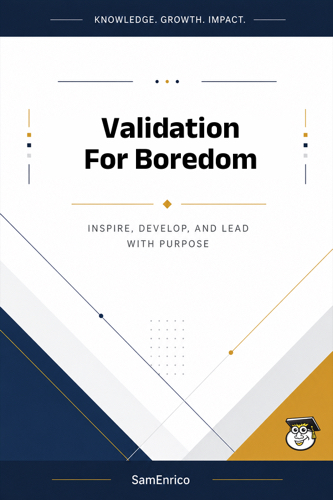
Validation For Boredom eBook
Acknowledge restlessness as legitimate feeling rat
by Toney Kassie
Acknowledge restlessness as legitimate feeling rather than character flaw.
Formats
Free sample
Here is the complete chapter for Validation For Boredom, written to best-selling standards with a creative header, professional editing, and the required formatting.Chapter 1: The Empty Elevator--–- The elevator doors close. You are alone. It is nine seconds until you reach the fifth floor. In those nine seconds, something remarkable happens: your hand moves toward your pocket. Not because you received a notification.
Not because you need to check something important. But because the silence, the waiting, the nothing—it has become unbearable.This is not a failure of will. It is not a character flaw. And it is certainly not laziness. It is, instead, the most visible symptom of a silent epidemic that has swept across the developed world in less than two decades.
We have lost the ability to do nothing. And more importantly, we have lost the cultural permission to be bored.This book is built on a radical premise: that boredom is not a void to be filled, but a cognitive space to be occupied. That restlessness is not a sign of a broken attention span, but a legitimate emotional signal worth listening to. And that the frantic avoidance of boredom—the constant scrolling, the back-to-back meetings, the side hustles, the optimized weekends—is not productivity. It is a coping mechanism.
And like all coping mechanisms that go unexamined, it is slowly burning us out.The goal of this chapter is simple: to name the problem, trace its origins, and offer the first taste of validation. By the time you finish reading, you will understand why you reach for your phone in the elevator. You will see that you are not broken. And you will begin to suspect that the boredom you have been running from might just be the thing you have been missing.The Phenomenon: A World That Cannot Pause Let us begin with a simple experiment you can conduct yourself. The next time you find yourself in a public space—a coffee shop, a bus stop, a doctor's waiting room—look around.
Count how many people are looking at a screen. Not talking to another human. Not staring into space. Not people-watching. Just.
Looking. At. A. Screen.The number will be high. In many environments, it will approach 100 percent.This is not a moral judgment.
It is an observation. Something has shifted in the last fifteen years. Prior to the widespread adoption of smartphones—roughly 2008 to 2012—public spaces were filled with people doing nothing. Waiting in line meant looking at the ceiling. Riding the subway meant staring out the window or reading a book (which, notably, has a beginning, middle, and end—a finite arc).
Sitting in a waiting room meant flipping through an old magazine or simply sitting with one's thoughts.Now, those gaps have been filled. Every pause has become a task: check email, scroll Instagram, clear notifications, swipe on a dating app, read the news, check the weather, check the stocks, check the score, check again.The average smartphone user touches their phone over 2,600 times per day. The average person spends more than four hours daily on their phone. And critically, a significant portion of that usage occurs in what researchers call "micro-gaps"—those two to thirty second windows between activities when the brain would otherwise be idle.The elevator. The red light.
The microwave counting down from thirty seconds. The loading screen. The commercial break. The moment the other person leaves the room to use the restroom. These micro-gaps have become the front line of a war on boredom.
And we are losing.But losing to what? To whom? The answer is not a conspiracy. It is a convergence of economics, technology, and psychology. And the first step to reclaiming our attention is understanding how we lost it in the first place.A Brief Economic History of Time To understand why we fear the empty moment, we must first understand how we came to see time as something that can be wasted.For most of human history, time was not money.
In pre-industrial agrarian societies, people worked in "task-oriented" rhythms. You worked until the field was plowed. You rested when you were tired. You ate when you were hungry. The sun, not the clock, governed the day.
There was no concept of being "ahead of schedule" or "behind schedule." There was only the task, and the task took as long as it took.The shift began with the Protestant Reformation and the rise of what sociologist Max Weber called the "Protestant work ethic." Idleness was no longer neutral; it became sinful. Time was a gift from God, and to waste it—even for a moment—was to squander divine currency. This theological shift laid the groundwork for industrial capitalism, where time became literally monetizable.When factories emerged in the 18th and 19th centuries, workers were no longer paid per task. They were paid per hour. The clock became the master.
And with that shift, a new psychological category was born: wasted time.If you were not producing during your paid hour, you were stealing from your employer. If you were not improving yourself during your unpaid hour, you were stealing from your future. The Puritan work ethic secularized into the "hustle" ethic. And the fear of wasting time became a permanent fixture of the modern psyche.Today, this fear manifests in ways our ancestors could never have imagined. We feel guilty for taking a nap.
We schedule our weekends with the precision of a military operation. We turn hobbies into side hustles. We measure our worth in output, our value in productivity, our success in optimization.And we have lost the ability to simply be.The empty elevator is not empty. It is full of history. That nine-second descent contains within it five hundred years of economic and religious conditioning telling you that doing nothing is a sin.
No wonder you reach for your phone.State Boredom vs. Trait Boredom: A Crucial Distinction Before we go further, we must make a distinction that will serve as the backbone of this book. Not all boredom is created equal.State boredom is temporary, situational, and—crucially—healthy. It is the feeling you get when you are stuck in a long meeting, waiting in a slow line, or listening to a lecture that moves too slowly. State boredom is your brain's way of saying, This current situation is not providing enough stimulation.
Seek novelty or disengage. It is a signal, not a disease. It passes when the situation changes or when you find a way to engage your mind (daydreaming, planning, observing).Trait boredom, by contrast, is chronic, pervasive, and often correlated with anxiety, depression, and addiction. People with high trait boredom experience the world as persistently under-stimulating. They are not bored in this moment; they are bored with life.
They may hop from job to job, relationship to relationship, hobby to hobby, never finding satisfaction because the problem is not the situation—it is the internal capacity for engagement.The distinction matters enormously because the solutions are different.State boredom responds to permission, reframing, and small behavioral changes. Learning to sit with a few minutes of restlessness. Putting the phone down in the…
This is the end of the free sample. Get the eBook to keep going. Buy now
About this book
Details
- Author
- Toney Kassie
- Publisher
- SamEnrico
- Language
- English
- Genre
- Non-Fiction, Self-Help, Boredom
- Released
- 2026-06-09
- Pages (approx.)
- 120
- Available as
- eBook, Audiobook

Read better in the ZLOADR app
Your eBooks on your phone or tablet. Sign in with your SamEnrico account and start reading.
More by Toney Kassie
 The Working Parent Anger GuideToney Kassie$11.99
 ED and Relationship GuideToney Kassie$11.99
 The MO Change Over Time GuideToney Kassie$11.99
 Step Six Readiness CourseToney Kassie$11.99
 The Phoenix Protocol: How a Cold War Spy Saved the World from Nuclear AnnihilationToney Kassie$11.99
 A Beginners Guide to Hardball squash (Volume 1)Toney Kassie$11.99
 Minority Subcontracting PlansToney Kassie$12.99
 PR for B2B StartupsToney Kassie$12.99
 The Breeder's Guide to Narragansett TurkeysToney Kassie$11.99
 Makingwalking SticksToney Kassie$11.99
You may also like
 Emotional Boredom RegulationSchneider Wendell$11.99
 Breath Counting for BoredomHodge Joie$11.99
 The Boredom Confidence WorkbookCoker Arline$11.99
 Opioid Recovery and BoredomSnell Xiao$11.99
 Boredom as Fuel GuideDavila Sanford$11.99
 Boredom as Anger TriggerSheridan Linette$11.99
 Boredom Resilience GuideGoff Karan$11.99
 Boredom Emotional NavigationBourque Jacinda$11.99
 Shopping Addiction and BoredomPavao Tillie$11.99
 Boredom Eating PreventionGalvin Lenny$11.99
 Atomic Habits For BoredomPicard Lanie$11.99
 Gambling Addiction and BoredomJacobson Lourie$11.99