
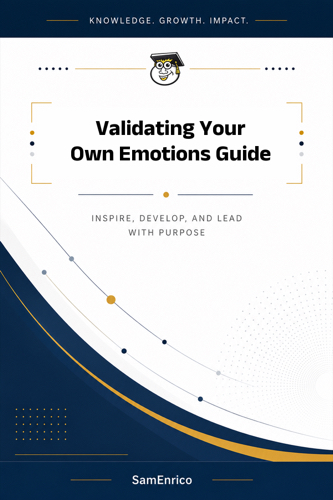
Non-FictionSelf-HelpSelf-Compassion
Validating Your Own Emotions Guide eBook
Practice self-validation to reduce self-criticism
Practice self-validation to reduce self-criticism and build emotional resilience from within.
Formats
Free sample
Chapter 1: The Empty Trophy Case--–- You have just achieved something significant. Perhaps you received a promotion at work, finished a creative project you poured yourself into, or received a heartfelt compliment from someone you respect. For a moment, there is a flicker of warmth. But then, almost immediately, the feeling begins to drain away. You find yourself checking your phone to see who else might acknowledge it.
You re-read the compliment, looking for hidden criticism. You wonder if the promotion was a fluke. Within hours, the achievement that should have felt like a solid foundation now feels like sand slipping through your fingers.This is the paradox of external validation: it feels essential, but it never lasts. And worse, the more you chase it, the more elusive it becomes.Welcome to the first chapter of your journey toward Radical Self-Validation. Before we can build the internal muscle of validating your own emotions, we must first understand why you learned, probably very early in life, to outsource that job to other people.
This chapter is not about blaming yourself or anyone else. It is about mapping the terrain. You cannot leave a prison until you know you are in one.The Evolutionary Hangover Your brain is running ancient software in a modern world. To understand why external validation feels like a matter of life and death, we have to go back approximately 200,000 years. Human beings evolved in small tribal groups where survival depended entirely on belonging.
If you were rejected by your tribe, you did not just feel sad—you died. There was no grocery store, no shelter, no protection from predators outside the group. Your brain learned, therefore, to treat social approval as a survival need on par with food and water.Neuroimaging studies show that social rejection activates the same neural pathways as physical pain. The anterior cingulate cortex, the region that registers a broken bone or a burn, also lights up when you are excluded from a conversation or ignored in a group chat. Your body does not distinguish between being exiled from a tribe and being left on read.
To your nervous system, they are the same emergency.Here is the problem: you no longer live in a tribe of 150 people. You live in a world of algorithmic feeds, performance reviews, likes, comments, retweets, and endless opportunities for comparison. Your ancient brain, designed to process a few social signals per day, is now bombarded with thousands. Every notification is a potential acceptance. Every silence is a potential rejection.
You are not broken for craving validation. You are having a normal response to an abnormal environment.But understanding the cause does not mean staying trapped by it. The first step toward self-validation is recognizing that your hunger for external approval is not a moral failing—it is a biological relic. And relics can be acknowledged without being obeyed.The Imposter Syndrome Loop There is a specific cycle that keeps people trapped in external validation, and it has a name you have probably heard: imposter syndrome. But imposter syndrome is not a personality flaw.
It is a predictable feedback loop that anyone can fall into when they rely on external praise to tell them they are enough.Let us walk through the loop together.Stage One: You do something well. You complete a project, help a friend, or simply show up consistently. Internally, there might be a small sense of satisfaction, but it is fragile.Stage Two: You wait for external confirmation. Without realizing it, you scan your environment for evidence that you did well. You look at your boss’s face.
You wait for a text back. You check the engagement on your post. Your internal sense of accomplishment is not allowed to solidify until it has been mirrored back to you by someone else.Stage Three: You receive validation (temporarily). The praise comes. Your boss says “good job.” Someone likes your photo.
A friend says “I’m proud of you.” For a brief moment, you feel relief. The alarm in your body quiets. You are safe. You belong.Stage Four: The relief fades. Within hours—sometimes minutes—the good feeling evaporates.
Your brain, always scanning for threats, begins to question the praise. Did they really mean it? Did they say it just to be nice? What if next time I fail? The temporary hit of external validation was never designed to last.
It was a signal, not a fuel source.Stage Five: You need another hit. So you repeat the loop. You work harder. You post again. You ask for reassurance in disguised ways (“Are you sure it was okay?”).
You become dependent on a cycle that was never meant to sustain you.Here is the cruelest part of the imposter syndrome loop: the more external validation you receive, the more you need. This is called hedonic adaptation. Your brain adjusts to every new level of praise as the new baseline. The promotion that thrilled you six months ago now feels normal, so you need a bigger promotion to feel the same hit. The compliment that made your day now feels insufficient, so you need more effusive praise.
You are running on a treadmill that is designed to accelerate forever.The only way off the treadmill is not to run faster. It is to step off entirely.The Difference Between Agreement and Acknowledgment At this point, you might be thinking: “Are you saying I should never want anyone to approve of me? That I should become a cold, self-sufficient island?” Absolutely not. That is a misunderstanding of self-validation.We need a new definition of validation itself. In popular usage, validation has come to mean agreement, praise, or solving.
When someone says “I validate your feelings,” we often hear “I agree with your feelings” or “Your feelings are correct.” This is not what validation means, and it is certainly not what self-validation means.Validation, at its core, is simply bearing witness. It is saying: “I see that you are feeling something. That feeling exists. It does not need to be justified, solved, or approved. It simply is.”Let me give you an example.
Imagine you feel angry at your partner for forgetting an important date. External validation would sound like: “You are right to be angry. They are wrong.” That is agreement, not validation. Self-validation would sound like: “I notice I am feeling anger. That anger is present.
It makes sense that I feel this way because this matters to me. I do not need to act on this anger right now, but I also do not need to pretend it is not there.”See the difference? Self-validation does not require you to believe your emotion is justified or correct. It only requires you to acknowledge that the emotion is happening. You can validate jealousy without believing the jealousy is rational.
You can validate fear without letting the fear control you. You can validate sadness without wallowing in it.This distinction is the foundation of everything that follows in this book. You are not trying to become someone who never seeks external feedback. You are trying to become someone who does not collapse without it.The Three Myths That…
This is the end of the free sample. Get the eBook to keep going. Buy now
About this book
Details
- Author
- Tobin Hermine
- Publisher
- SamEnrico
- Language
- English
- Genre
- Non-Fiction, Self-Help, Self-Compassion
- Released
- 2026-06-07
- Pages (approx.)
- 148
- Available as
- eBook, Audiobook

Read better in the ZLOADR app
Your eBooks on your phone or tablet. Sign in with your SamEnrico account and start reading.
More by Tobin Hermine
 Allergy Season Sleep GuideTobin Hermine$11.99
 The Governor's Veto PenTobin Hermine$11.99
 Telegram Stories ComparisonTobin Hermine$11.99
 TM for Nicotine CravingsTobin Hermine$11.99
 Chile Remote Tax GuideTobin Hermine$11.99
 Pomodoro For TeamsTobin Hermine$11.99
 Home Sleep Test GuideTobin Hermine$11.99
 Hitchcock BlondeTobin Hermine$11.99
 The Hypatia Paradox: Alexandria’s Lost GeniusTobin Hermine$11.99
 The Great Unraveling: How a Single Leak Doomed the Soviet UnionTobin Hermine$11.99
 The Golden Scrivener: Timbuktu's Forgotten Scholars of the Saharan RenaissanceTobin Hermine$11.99
 How to Start a Money Lender Business (Beginners Guide)Tobin Hermine$11.99
You may also like
 Hong Kong Handover 1997Dunn Johnnie$11.99
 Zumba For Postnatal Recovery CourseNeal Christian$11.99
 Zumba for BeginnersLadner Nikia$11.99
 YouTube Comment Mining GuideHumes Pandora$12.99
 Worry Box MeditationCarlin Rudy$11.99
 Workplace Stress MeditationNguyen Lynn$11.99
 Workplace Stress and Sleep RepairHawley Ivory$11.99
 Workplace Perfectionism CureDelaney Jeffry$11.99
 Workplace Injustice Anger GuideWallen Isabelle$11.99
 Work Addiction and Burnout LinkGreenwood Ester$11.99
 Women in Yoga and WellnessBeattie Galina$11.99
 Women in Stand Up ComedyChun Evangeline$11.99