
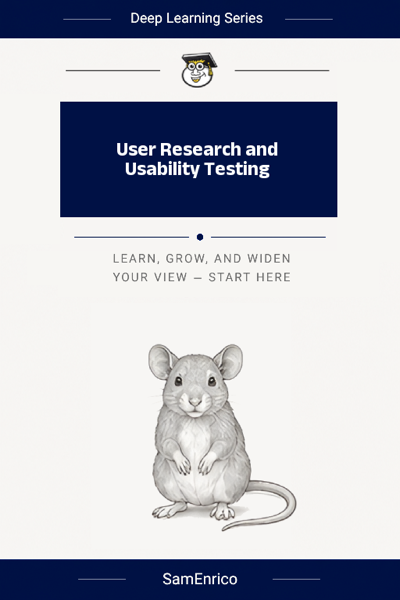
User Research and Usability Testing
A Coursebook on User Research and Usability Testin
A Coursebook on User Research and Usability Testing
Formats
About this book
Free sample
Chapter 1: The Curiosity Mandate--The email arrived at 11:47 PM on a Tuesday. The product owner, copied on the thread, had written one sentence: “We don’t have budget for users—we already know what they want.” Attached was a wireframe for a new medical device interface. The designer who received that email had two choices: nod along and build what the team assumed was correct, or fight for research. Six months later, that device was recalled because nurses, confronted with a confusing dosage screen, had manually calculated every entry—introducing a 14% error rate. The company lost $4.2 million in召回 costs and reputational damage.
The designer’s name never appeared in the news. But the lesson did: skipping research is not a cost-saving measure. It is a risk multiplier.This is not an isolated story. From e-commerce checkout flows that abandoned $300 million in cart value to safety-critical aviation software that confused pilots, the history of product development is littered with failures that could have been prevented by talking to a handful of users before launch. Yet, in organizations large and small, the same objections recur: “We are users too.” “We'll do research next quarter.” “Our instincts have served us well.” This chapter dismantles those assumptions and replaces them with a single, non-negotiable principle: curiosity is not a personality trait—it is a professional mandate.You will learn why User-Centered Design (UCD) consistently outperforms ego-driven design, how to quantify the cost of not doing research, and the foundational ethical obligations that separate legitimate research from exploitative data collection.
By the end, you will be able to walk into any stakeholder meeting and build a business case for research that no rational product owner can dismiss. Let us begin with a fundamental question: whose opinion actually matters?The Myth of the Intuitive Designer Every product team harbors at least one person who claims to have “good instincts.” Sometimes that person is the CEO. Sometimes it is a senior engineer who has used the product for five years. Occasionally it is a designer who proudly announces, “I am a user too.” This is the ego-driven design fallacy…
This is the end of the free sample. Get the eBook to keep going. Buy now
Contents
- Chapter 1
- Chapter 2
- Chapter 3
- Chapter 4
- Chapter 5
- Chapter 6
- Chapter 7
- Chapter 8
- Chapter 9
- Chapter 10
- Chapter 11
- Chapter 12
Details
- Author
- Bourque Jolyn
- Publisher
- SamEnrico
- Language
- English
- Genre
- research, Informative, Educational
- Released
- 2026-05-04
- Pages (approx.)
- 159
- Available as
- eBook, Audiobook

Read better in the ZLOADR app
Your eBooks on your phone or tablet. Sign in with your SamEnrico account and start reading.
More by Bourque Jolyn
 The 48 Hour JumpstartBourque Jolyn$11.99
 Pain Meditation MistakesBourque Jolyn$11.99
 Boundary Setting For ExecutivesBourque Jolyn$11.99
 Napping for Night OwlsBourque Jolyn$11.99
 Small Talk for Book ClubsBourque Jolyn$11.99
 Zumba for KidsBourque Jolyn$11.99
 Alibaba Counterfeit DetectionBourque Jolyn$11.99
 Lithium Treatment GuideBourque Jolyn$11.99
 The Silk Road Heist: How a Textile Artist Smuggled Forbidden Fabrics to FreedomBourque Jolyn$11.99
 Child Loss And Social WithdrawalBourque Jolyn$11.99
 The Timbuktu Tally Masters: Counting the Stars and Gold of MaliBourque Jolyn$11.99
 The Collapse of Wirecard: How a Fintech Empire Evaporated OvernightBourque Jolyn$11.99