
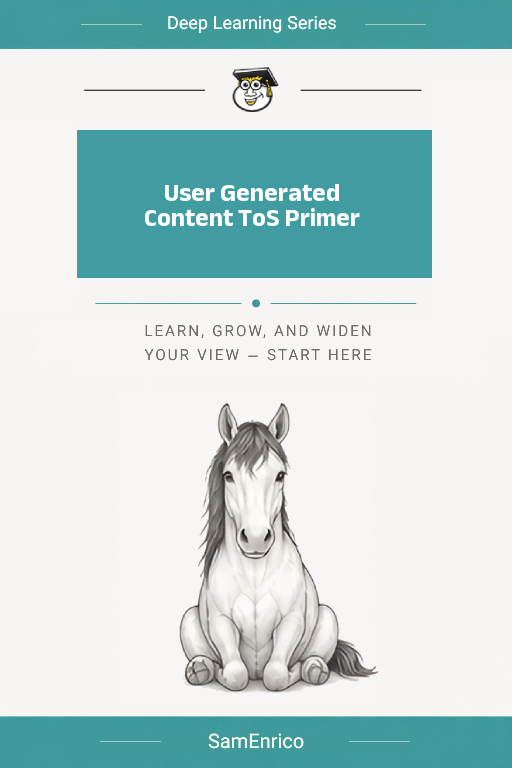
Non-FictionFirst 30 DaysLegal BasicsContent Platform Guide
User Generated Content ToS Primer Audiobook
Protect your platform from user-submitted photos,
by Glenn Shanta
Protect your platform from user-submitted photos, reviews, and comments. Covers DMCA takedown procedures, license grants, and moderation rights for community websites.
Formats
Free sample
Chapter 1: The $150,000 Comment Box...--–- The email arrived on a Tuesday. Sarah, who had built a cozy recipe blog over three years of late nights and burned test batches, was checking her inbox between coffee sips. The subject line read "Demand for Immediate Takedown and Monetary Settlement." She assumed it was spam. It was not. The letter attached demanded 150,000forcopyrightinfringement.Auserhaduploadedaprofessionalphotographer′simageofachocolatecaketo Sarah′s"Reader Recipes"section.Thephotographerfoundit.Sarahhadnoregistered DMCAagent.Shehadnotakedownworkflow.Shehadnoideathatherinnocentcommentboxhadjustbecomea150,000 for copyright infringement.
A user had uploaded a professional photographer's image of a chocolate cake to Sarah's "Reader Recipes" section. The photographer found it. Sarah had no registered DMCA agent. She had no takedown workflow. She had no idea that her innocent comment box had just become a 150,000forcopyrightinfringement.Auserhaduploadedaprofessionalphotographer′simageofachocolatecaketo Sarah′s"Reader Recipes"section.Thephotographerfoundit.Sarahhadnoregistered DMCAagent.Shehadnotakedownworkflow.Shehadnoideathatherinnocentcommentboxhadjustbecomea150,000 liability generator.This chapter is the story of how that happens—and how it does not have to happen to you.The Simple Comment Box Fallacy Every founder, product manager, and community lead makes the same assumption.
It feels reasonable. It feels intuitive. And it is dangerously wrong.The assumption is this: "My users are responsible for their own content. If they post something illegal, they get in trouble. Not me."Courts stopped believing this around 2007.
The shift happened gradually, then all at once. In the 1990s, platforms were treated like telephone companies—common carriers that merely transmitted content without responsibility for its legality. If a user said something defamatory on a phone call, AT&T was not liable. If a user posted a copyrighted song on a forum, the forum owner was not liable. This was the "passive conduit" theory, and it protected early internet platforms from ruin.That era is over.Today, courts view platforms as active participants in the content ecosystem.
If you allow users to upload photos, you are a publisher of those photos. If you allow comments, you are a publisher of those comments. If you curate, recommend, or fail to remove illegal content after receiving notice, you lose nearly all legal protections. The question is no longer "Did you post it?" The question is "Did you have the right systems in place to handle it when someone complained?"Sarah did not. Neither do most platforms.
According to a 2023 study of 1,000 startup To S documents, 73% lacked a registered DMCA agent. 81% had no repeat infringer policy. 94% had…
This is the end of the free sample. Get the Audiobook to keep going. Buy now
About this book
Details
- Author
- Glenn Shanta
- Publisher
- SamEnrico
- Language
- English
- Genre
- Non-Fiction, First 30 Days, Legal Basics, Content Platform Guide
- Released
- 2026-05-28
- Pages (approx.)
- 152
- Available as
- eBook, Audiobook

Listen in the VoxFlicks app
Audiobooks and audio dramas wherever you go. Sign in with your SamEnrico account and press play.
More by Glenn Shanta
 Last Mile Delivery Driver Mobile App Optimization GuideGlenn Shanta$11.99
 Alopecia Body Image Self EsteemGlenn Shanta$11.99
 Therapy For Intimate Partner ViolenceGlenn Shanta$11.99
 Cocaine and Alcohol CocalethyleneGlenn Shanta$11.99
 The Great River Quest: Tracking the Amazon's Ancient OriginsGlenn Shanta$11.99
 Breakaway: The Unfinished Rebellion of the Republic of TexasGlenn Shanta$11.99
 How to Become a Trim-machine OperatorGlenn Shanta$11.99
 2026-2030 AI Education OutlookGlenn Shanta$12.99
 Fencing/historical FencingGlenn Shanta$11.99
 Understanding Hip Dysplasia (Human)Glenn Shanta$17.99
You may also like
 Hong Kong Handover 1997Dunn Johnnie$11.99
 Zumba For Postnatal Recovery CourseNeal Christian$11.99
 Zumba for BeginnersLadner Nikia$11.99
 YouTube Comment Mining GuideHumes Pandora$12.99
 Worry Box MeditationCarlin Rudy$11.99
 Workplace Stress MeditationNguyen Lynn$11.99
 Workplace Stress and Sleep RepairHawley Ivory$11.99
 Workplace Perfectionism CureDelaney Jeffry$11.99
 Workplace Injustice Anger GuideWallen Isabelle$11.99
 Work Addiction and Burnout LinkGreenwood Ester$11.99
 Women in Yoga and WellnessBeattie Galina$11.99
 Women in Stand Up ComedyChun Evangeline$11.99