
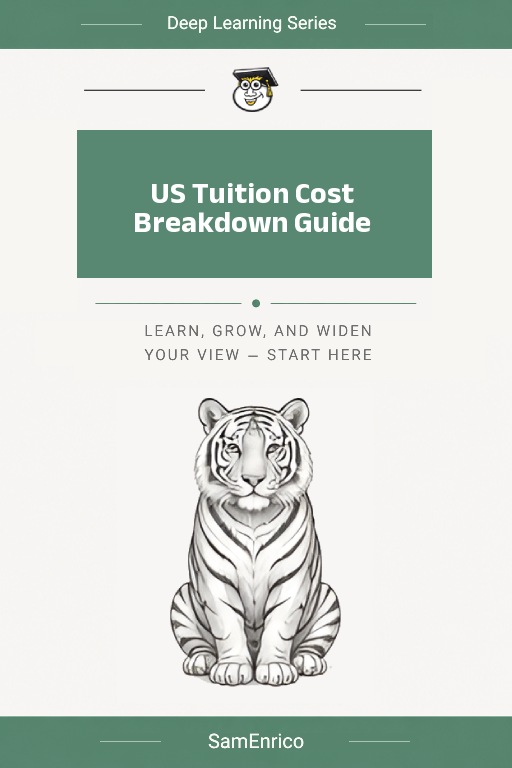
US Tuition Cost Breakdown Guide eBook
Understand sticker price versus net cost for Ameri
by Oh Nichelle
Understand sticker price versus net cost for American public and private colleges.
Formats
Free sample
Chapter 1: The $80,000 Lie--–- The first time Maria checked the tuition page for a private liberal arts college, she nearly spit out her coffee. The screen read 79,840.Herhusband,ahighschoolprincipalearning79,840. Her husband, a high school principal earning 79,840.Herhusband,ahighschoolprincipalearning92,000 a year, would need to work an entire twelve months just to cover tuition. Room and board would add another 16,000.Books,fees,transportation?Another16,000. Books, fees, transportation?
Another 16,000.Books,fees,transportation?Another5,000. Total: over $100,000 for a single year of college.She closed the browser tab. Then she opened the website for her state flagship university. 34,500.Sheexhaled.Thatwasmorelikeit.Butthenshelookedcloser.“Estimatedtotalcostofattendanceforin−stateresidents:34,500. She exhaled.
That was more like it. But then she looked closer. “Estimated total cost of attendance for in-state residents: 34,500.Sheexhaled.Thatwasmorelikeit.Butthenshelookedcloser.“Estimatedtotalcostofattendanceforin−stateresidents:34,500.” That included tuition, fees, housing, and a meal plan. Still expensive. Still more than her family could comfortably afford.
But at least it wasn't a hundred thousand dollars.Maria made her decision that day. Private college was for rich people. Her daughter would attend the public university. It was the responsible choice. The affordable choice.
The only choice.Six months later, Maria’s neighbor Jenna—who earned 68,000asanurse—sentherdaughtertothatsameprivatecollege.Theonewiththe68,000 as a nurse—sent her daughter to that same private college. The one with the 68,000asanurse—sentherdaughtertothatsameprivatecollege.Theonewiththe79,840 sticker price. And Jenna paid 18,000outofpocket.Therestcamefromscholarships,grants,andwork−study.Jenna’sdaughtergraduatedwith18,000 out of pocket. The rest came from scholarships, grants, and work-study. Jenna’s daughter graduated with 18,000outofpocket.Therestcamefromscholarships,grants,andwork−study.Jenna’sdaughtergraduatedwith12,000 in federal loans.
Maria’s daughter graduated from the public university with $38,000 in loans and a degree that cost more than the private college would have.How is this possible? How does a nurse’s family afford a $80,000 college while a principal’s family ends up deeper in debt for a “cheaper” school?This chapter answers that question. And the answer will change how you see every college price tag from now on.The Sticker Price Is Not the Price Let’s start with a simple truth that most parents learn too late: the published cost of attendance—the number printed on brochures, displayed on websites, and repeated by guidance counselors—is a fiction. It is a starting point for negotiation, not a bill. It is the “manufacturer’s suggested retail price” on a new car.
Nobody pays MSRP. And just like with cars, the gap between what colleges ask for and what families actually pay can be tens of thousands of dollars.Here is the data that Maria didn’t have when she made her decision. According to the National Center for Education Statistics, the average published tuition and fees for private nonprofit four-year colleges in 2024-2025 was approximately 42,000.Addroom,board,books,andtransportation,andtheaveragepublished COAwasroughly42,000. Add room, board, books, and transportation, and the average published COA was roughly 42,000.Addroom,board,books,andtransportation,andtheaveragepublished COAwasroughly56,000. But the average net price—what students actually paid after grants and scholarships—was approximately $33,000 at private colleges.
That is a discount of over 40 percent off the sticker price.Public universities tell a different story. The average published in-state tuition and fees was approximately 11,000,withatotal COAaround11,000, with a total COA around 11,000,withatotal COAaround28,000. The average net price for in-state students was approximately $20,000. That is a discount of only about 28 percent. Public universities have smaller endowments and less scholarship money to give away.Now let us return to Maria and Jenna.
Maria looked at the private college’s 80,000stickerandthepublicuniversity’s80,000 sticker and the public university’s 80,000stickerandthepublicuniversity’s35,000 sticker. She assumed the private college would cost nearly two and a half times more. But the actual net price for a family with Maria’s income (92,000)atthatprivatecollegewouldlikelyhavebeenaround92,000) at that private college would likely have been around 92,000)atthatprivatecollegewouldlikelyhavebeenaround25,000 after need-based grants and a modest merit scholarship. The public university’s net price for the same family was approximately 20,000.Theprivatecollegewouldhavecostonly20,000. The private college would have cost only 20,000.Theprivatecollegewouldhavecostonly5,000 more per year—not 45,000more.Overfouryears,thatisa45,000 more.
Over four years, that is a 45,000more.Overfouryears,thatisa20,000 difference, not a $180,000 difference.Jenna’s income was lower (68,000).Herexpectedfamilycontributionwaslower.Herdaughterhadstronggrades.Theprivatecollegegaveheracombinationofneed−basedaidandmeritscholarshipsthatbroughtthenetpricedownto68,000). Her expected family contribution was lower. Her daughter had strong grades. The private college gave her a combination of need-based aid and merit scholarships that brought the net price down to 68,000).Herexpectedfamilycontributionwaslower.Herdaughterhadstronggrades.Theprivatecollegegaveheracombinationofneed−basedaidandmeritscholarshipsthatbroughtthenetpricedownto18,000. The public university offered her daughter only 4,000inaid,bringingtheirnetpriceto4,000 in aid, bringing their net price to 4,000inaid,bringingtheirnetpriceto24,000.
The private college was actually six thousand dollars cheaper per year for Jenna’s family.The sticker price lied to both families. Maria assumed the private college was out of reach. Jenna assumed the public university was the only option. Both assumptions were wrong.Two Models: Luxury Hotels and Budget Airlines To understand why sticker prices are so misleading, we need to understand the two fundamentally different pricing models used by American colleges.Private colleges operate on the luxury hotel model. A luxury hotel has a high “rack rate”—the published price for a room.
But almost nobody pays the rack rate. Business travelers get corporate discounts. Vacationers use Expedia or Kayak. Loyalty members get free nights. AAA members get 10 percent off.
The hotel publishes a high price to signal quality and prestige, then offers deep discounts to almost everyone who asks. Private colleges do the same thing. They publish a high sticker price to signal exclusivity and investment in faculty, facilities, and campus amenities. Then they distribute institutional grants and merit scholarships to discount that price for the vast majority of students.Public universities operate on the budget airline model. A budget airline like Southwest or Spirit has a low base fare.
That is the price you see. But then they add fees. Checked bag fee. Carry-on fee. Seat selection fee.
Priority boarding fee. The low base fare is real, but the total price after all the add-ons is often much higher than you expected. Public universities have low base tuition, but they offer fewer discounts. The price you see is closer to the price you pay. However, the total cost of attendance—including fees, housing, meal plans, and textbooks—may be significantly higher than the tuition number you started with.Here is the critical insight that changes everything: the luxury hotel model (private colleges) offers far more room for negotiation and discounting than the budget airline model (public universities).
If you know how to ask—and this book will teach you exactly how—you can often get a private college to discount its price by 40 to 60 percent. You cannot get the same percentage discount from a public university because they have less scholarship money to give.But wait. Does that mean private colleges are always cheaper than public universities? No. That would be just as misleading as the sticker price.
What it means is that the gap between public and private net prices is much smaller than the gap between public and private sticker prices. For a family earning 150,000,thedifferencebetweenapublicflagshipandaprivateliberalartscollegemightbe150,000, the difference between a public flagship and a private liberal arts college might be 150,000,thedifferencebetweenapublicflagshipandaprivateliberalartscollegemightbe10,000 per year—not 40,000.Forafamilyearning40,000. For a family earning 40,000.Forafamilyearning80,000, the difference might disappear entirely, with the private college actually costing less.The High-Income Trap: Why Wealthy Families Overpay If there is one group of families that consistently…
This is the end of the free sample. Get the eBook to keep going. Buy now
About this book
Details
- Author
- Oh Nichelle
- Publisher
- SamEnrico
- Language
- English
- Genre
- Non-Fiction, Student's Shortcut
- Released
- 2026-05-29
- Pages (approx.)
- 158
- Available as
- eBook, Audiobook

Read better in the ZLOADR app
Your eBooks on your phone or tablet. Sign in with your SamEnrico account and start reading.
More by Oh Nichelle
 The DEARMAN Script GuideOh Nichelle$11.99
 The Nun Who Read MindsOh Nichelle$11.99
 Reformation Lutheran Hymn Warfare ManualOh Nichelle$11.99
 Buy Now Pay Later TrapOh Nichelle$11.99
 Metta for Beginners GuideOh Nichelle$11.99
 Saccharomyces Boulardii GuideOh Nichelle$11.99
 The Hand-Me-Down EverythingOh Nichelle$11.99
 Nightmare and AnxietyOh Nichelle$11.99
 Spouse Terminal GriefOh Nichelle$11.99
 The Dark Money Mirage: How a Billionaire’s Shadow Fund Reshaped a Nation’s VoteOh Nichelle$11.99
 The Skull of the Dawn: Uncovering the First Humans of the LevantOh Nichelle$11.99
 The Lion of Sicily: Frederick II and the Holy Roman Empire's RenaissanceOh Nichelle$11.99
You may also like
 Hong Kong Handover 1997Dunn Johnnie$11.99
 Zumba For Postnatal Recovery CourseNeal Christian$11.99
 Zumba for BeginnersLadner Nikia$11.99
 YouTube Comment Mining GuideHumes Pandora$12.99
 Worry Box MeditationCarlin Rudy$11.99
 Workplace Stress MeditationNguyen Lynn$11.99
 Workplace Stress and Sleep RepairHawley Ivory$11.99
 Workplace Perfectionism CureDelaney Jeffry$11.99
 Workplace Injustice Anger GuideWallen Isabelle$11.99
 Work Addiction and Burnout LinkGreenwood Ester$11.99
 Women in Yoga and WellnessBeattie Galina$11.99
 Women in Stand Up ComedyChun Evangeline$11.99