
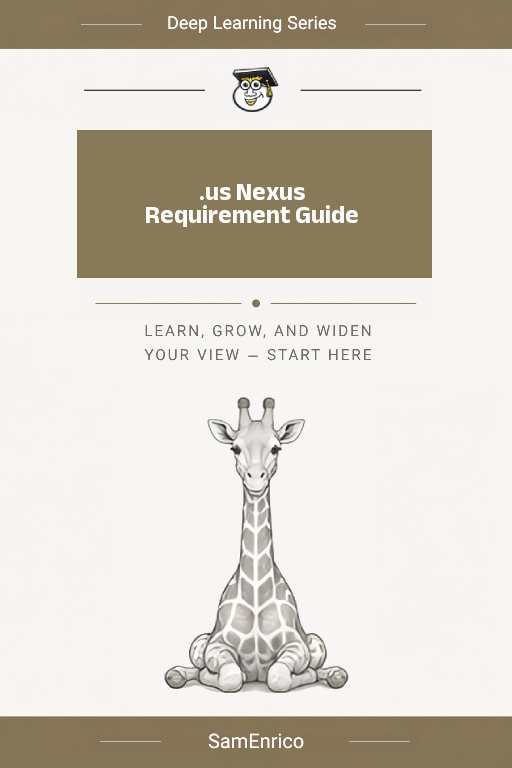
.us Nexus Requirement Guide
Qualifies for .us domain requiring US citizenship,
by Winn Tisha
Qualifies for .us domain requiring US citizenship, residency, or organization with bona fide presence in the United States.
Formats
About this book
Free sample
Chapter 1: The Invisible Contract---- Most people who buy a .us domain believe they are purchasing a piece of digital real estate. They click through the registration form, enter their credit card, and assume that as long as they pay the renewal fee each year, the domain belongs to them. This is a dangerous misconception. A .us domain is not property. It is a license.
And like any license—whether a driver’s license, a medical board certification, or a liquor sales permit—it comes with conditions that must be continuously met. Fail to meet those conditions, and the license disappears. No refund. No appeal. No warning beyond a single email that often lands in a spam folder.This chapter exists to shatter the commodity mindset.
Before we discuss Nexus categories, documentation requirements, or audit survival strategies, you must understand what you are actually holding when you own a .us domain. The difference between a g TLD like .com and a cc TLD like .us is not merely technical. It is legal, jurisdictional, and existential to your rights as a registrant.The Great Misunderstanding: .com vs. .us The internet’s domain name system divides all top-level domains into two broad families. The first family, generic top-level domains (g TLDs), includes .com, .org, .net, and hundreds of newer extensions like .shop, .blog, and .tech.
These domains are governed by contracts between registrars, registries, and ICANN (the Internet Corporation for Assigned Names and Numbers). They operate under a relatively uniform set of rules designed for global commerce. When you register a .com domain, you are entering a commercial transaction governed by private contract law, typically interpreted in courts located in the registrar’s home jurisdiction.The second family, country-code top-level domains (cc TLDs), includes .us (United States), .uk (United Kingdom), .ca (Canada), .de (Germany), and roughly 250 other national extensions. Each cc TLD is sovereign territory in the digital sense. The country that controls the cc TLD sets its own rules, often for reasons of national policy, consumer protection, or economic development.
Some cc TLDs, like .io (British Indian Ocean Territory), have become commercially successful despite their small geographic footprint. Others, like…
This is the end of the free sample. Get the eBook to keep going. Buy now
Contents
- Chapter 1
- Chapter 2
- Chapter 3
- Chapter 4
- Chapter 5
- Chapter 6
- Chapter 7
- Chapter 8
- Chapter 9
- Chapter 10
- Chapter 11
- Chapter 12
Details
- Author
- Winn Tisha
- Publisher
- SamEnrico
- Language
- English
- Genre
- Non-Fiction, First 30 Days, Nexus
- Released
- 2026-05-30
- Pages (approx.)
- 146
- Available as
- eBook, Audiobook

Read better in the ZLOADR app
Your eBooks on your phone or tablet. Sign in with your SamEnrico account and start reading.
More by Winn Tisha
 The Spanking Alternative GuideWinn Tisha$11.99
 Validation For Postpartum MoodWinn Tisha$11.99
 ED in Older MenWinn Tisha$11.99
 The Spatial Span Training GuideWinn Tisha$11.99
 Step Two Practical SanityWinn Tisha$11.99
 The Lion Kings of Aksum: Africa's Forgotten Naval EmpireWinn Tisha$11.99
 How to Become a Loft Worker ApprenticeWinn Tisha$11.99
 PR for Nonprofit StartupsWinn Tisha$12.99
 The Breeder's Guide to Persian Rumpless ChickensWinn Tisha$11.99
 MopedsWinn Tisha$11.99
You may also like
 Hong Kong Handover 1997Dunn Johnnie$11.99
 Zumba For Postnatal Recovery CourseNeal Christian$11.99
 Zumba for BeginnersLadner Nikia$11.99
 YouTube Comment Mining GuideHumes Pandora$12.99
 Worry Box MeditationCarlin Rudy$11.99
 Workplace Stress MeditationNguyen Lynn$11.99
 Workplace Stress and Sleep RepairHawley Ivory$11.99
 Workplace Perfectionism CureDelaney Jeffry$11.99
 Workplace Injustice Anger GuideWallen Isabelle$11.99
 Work Addiction and Burnout LinkGreenwood Ester$11.99
 Women in Yoga and WellnessBeattie Galina$11.99
 Women in Stand Up ComedyChun Evangeline$11.99