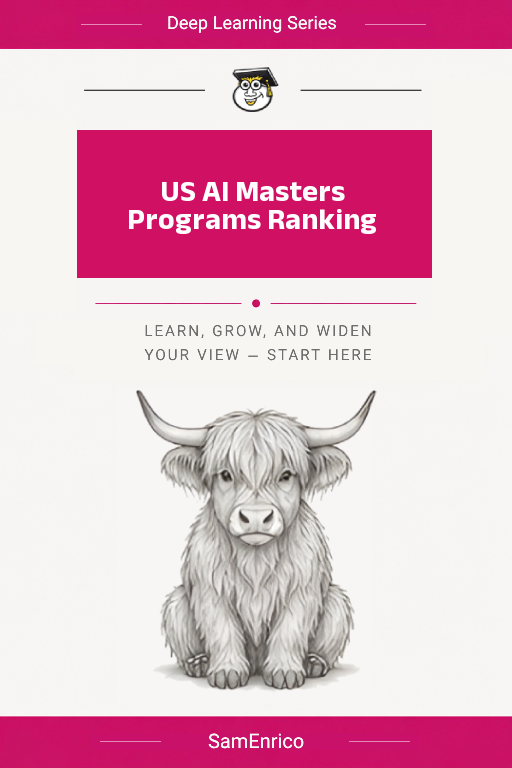
US AI Masters Programs Ranking Audiobook
Study AI at Carnegie Mellon, MIT, Stanford, UC Ber
Study AI at Carnegie Mellon, MIT, Stanford, UC Berkeley, and Georgia Tech with program details.
Formats
Free sample
Chapter 1: The 96% Reality--The email arrives on a Tuesday in March. You’ve checked your application portal forty-seven times in the past seventy-two hours. Your heart rate spikes when you see the subject line: “Decision Update – Artificial Intelligence Masters Program.” You click. You read. And then you sit in silence, wondering what you did wrong.You are not alone.
In fact, you are part of a vast majority that no one talks about.Between 2023 and 2026, the number of applicants to top-tier AI master’s programs in the United States nearly tripled. Carnegie Mellon University’s School of Computer Science received over 12,000 applications for its MS in Artificial Intelligence program. They accepted fewer than 200. That is an acceptance rate of approximately 1.6 percent — lower than Harvard Medical School, lower than Yale Law, lower than almost any graduate program in the world. Stanford’s AI track within its Computer Science MS hovers around 5 percent.
MIT’s EECS department, which houses its AI offerings, admits about 6 percent of applicants. UC Berkeley’s on-campus EECS MS/Ph D track accepts roughly 4 percent. Even Georgia Tech, the largest producer of computer science master’s graduates in the country, admits only about 10 to 15 percent of applicants to its on-campus AI concentration.Collectively, the “Big Five” — Carnegie Mellon University, Stanford University, Massachusetts Institute of Technology, University of California Berkeley, and Georgia Institute of Technology — reject approximately 96 percent of applicants who seek entry into their artificial intelligence master’s programs.This book exists because of that number.The Myth of the Generalist For decades, the Master of Science in Computer Science served as the default credential for anyone seeking to advance their technical career. It was a flexible degree — you could study databases, operating systems, compilers, networks, human-computer interaction, or a dozen other subfields. Employers valued the signal: this person knows how to write code, understand algorithms, and ship software.That era has ended.The rise of specialized artificial intelligence roles has fragmented the job market in ways that no one predicted five years ago.
Job postings for “AI Engineer” grew 300 percent faster than those for “Software Engineer” between 2023 and 2026, according to labor market data from Lightcast and the Burning Glass Institute. More striking: the salary premium for AI specialization now exceeds 50,000peryearattheentrylevel.Ageneralistsoftwareengineeratatoptechcompanymightstartat50,000 per year at the entry level. A generalist software engineer at a top tech company might start at 50,000peryearattheentrylevel.Ageneralistsoftwareengineeratatoptechcompanymightstartat150,000 total compensation. An AI engineer…
This is the end of the free sample. Get the Audiobook to keep going. Buy now
About this book
Details
- Author
- Goebel Brittney
- Publisher
- SamEnrico
- Language
- English
- Genre
- Non-Fiction, Student's Shortcut, US
- Released
- 2026-05-30
- Pages (approx.)
- 117
- Available as
- eBook, Audiobook

Listen in the VoxFlicks app
Audiobooks and audio dramas wherever you go. Sign in with your SamEnrico account and press play.
More by Goebel Brittney
 Immigrant Daycare Center FounderGoebel Brittney$11.99
 Unexpected Departure Legal Risk Assessment GuideGoebel Brittney$11.99
 Teen Academic Self EsteemGoebel Brittney$11.99
 Shame Resilience in Addiction RecoveryGoebel Brittney$11.99
 The Self Hypnosis for MeditationGoebel Brittney$11.99
 Spouse Death WorkbookGoebel Brittney$11.99
 Janis Joplin PearlGoebel Brittney$11.99
 BPH Symptoms GuideGoebel Brittney$11.99
 The Devil in the Details: The Trial That Split a NationGoebel Brittney$11.99
 The Djinn’s Double Game: A Spy Among the SpiritsGoebel Brittney$11.99
 A Collector's Handbook to the Skoda S110rGoebel Brittney$11.99
 Citation for Videos and Media GuideGoebel Brittney$12.99