
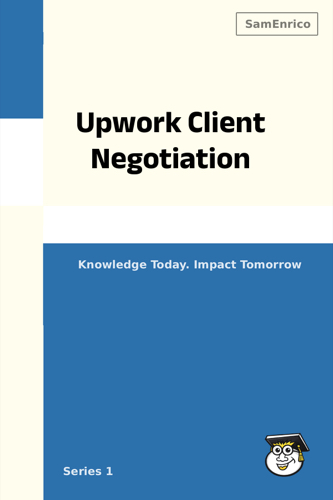
Upwork Client Negotiation eBook
Raise your rates without losing existing clients u
Raise your rates without losing existing clients using value based arguments.
Formats
Free sample
Chapter 1: The Loyalty Tax--–- On a Tuesday morning in March, a freelance copywriter named Sarah did something she had never done before: she opened a spreadsheet and calculated exactly how much money her “loyalty” had cost her over the past three years. The number she saw made her stomach turn. She had been working with four legacy clients—people who had hired her when she was charging $45 per hour, back when she lived in a studio apartment and considered “making rent” a major victory. Three years later, her skills had sharpened, her portfolio had grown, her testimonials sparkled, and her confidence had climbed. But her rates had not.
She was still charging those four clients $45 per hour while charging every new client $85 per hour. The difference—$40 per hour, times twenty hours per week per client, times fifty weeks a year, times three years—came out to over $120,000 in forgone income. One hundred and twenty thousand dollars. That was not a rounding error. That was a down payment on a house.
That was two years of her daughter’s college tuition. That was the price of staying “loyal” to people who had long since stopped thinking about her rates at all.This book begins with Sarah not because she is special, but because she is every freelancer who has ever read this sentence. You know her. You might be her. You have a client—or two, or five—who hired you when you were cheap, who has never asked for a discount, who pays on time, who says “great work” at the end of every project, and who has absolutely no idea that they are currently costing you a fortune.
They are not villains. They are not trying to exploit you. They simply have no reason to offer you more money because you have never given them one. And you have never given them one because you are afraid—not of them, but of yourself. You are afraid that if you ask for what you are worth, they will say no.
You are afraid that they will leave. You are afraid that you will be left with nothing but a spreadsheet full of “what ifs” and an empty inbox. That fear is real. That fear is also the most expensive line item in your business.This chapter is called “The Loyalty Tax” because that is exactly what you are paying: a tax on your own fear dressed up in the respectable clothing of loyalty. You tell yourself you are being grateful.
You tell yourself you are building long-term relationships. You tell yourself that low rates now will lead to higher rates later. But later has come and gone, and the rates have not moved. The clients who hired you at $45 still pay you $45, while the market rate for your skills has climbed to $90, $100, even $150 per hour depending on your niche. You are not being loyal.
You are being stuck. And the difference between what you earn and what you could earn is not a “nice-to-have” or a “someday goal.” It is the Loyalty Tax, and you pay it every single week.The Anatomy of the Loyalty Tax Let us define the term precisely because vague fears cannot be fixed, but precise numbers can. The Loyalty Tax is the calculable difference between what a legacy client pays you and what you could earn from a new client at market rate for the same work, multiplied by the hours or projects you have completed for that client over a given period. In Sarah’s case, the math was brutal: $40 per hour times 2,000 hours over three years equals $80,000 in direct lost income, plus the opportunity cost of what she could have done with that money (invested, saved, or used to hire help). But the Loyalty Tax is not just about money.
It is also about attention, energy, and opportunity. Every hour you spend working for a legacy client at half your market rate is an hour you cannot spend finding or serving a client who will pay you double. That is the hidden cost of loyalty: it crowds out growth.Most freelancers do not calculate their Loyalty Tax because they are afraid of what they will find. That is understandable. But fear does not dissolve debt; it compounds it.
The longer you avoid looking at the number, the larger it grows. So let us do together what Sarah did alone. Take out your phone, your laptop, or a napkin if that is all you have. Write down the names of every client you have worked with for more than twelve months. Next to each name, write the rate you are currently charging them.
Next to that, write the rate you would charge a brand‑new client for the exact same work. If you do not know what that rate is, look at Upwork’s “Freelancer Plus” rate insights, search for freelancers in your niche with similar experience, or simply add 50% to your current rate as a starting estimate. Now multiply the difference by the average number of hours you work for that client each month. Multiply that by twelve. That number—right there, on your screen—is your annual Loyalty Tax.
That is what you are paying every year for the privilege of being “loyal.” Not a membership fee. Not a subscription. A tax on your own hesitation.The 82% Acceptance Rule: Why Most Clients Will Say Yes If the Loyalty Tax is the problem, then the 82% Acceptance Rule is the solution. This rule comes from a compilation of freelance negotiation studies conducted across platforms including Upwork, Fiverr, and direct client relationships. The finding is remarkably consistent: when freelancers present a rate increase to an existing client using a value‑based argument (as opposed to a cost‑based argument like “my expenses went up”), approximately 82% of clients accept the new rate.
Only 18% decline. And here is the detail that changes everything: the 18% who decline are almost never the clients you want to keep. They are the most price‑sensitive, highest‑maintenance, slowest‑paying clients in your roster. They are the ones who haggle over every invoice, request endless revisions, and disappear for weeks only to reappear with a “quick emergency.” The 82% who stay are the clients who value your work, respect your time, and have the budget to pay for quality. In other words, the raise does not just increase your income—it filters your client list.Let me say that again because it is the most important sentence in this chapter: raising your rates is not just a revenue strategy; it is a client filtration system.
The clients who say no were costing you more than they were paying you. The clients who say yes were already subsidizing the ones who left. When you lose the bottom 18%, you do not lose income. You lose headaches. You lose scope creep.
You lose the 2 a.m. Slack messages about “one small change.” You lose the clients who treat your rates as a starting point for negotiation rather than a reflection of your expertise. And what you gain—in addition to the higher rate from the remaining 82%—is time. Time to find better clients. Time to do…
This is the end of the free sample. Get the eBook to keep going. Buy now
About this book
Details
- Author
- Mears Sherrell
- Publisher
- SamEnrico
- Language
- English
- Genre
- Non-Fiction, Business Brief, Negotiation
- Released
- 2026-06-09
- Pages (approx.)
- 141
- Available as
- eBook, Audiobook

Read better in the ZLOADR app
Your eBooks on your phone or tablet. Sign in with your SamEnrico account and start reading.
More by Mears Sherrell
 Freemium Inflation StrategyMears Sherrell$11.99
 From Cart To ClarityMears Sherrell$11.99
 Stress In Blended Families GuideMears Sherrell$11.99
 Growth Mindset for Project ManagersMears Sherrell$11.99
 The Music Teacher GiftMears Sherrell$11.99
 Facebook Marketplace AddictionMears Sherrell$11.99
 Discounted Cash Flow PrimerMears Sherrell$11.99
 The Day the Sky Turned Black: The 1815 Tambora Eruption That Changed the WorldMears Sherrell$11.99
 The Great Escape That Changed the Law: The Case of Frank Morris and the Alcatraz BreakoutMears Sherrell$11.99
 How to Produce TuxedosMears Sherrell$11.99
 How to Produce Jewelry FindingsMears Sherrell$11.99
 Two Week Digital Product SprintMears Sherrell$12.99
You may also like
 The Retirement Housing Negotiation ScriptsNg Hans$11.99
 Retail Space Lease NegotiationSaylor Patrick$11.99
 Upwork Contract NegotiationSheets Heriberto$11.99
 Getting To Yes Method GuideBatten Janey$11.99
 The Retirement Housing Negotiation PrimerSweet Loris$11.99
 Freelance Rate Negotiation ScriptsStanley Lynette$11.99
 Downsizing Negotiation TacticsBeckham Blaine$11.99
 Wholesaling Negotiation Scripts GuideMarble Daniella$11.99
 Overconfidence in NegotiationValles Stephaine$11.99
 Anchoring Effect StrategiesCharlton Octavia$11.99
 The Reciprocity EffectCorbin Charla$11.99
 Leaseback and Rent Back NegotiationChaffin Noelia$11.99