
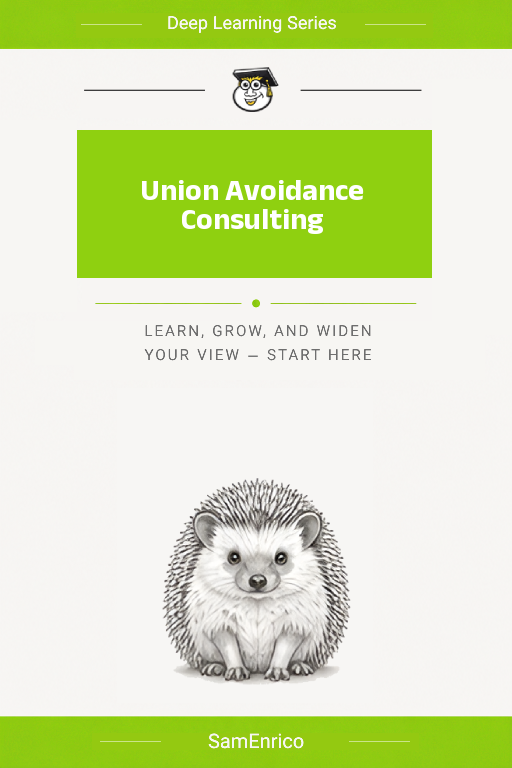
Non-FictionAnnual CheckupAvoidanceConsulting
Union Avoidance Consulting eBook
Understand union avoidance consulting industry inc
by Wyman Kandis
Understand union avoidance consulting industry including strategies used by retailers and tech companies.
Formats
Free sample
Chapter 1: The Billion-Dollar Secret--The union avoidance consulting industry does not want you to read this book. That is not marketing hyperbole or a paranoid author’s conceit. It is a statement of fact about an industry built on a foundational paradox: the people who pay $1.7 billion annually to keep unions out of their workplaces succeed only when no one knows they are paying it. Secrecy is not a byproduct of their work. Secrecy is the product.Consider the math.
In the United States today, nearly seven out of ten adults express approval of labor unions. That number has climbed steadily for a decade, crossing thresholds not seen since the heyday of the post-war labor movement. Yet in the private sector—where the vast majority of Americans work—only about six percent belong to a union. This gap between what workers want and what they have is not an accident of history or a reflection of changing preferences. It is the result of a deliberate, well-funded, and largely invisible industry that has perfected the art of preventing workers from exercising their legal right to organize.The gap is the industry’s business model.This book is about that industry.
It is about the lawyers who have turned labor law into a maze of loopholes, the consultants who script every word a manager says during a union campaign, the surveillance technologies that scan employee chat logs for forbidden words, and the private operatives who have been caught infiltrating worker organizing meetings. It is about Amazon spending 26milliontostopsixwarehouseworkersin Alabama,about Dollar Generalspending26 million to stop six warehouse workers in Alabama, about Dollar General spending 26milliontostopsixwarehouseworkersin Alabama,about Dollar Generalspending13,500 per day to fight a handful of employees making $13 an hour, and about Starbucks deploying an army of lawyers to delay contract negotiations for more than four hundred days after workers won their union election.But before we dive into the tactics, the case studies, and the technologies, we need to understand what this industry actually is, who its key players are, and why its very existence depends on a paradox that this book will spend twelve chapters unraveling.The Industry That Does Not Want to Be Named Let us start with the name. What do we call this industry? The practitioners themselves prefer terms like "labor relations consulting," "employee relations strategy," or "workplace compliance." These phrases are designed to sound neutral, even benign. They evoke images of HR professionals helping managers communicate more effectively with their teams.
That is the point.The more accurate term—the one used by labor unions, worker advocates, and a growing number of journalists—is "union avoidance consulting." Some critics use blunter language: "union busting." But even that term obscures as much as it reveals. Union busting suggests a reactive activity, something you do after a union appears. In reality, the most sophisticated firms in this space are not reactive at all. They are predictive. They use data analytics to identify which workers might organize years before any union shows up.
They train managers to spot early warning signs. They create "positive employee relations" programs designed to make unions seem unnecessary before anyone ever mentions the word.The industry operates in the shadows not because it is illegal—almost everything in this book is perfectly legal under current law—but because transparency would undermine its effectiveness. If workers knew that their employer had hired a $2,000-per-hour law firm to monitor their Slack messages and coach their supervisors on how to discourage organizing, that knowledge might radicalize them. It might make them angry. It might make them more determined to unionize.
So the industry hides. It uses attorney-client privilege as a shield. It labels its activities as "advice" rather than "persuasion" to avoid public disclosure. It funnels its work through law firms that claim special protection from scrutiny.This secrecy is not a bug. It is a feature.
And it is the first thing any reader must understand before we can explore the tactics that follow.The Two Faces of Union Avoidance: Big Law and Boutique Shops The union avoidance industry is not monolithic. It consists of two distinct types of firms, each with its own business model, its own legal strategy, and its own relationship to secrecy.The first type is what we will call the "Big Law" defense firms. These are large, established labor and employment law practices with names like Littler Mendelson, Ogletree Deakins, and Jackson Lewis. They bill by the hour—often 800to800 to 800to2,000 per hour for partner time—and they sell legal advice, election defense, and regulatory compliance. Their clients are typically large corporations with sophisticated HR departments and deep pockets.
When a company like Amazon or Starbucks faces a union organizing drive, it is almost certainly working with one or more of these firms.The Big Law firms have a crucial advantage: they can claim that almost everything they do is protected by the attorney-client privilege and the "advice" loophole in federal labor law. As we will explore in detail in Chapter 3, the distinction between "advice" (which is confidential) and "persuader activity" (which must be disclosed) is intentionally vague. The Big Law firms exploit this vagueness relentlessly, labeling virtually all of their anti-union work as privileged legal advice. This means they can operate in near-total secrecy, with no public disclosure of their activities, their fees, or even the fact that they have been hired.The second type is what we will call the "boutique persuader shops." These are smaller, specialized consulting firms like the Labor Relations Institute and Road Warrior Productions. Unlike the Big Law firms, these shops do not hide behind legal credentials.
They are overtly in the business of persuasion. They write scripts for captive audience meetings. They design anti-union mailers, text message campaigns, and social media ads. They train supervisors on how to interrogate workers about their union sympathies. Some of them, as we will see in Chapter 6, have even embedded operatives directly into warehouses during organizing drives.The boutique shops cannot claim the same legal protections as the Big Law firms.
Their work is more clearly "persuader activity," which means they are theoretically required to disclose their clients and their fees. In practice, as Chapter 10 will reveal, the vast majority of them do not. The disclosure forms exist. The penalties for non-compliance are minimal. And the enforcement mechanism is essentially nonexistent.
So the boutique shops operate in the same shadows as the Big Law firms, even though they lack the same legal fig leaf.The $1.7 Billion Question: Why Do Employers Pay?Before we can understand the tactics, we must understand the economics. Why do employers spend an estimated $1.7 billion annually on union avoidance? The answer is not simply "they hate unions" or "they want to exploit workers." Those explanations are emotionally satisfying but analytically incomplete.The real answer is more complex. Employers pay because unionization imposes costs—real, measurable, and often substantial costs. A unionized workforce typically earns 10 to 20 percent higher wages than a non-unionized workforce in the same industry.
Unionized workers are more likely to have health insurance, pensions, paid sick leave, and predictable schedules. They are protected by seniority systems that limit management's discretion over promotions…
This is the end of the free sample. Get the eBook to keep going. Buy now
About this book
Details
- Author
- Wyman Kandis
- Publisher
- SamEnrico
- Language
- English
- Genre
- Non-Fiction, Annual Checkup, Avoidance, Consulting
- Released
- 2026-05-29
- Pages (approx.)
- 138
- Available as
- eBook, Audiobook

Read better in the ZLOADR app
Your eBooks on your phone or tablet. Sign in with your SamEnrico account and start reading.
More by Wyman Kandis
 Loneliness Self Compassion GuideWyman Kandis$11.99
 Antwerp Diamond Heist International Smuggling RingWyman Kandis$11.99
 Zumba Playlist Curation GuideWyman Kandis$11.99
 Teen Goal Setting ConfidenceWyman Kandis$11.99
 Stalking Military Service Member CasesWyman Kandis$11.99
 From Rags to Retail: The Unlikely Rise of Dollar TreeWyman Kandis$11.99
 The Octopus Who Outsmarted the Navy: Clever Hansi’s Underwater EscapeWyman Kandis$11.99
 Understanding D-plus Hemolytic Uremic SyndromeWyman Kandis$17.99
 Category General ManagerWyman Kandis$11.99
 How to Become a Automobile-service-station AttendantWyman Kandis$11.99
You may also like
 Hong Kong Handover 1997Dunn Johnnie$11.99
 Zumba For Postnatal Recovery CourseNeal Christian$11.99
 Zumba for BeginnersLadner Nikia$11.99
 YouTube Comment Mining GuideHumes Pandora$12.99
 Worry Box MeditationCarlin Rudy$11.99
 Workplace Stress MeditationNguyen Lynn$11.99
 Workplace Stress and Sleep RepairHawley Ivory$11.99
 Workplace Perfectionism CureDelaney Jeffry$11.99
 Workplace Injustice Anger GuideWallen Isabelle$11.99
 Work Addiction and Burnout LinkGreenwood Ester$11.99
 Women in Yoga and WellnessBeattie Galina$11.99
 Women in Stand Up ComedyChun Evangeline$11.99