
Unfair Advantage Statement eBook
Articulate your defensible competitive advantage t
by Warren Tracy
Identify what makes you uniquely capable to succeed.
Formats
Free sample
Chapter 1: The Effort Trap--The hardest-working person in the room is almost never the most successful one. Let that land for a moment.We have been raised on a diet of inspirational posters, graduation speeches, and biopic montages that all preach the same gospel: work harder than everyone else, and you will win. The hero wakes up at 4:00 AM. The hero works through weekends. The hero outlasts, out-lifts, and out-grinds the competition.
And then, inevitably, the hero triumphs.It is a beautiful story. It is also statistically, psychologically, and strategically wrong.This chapter will dismantle the single most dangerous myth in business and career strategy: that relentless effort alone is the primary driver of success. In its place, we will introduce a radically different framework—one based on asymmetries, not hours. You will learn why the hardest worker often finishes last, why the concept of "fair competition" is a trap, and how to shift your focus from working harder to working with an Unfair Advantage.The Invention That Wasn't Consider the story of the automobile. Ask most people who invented the car, and they will say Henry Ford.
This is incorrect. The first practical automobile was built by Karl Benz in 1885—a full eleven years before Henry Ford built his first quadricycle. Benz was a brilliant engineer. He worked incredibly hard. He held the patents.
By the logic of the hard work myth, Benz should have become the dominant name in automotive history.But he did not.Ford did not invent the car. He did not work harder than Benz's engineers. What Ford possessed was something entirely different: an unfair advantage. He had a vision of a moving assembly line, access to capital from investors who trusted his reputation, and a location in Detroit that had become a hub of manufacturing talent. Ford's advantage was not effort.
It was asymmetry. He had something Benz could not easily copy: a system, a network, and a context.The same pattern repeats across every industry. The winner is not the hardest worker. The winner is the one whose unique, non-replicable asymmetries align best with the opportunity at hand.The Hard Work Lie: Why It Persists Before we build a better framework, we must understand why the hard work myth is so durable. It persists for three psychological reasons.First, the Just-World Hypothesis.
Humans have a deep need to believe that the world is fair—that outcomes are distributed based on merit and effort. If success came down to luck or unearned advantages, then our own failures might be outside our control. That is terrifying. So we cling to the story that hard work is the master key. It gives us the illusion of control.Second, Survivorship Bias.
We hear about the founder who worked 100-hour weeks and built a unicorn. We do not hear about the thousands of founders who worked 100-hour weeks and went bankrupt. The survivors tell stories that flatter their effort, not their luck. They want to believe they earned their success purely, so they emphasize the grind and downplay the asymmetric advantages they inherited or stumbled upon.Third, The Grind Culture Industrial Complex. There is an entire economy built on selling hard work.
Productivity gurus, time management apps, and hustle-culture influencers all profit when you believe that the solution to your problems is more effort. They sell you the belief that you are just one more hour of work away from breakthrough. This is rarely true.The Statistical Reality of Asymmetry Let us look at the data. A landmark study by economists at the National Bureau of Economic Research tracked thousands of startup founders over a decade. They found that the correlation between founder effort (measured in hours worked per week) and startup success (measured in revenue growth or exit value) was surprisingly weak—approximately 0.12 on a scale where 1.0 would indicate perfect correlation.
In plain English: knowing how hard someone worked told you almost nothing about whether they would succeed.What predicted success far more accurately? Four factors:One, access to unique information not available to competitors. Two, existing relationships with key customers or distributors. Three, prior experience in the exact problem space. Four, location in a high-density ecosystem of talent and capital.Notice what is missing from that list: effort.
Hard work was a secondary variable at best.The authors of that study coined a memorable phrase: "Effort is the currency of the desperate." Those without asymmetries must outwork everyone else just to stay in the game. Those with asymmetries can achieve better outcomes with less effort—not because they are lazy, but because they are strategic.Symmetric vs. Asymmetric Competition To understand why hard work is overrated, we must understand the two types of competition.Symmetric competition occurs when all players have roughly the same resources, information, and capabilities. In symmetric competition, effort becomes the only differentiator. Two identical bakeries on the same street.
Two identical freelance graphic designers with the same portfolio. Two identical software startups with the same feature set. In these situations, the harder worker might win—but only by a small margin, and only temporarily. Symmetric competition inevitably leads to commoditization, price wars, and burnout.Asymmetric competition occurs when players have different resources, information, and capabilities. In asymmetric competition, the player with the better asymmetries wins almost regardless of effort.
A bakery that owns its building (lower costs) competes differently than a bakery paying market rent. A graphic designer who previously worked at a major ad agency (status and relationships) closes deals faster than an equally talented unknown. A software startup with exclusive data from a previous employer builds features competitors cannot replicate.The mistake most people make is trying to win in symmetric competition through brute force effort. They compete on the same playing field, with the same tools, against the same competitors—and they simply try to outwork everyone. This is exhausting, demoralizing, and ultimately losing.The winning move is to escape symmetric competition entirely.
To find or build asymmetries that make the comparison irrelevant.What Is an Unfair Advantage Statement?This brings us to the central concept of this book. An Unfair Advantage Statement (UAS) is a concise articulation of the defensible relationship between your unique asymmetries and a specific market opportunity.Let us break that definition into its three components.First, your unique asymmetries. These are the things you have (or have access to) that are not universally available. They come from the MILES framework, which we will explore in depth in Chapter 2: Money (runway, capital access), Intelligence (creative, analytical, emotional), Location and Exposure (geography, network density), Education (depth and breadth of knowledge), and Status (reputation, trust signals). These are your raw materials.Second, a specific market opportunity.
An asymmetry is not an advantage in a vacuum. Having a Ph D in astrophysics is an asymmetry. It becomes an unfair advantage only when applied to a market that needs astrophysics expertise. The same asymmetry is worthless if you are trying to sell handmade candles.Third, a defensible relationship. This is the critical word: defensible.
Your advantage must be difficult or impossible for competitors to copy. If your advantage can be replicated in six months with enough money, it is not…
This is the end of the free sample. Get the eBook to keep going. Buy now
About this book
Details
- Author
- Warren Tracy
- Publisher
- SamEnrico
- Language
- English
- Genre
- Non-Fiction, First 30 Days, Advantage, First 30 Days, Competitive Edge
- Released
- 2026-05-28
- Pages (approx.)
- 136
- Available as
- eBook, Audiobook

Read better in the ZLOADR app
Your eBooks on your phone or tablet. Sign in with your SamEnrico account and start reading.
More by Warren Tracy
 The Daily Loci Practice PlanWarren Tracy$11.99
 Emotional Intelligence Complete GuideWarren Tracy$11.99
 Spain Remote Tax GuideWarren Tracy$11.99
 Seasonal Affective SleepWarren Tracy$11.99
 Mindfulness Meditation for Imposter SyndromeWarren Tracy$11.99
 Bipolar College Student GuideWarren Tracy$11.99
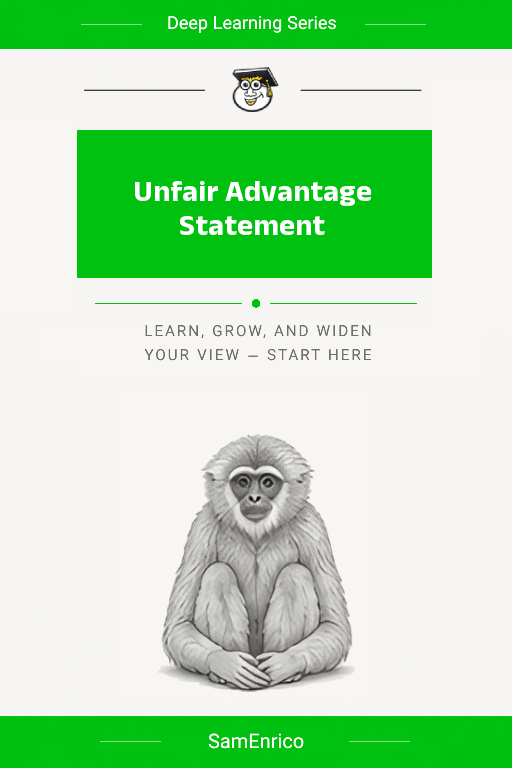 Unfair Advantage StatementWarren Tracy$12.99
 Gut Microbiome Testing GuideWarren Tracy$11.99
 Public Speaking Loci CourseWarren Tracy$11.99
 Alpha Lipoic Acid GuideWarren Tracy$11.99
 The Deep Silence: The Great Pacific Garbage Patch's Predatory EcosystemWarren Tracy$11.99
 The Billionaire’s Bargain: How a Tech Mogul Reshaped Global EducationWarren Tracy$11.99