
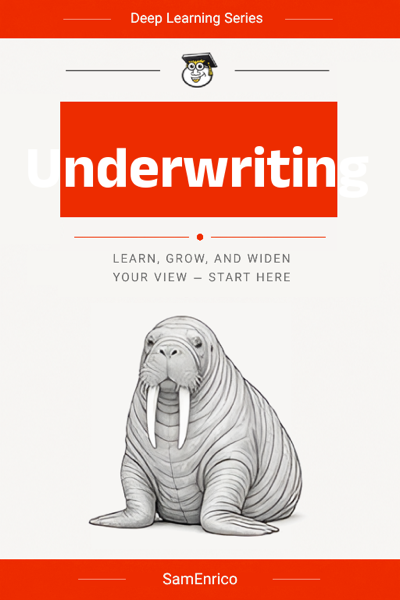
Non-FictionInformativeEducational
Underwriting eBook
A Coursebook on Underwriting
A Coursebook on Underwriting
Formats
Free sample
Chapter 1: The Pen That Prints Money--The phone rang at 7:43 on a Tuesday morning. Elena Vasquez, a senior commercial underwriter with seventeen years of experience, picked it up without checking the caller ID—a habit she had cultivated when she was still an assistant underwriter and her boss expected her to answer before the second ring. On the other end was a broker she knew well, a fast-talking man named Doug who specialized in placing risks that other carriers had already declined."Elena, I've got something beautiful for you," Doug said. "Manufacturing facility, been in business thirty years, excellent loss history, new management team, asking for a two-million-dollar umbrella. I can have the submission in your inbox in ten minutes."Elena leaned back in her chair and looked at the calendar on her wall—a physical calendar, because she was old school in a profession that was rapidly becoming new school.
"Doug, when you say 'beautiful,' what you usually mean is 'everyone else said no.' What did they see that I'm not seeing?"A pause. Then Doug laughed, because she had caught him. "Okay, fine. There was a small fire eighteen months ago. Electrical.
No injuries, total payout under fifty thousand. But the previous carrier non-renewed them anyway, and the replacement carrier is skittish about the age of the building's wiring."Elena wrote down three words on a yellow legal pad: fire, wiring, age. "Send me the file. No promises."She hung up and looked at the pad. Under those three words, she wrote a fourth: opportunity.This is the moment that separates underwriters who merely process applications from those who actually practice the craft.
Doug saw a problem—a fire, old wiring, a non-renewal. Elena saw a question: did the previous carrier overreact, or did they know something she did not? And beneath that question lay an even deeper one: could she price this risk profitably when her competitors could not?That is what underwriting really is. Not saying no. Not stamping approvals.
But looking at uncertainty—at the fog of incomplete information, conflicting signals, and human fallibility—and deciding, with the best available tools, whether to take a bet. And then deciding how much to charge for that bet, and how much of that bet to keep, and how much to lay off on someone else.This chapter is about the economics that make that bet possible. It is about why underwriting exists, how it makes money, and why a job that most people have never heard of actually determines whether you can buy a house, insure your car, or keep your small business open after a disaster. By the end of this chapter, you will understand the financial machinery behind every insurance policy and every mortgage approval. You will also understand why bad underwriting—the kind that cuts corners or ignores fundamentals—has destroyed more companies than almost any other single cause.Let us start with a simple question that has a surprisingly complicated answer.The Core Objective: More Than Just Saying Yes or No Most people outside the industry think underwriting is just about acceptance and rejection.
An application comes in. The underwriter checks some boxes. The answer is either "yes, you're covered" or "no, you're not." This is like saying that a chef's job is just about turning on the stove.The actual objective of underwriting is threefold, and each part depends on the others. First, risk selection: identifying which risks are likely to be profitable and which are likely to lose money. Second, risk classification: grouping similar risks together so that they can be priced consistently and fairly.
Third, risk pricing: determining how much premium to charge for each risk, given its characteristics and the insurer's need to earn a profit.Notice what is not in that list. Nowhere does the definition say "decline as many risks as possible." Nowhere does it say "charge the highest possible price." A good underwriter does not maximize declinations; a good underwriter maximizes the expected profitability of the accepted book of business, subject to the constraint of staying within the carrier's risk appetite and regulatory boundaries.Consider Elena's manufacturing risk again. She could simply decline it—the fire, the old wiring, the non-renewal all point toward trouble. That would be the safest decision for her career. No declined risk ever becomes a large loss.
But also, no declined risk ever generates premium revenue. An underwriter who declines everything will never be fired for a catastrophic loss, but will also never be promoted for growing a profitable book. The art is in finding the risks that look problematic to others but are actually mispriced, misunderstood, or both.This is where the comparison to gambling becomes useful, though imperfect. A casino does not try to win every hand. It tries to win over time, using the law of large numbers and a built-in statistical edge.
Underwriting is similar, but with one crucial difference: in a casino, the odds are known and fixed. In underwriting, the odds are estimated from historical data that may or may not predict the future. The underwriter is playing a game where the rules change, the deck is sometimes stacked, and the other players (the insureds) often know more about their own hands than the underwriter does.That last point—asymmetric information—is the central challenge of underwriting. The person applying for insurance almost always knows more about their own risk than the underwriter does. They know if they have been driving recklessly.
They know if their warehouse has been cutting corners on fire safety. They know if their health has been deteriorating. The underwriter's job is to use the tools available—applications, inspections, loss runs, credit scores, predictive models—to close that information gap as much as possible, and then to price the remaining uncertainty.The Insurance Business Model: Where the Money Actually Comes From To understand underwriting, you have to understand how insurance companies make money. The answer is not as obvious as it seems, and getting it wrong has been the downfall of many talented underwriters.An insurance company collects premiums before it pays claims. That cash sits in the company's hands for a period of time—sometimes weeks, sometimes years—before it flows back out to policyholders as claim payments.
During that time, the company can invest that money. The investment earnings are a major source of profit for the insurance industry, particularly in lines of business where claims are paid out slowly, such as liability insurance or workers' compensation.This leads to a fundamental distinction that every underwriter must internalize: underwriting profit versus investment income.Underwriting profit is the difference between the premiums collected and the claims paid plus expenses. If an insurer collects one million dollars in premiums, pays six hundred thousand in claims, and spends two hundred thousand on salaries, rent, and other expenses, the underwriting profit is two hundred thousand dollars. The combined ratio—the sum of losses and expenses divided by premiums—would be 80% (600,000 + 200,000 = 800,000 ÷ 1,000,000 = 0.80). A combined ratio below 100% means an underwriting profit.
Above 100% means an underwriting loss.But here is where it gets interesting. Many insurance companies operate at a combined ratio above 100% for years…
This is the end of the free sample. Get the eBook to keep going. Buy now
About this book
Details
- Author
- Lowery Angeles
- Publisher
- SamEnrico
- Language
- English
- Genre
- Non-Fiction, Informative, Educational
- Released
- 2026-06-02
- Pages (approx.)
- 140
- Available as
- eBook, Audiobook

Read better in the ZLOADR app
Your eBooks on your phone or tablet. Sign in with your SamEnrico account and start reading.
More by Lowery Angeles
 Mindfulness for Tinnitus WorkbookLowery Angeles$11.99
 The Mindful Workday GuideLowery Angeles$11.99
 Ayurvedic Women's Health GuideLowery Angeles$11.99
 Foster Teen Self Esteem GuideLowery Angeles$11.99
 Gulf Region Talent Import ForecastLowery Angeles$11.99
 The Vancouver Vipers: Canada's Forgotten Bootlegging WarsLowery Angeles$11.99
 Ghana Returns and Refund ProcessLowery Angeles$12.99
 Budget Tracking AI WorkflowLowery Angeles$12.99
 Understanding Meyenburg–altherr–uehlinger SyndromeLowery Angeles$17.99
 How to Become a Clicking-machine OperatorLowery Angeles$11.99
You may also like
 Hong Kong Handover 1997Dunn Johnnie$11.99
 Zumba For Postnatal Recovery CourseNeal Christian$11.99
 Zumba for BeginnersLadner Nikia$11.99
 YouTube Comment Mining GuideHumes Pandora$12.99
 Worry Box MeditationCarlin Rudy$11.99
 Workplace Stress MeditationNguyen Lynn$11.99
 Workplace Stress and Sleep RepairHawley Ivory$11.99
 Workplace Perfectionism CureDelaney Jeffry$11.99
 Workplace Injustice Anger GuideWallen Isabelle$11.99
 Work Addiction and Burnout LinkGreenwood Ester$11.99
 Women in Yoga and WellnessBeattie Galina$11.99
 Women in Stand Up ComedyChun Evangeline$11.99