
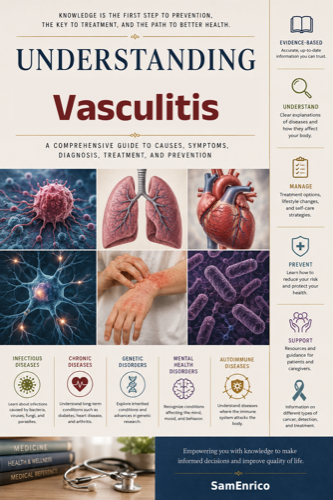
Non-FictionInformativeEducational
Understanding Vasculitis eBook
This disease publication, published by SamEnrico,
This disease publication, published by SamEnrico, covers Understanding Vasculitis
Formats
Free sample
Chapter 1: The Red Thread...--–- Imagine for a moment that your body is a vast, sprawling city. Not just any city, but a living, breathing metropolis home to trillions of citizens—your cells. Like any great city, it requires an intricate transportation network to survive. That network is your circulatory system: a web of blood vessels stretching nearly 60,000 miles if laid end to end, enough to circle the Earth more than twice. The largest vessels are the interstate highways—the aorta and its major branches—carrying high-speed traffic of oxygen-rich blood from your heart to your organs.
The medium vessels are the city streets, delivering supplies to specific neighborhoods like your kidneys, your nerves, and your muscles. And the smallest vessels, the capillaries and venules, are the narrow alleys and footpaths that make the final delivery to every single citizen—every skin cell, every brain cell, every fingertip.Now imagine that the city’s police force—your immune system—suddenly receives faulty intelligence. It mistakes the roads themselves for the enemy. Instead of chasing down real threats like viruses or bacteria, it turns its weapons on the city’s own infrastructure. It attacks the highway walls, the street curbs, the alleyways.
This is vasculitis. Not a disease of a single organ, not a simple infection you can cure with a course of antibiotics, but a fundamental betrayal of your body’s own defense system. Your immune system has declared war on your blood vessels.This chapter is called “The Red Thread” because that is what blood vessels are—a continuous thread that runs through every part of you, from the crown of your head to the tips of your toes. And when that thread becomes inflamed, the consequences ripple everywhere. Understanding this thread—what it is, what it does, and what happens when it comes under attack—is the foundation for everything else in this book.
If you grasp only one chapter, let it be this one. Because once you understand the red thread, you understand why vasculitis can cause a rash on your leg, kidney failure, and a stroke—all in the same person. You understand why no two patients have exactly the same journey. And you understand why there is hope.The Architecture of You: A Tour of Your Blood Vessels Before we can understand what goes wrong in vasculitis, we need to understand what healthy blood vessels look like and how they work. Let us take a brief tour—not like a medical student studying for an exam, but like a traveler learning the layout of a new city.Blood vessels are not passive pipes.
They are dynamic, living organs with three distinct layers. The innermost layer, called the tunica intima, is a smooth, slippery surface that allows blood to flow without clotting. This layer is in direct contact with your blood at all times. The middle layer, the tunica media, is made of smooth muscle and elastic fibers. This layer can contract or relax to change the diameter of the vessel—narrowing to raise blood pressure, widening to lower it.
The outermost layer, the tunica adventitia, is a tough, fibrous sheath that anchors the vessel to surrounding tissues and contains tiny nerves and its own blood supply (yes, blood vessels have their own tiny blood vessels—vasa vasorum, or “vessels of the vessels”).Now, size matters. Not in the way you might think, but in a way that determines almost everything about how vasculitis will affect you.Large vessels are the aorta—the main pipeline leaving your heart—and its major branches: the carotid arteries going up to your brain, the subclavian arteries going to your arms, the iliac arteries going to your legs. These vessels have thick, muscular walls designed to handle high pressure. When large vessels become inflamed, the consequences are dramatic but localized. A narrowed carotid artery might cause a stroke.
A weakened aorta might balloon into a life-threatening aneurysm.Medium vessels are the arteries that supply specific organs. The renal arteries take blood to your kidneys. The mesenteric arteries feed your intestines. The coronary arteries wrap around your heart. These vessels are smaller than large arteries but still have significant muscle layers.
When medium vessels become inflamed, you get organ-specific problems: kidney failure from renal artery narrowing, abdominal pain and bloody diarrhea from intestinal involvement, heart attacks from coronary arteritis.Small vessels are the capillaries and venules where the real work of your body happens. This is where oxygen leaves the blood and enters your tissues. This is where carbon dioxide is picked up for removal. This is where your immune cells patrol for threats. Small vessels have very thin walls—sometimes just a single layer of cells.
When they become inflamed, they can leak or rupture easily. That is why small vessel vasculitis so often causes palpable purpura—those small red or purple spots on your skin that don’t fade when you press on them. The tiny vessels in your skin have burst.Here is the key insight: Vasculitis is classified by the size of the vessel primarily affected, not by which organ hurts the most. A patient with large vessel vasculitis (say, Giant Cell Arteritis) might have a headache and jaw pain. A patient with small vessel vasculitis (say, Granulomatosis with Polyangiitis) might have a bloody nose and kidney failure.
Both have vasculitis. Both have inflammation of blood vessels. But the size of the vessel targeted determines the pattern of symptoms, the organs at risk, and the treatment approach. This is why your rheumatologist asks not just “where does it hurt?” but “what kind of blood vessel is there?”The Betrayal: What Inflammation Actually Means Inflammation is a word that gets thrown around a lot. You have probably heard it in commercials for arthritis medications or read it in articles about heart disease.
But what is inflammation, really? At its core, inflammation is the immune system’s response to something it perceives as a threat. This is not inherently bad. In fact, acute inflammation—the kind you get when you cut your finger or catch the flu—is essential for survival. Your immune system sends white blood cells to the site of injury or infection.
Those cells release chemicals that cause redness (from increased blood flow), heat (also from increased blood flow), swelling (from fluid leaking out of vessels), and pain (from nerve irritation). This response contains the threat, kills pathogens, and begins the healing process. Without inflammation, you would die from the first minor infection.Vasculitis is inflammation without a legitimate threat. Your immune system has activated its full inflammatory arsenal—but there is no virus to kill, no bacteria to destroy, no wound to heal. The target is your own blood vessel walls.Let us look at what happens at the microscopic level, because seeing this process makes everything else make sense.Step one: Something triggers your immune system to become activated.
That “something” is different for different types of vasculitis and is often unknown—a topic we will explore in Chapter 3. But for now, know that the trigger causes your immune cells to become aggressive and misdirected.Step two: White blood cells—particularly neutrophils and lymphocytes—begin to…
This is the end of the free sample. Get the eBook to keep going. Buy now
About this book
Details
- Author
- Poulsen Jennie
- Publisher
- SamEnrico
- Language
- English
- Genre
- Non-Fiction, Informative, Educational
- Released
- 2026-05-09
- Pages (approx.)
- 160
- Available as
- eBook, Audiobook

Read better in the ZLOADR app
Your eBooks on your phone or tablet. Sign in with your SamEnrico account and start reading.
More by Poulsen Jennie
 Digital Legacy And Password Planning WorkbookPoulsen Jennie$11.99
 Laci Peterson Media FrenzyPoulsen Jennie$11.99
 The Degree Family StatementPoulsen Jennie$11.99
 Romanian Business GuidePoulsen Jennie$11.99
 The German Free Tuition GuidePoulsen Jennie$11.99
 Code Zero: The Last Broadcast of Radio SilencePoulsen Jennie$11.99
 Late Career Promotion CasePoulsen Jennie$12.99
 Bubble Charts and GraphsPoulsen Jennie$12.99
 Ultimate Handbook Guide to Bogor : (Indonesia) Travel GuidePoulsen Jennie$11.99
 Levyne MiningPoulsen Jennie$11.99
You may also like
 Hong Kong Handover 1997Dunn Johnnie$11.99
 Zumba For Postnatal Recovery CourseNeal Christian$11.99
 Zumba for BeginnersLadner Nikia$11.99
 YouTube Comment Mining GuideHumes Pandora$12.99
 Worry Box MeditationCarlin Rudy$11.99
 Workplace Stress MeditationNguyen Lynn$11.99
 Workplace Stress and Sleep RepairHawley Ivory$11.99
 Workplace Perfectionism CureDelaney Jeffry$11.99
 Workplace Injustice Anger GuideWallen Isabelle$11.99
 Work Addiction and Burnout LinkGreenwood Ester$11.99
 Women in Yoga and WellnessBeattie Galina$11.99
 Women in Stand Up ComedyChun Evangeline$11.99