
Non-FictionInformativeEducational
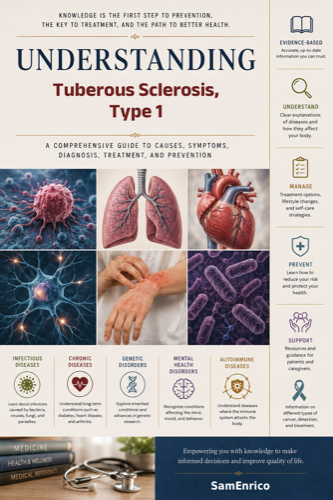
Understanding Tuberous Sclerosis, Type 1
This disease publication, published by SamEnrico,
This disease publication, published by SamEnrico, covers Understanding Tuberous Sclerosis, Type 1
Formats
About this book
Free sample
Chapter 1: The Broken Brake...–- Imagine for a moment that every cell in your body is a car. Not a self-driving, fully autonomous vehicle, but a finely tuned machine with an accelerator pedal pressed firmly to the floor. From the moment of conception, your cells want to grow, divide, and multiply. This drive is ancient, powerful, and relentless—honed by billions of years of evolution. Without it, you would never develop from a single fertilized egg into a being of trillions of cells.
Without it, a scraped knee would never heal, and a broken bone would never knit back together. Cellular growth is the engine of life itself.But an engine without brakes is a catastrophe. If cells grew unchecked, you would not become a healthy adult—you would become a chaotic mass of tissue, a tumor. That is why every cell in your body also comes equipped with a sophisticated braking system, a set of molecular pathways that say "enough" when growth is no longer needed. These brakes are not optional.
They are as essential as the accelerator.Tuberous Sclerosis Complex Type 1, or TSC1, is fundamentally a disease of broken brakes. A single misspelling in a single gene—the TSC1 gene on chromosome 9—disables one of the most important growth control mechanisms in the human body. The accelerator stays pressed down. Cells grow when they should rest. They divide when they should stop.
The result is a collection of benign tumors, called hamartomas, that can appear in the brain, kidneys, heart, lungs, and skin.But here is the paradox. Those same broken brakes also cause seizures, autism, anxiety, and intellectual disability—not because of tumors, but because of how the growing brain wires itself. The disease is named for the potato-like "tubers" that harden the brain's surface, but those tubers are only part of the story. TSC1 is a disease of excess: too much growth, too much electrical activity, too much connectivity in some circuits and not enough in others.Understanding how a single broken brake leads to so many different problems is the key to understanding TSC1. And that understanding is…
This is the end of the free sample. Get the eBook to keep going. Buy now
Contents
- Chapter 1
- Chapter 2
- Chapter 3
- Chapter 4
- Chapter 5
- Chapter 6
- Chapter 7
- Chapter 8
- Chapter 9
- Chapter 10
- Chapter 11
- Chapter 12
Details
- Author
- Brannon Bonny
- Publisher
- SamEnrico
- Language
- English
- Genre
- Non-Fiction, Informative, Educational
- Released
- 2026-06-02
- Pages (approx.)
- 159
- Available as
- eBook, Audiobook

Read better in the ZLOADR app
Your eBooks on your phone or tablet. Sign in with your SamEnrico account and start reading.
More by Brannon Bonny
 Weather Persuasion EffectBrannon Bonny$11.99
 Kaizen Creative GuideBrannon Bonny$11.99
 Mediterranean and SleepBrannon Bonny$11.99
 The Mediterranean Diet for DiabetesBrannon Bonny$11.99
 Art Therapy for Sexual AddictionBrannon Bonny$11.99
 The Guns of Shimonoseki: How a Forgotten War Forged Modern JapanBrannon Bonny$11.99
 How to Become a Pitch FillerBrannon Bonny$11.99
 Data Software EngineerBrannon Bonny$11.99
 YC African Startup Market SizeBrannon Bonny$12.99
 VAT and ConstructionBrannon Bonny$12.99
You may also like
 Hong Kong Handover 1997Dunn Johnnie$11.99
 Zumba For Postnatal Recovery CourseNeal Christian$11.99
 Zumba for BeginnersLadner Nikia$11.99
 YouTube Comment Mining GuideHumes Pandora$12.99
 Worry Box MeditationCarlin Rudy$11.99
 Workplace Stress MeditationNguyen Lynn$11.99
 Workplace Stress and Sleep RepairHawley Ivory$11.99
 Workplace Perfectionism CureDelaney Jeffry$11.99
 Workplace Injustice Anger GuideWallen Isabelle$11.99
 Work Addiction and Burnout LinkGreenwood Ester$11.99
 Women in Yoga and WellnessBeattie Galina$11.99
 Women in Stand Up ComedyChun Evangeline$11.99