
Non-FictionInformativeEducational
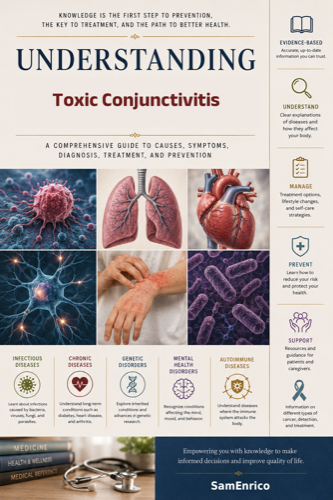
Understanding Toxic Conjunctivitis eBook
This disease publication, published by SamEnrico,
This disease publication, published by SamEnrico, covers Understanding Toxic Conjunctivitis
Formats
Free sample
Chapter 1: The Silent Epidemic...--–- The eye is red. Not the dramatic, frightening red of a subconjunctival hemorrhage, nor the purulent red of bacterial conjunctivitis. It is a quieter red—a low-grade, persistent, maddening redness that has been present for months, perhaps years. The patient, a sixty-seven-year-old woman with well-controlled glaucoma, has seen three ophthalmologists and two optometrists. She has been treated with artificial tears, antihistamine drops, antibiotic-steroid combinations, and even a course of oral doxycycline for suspected rosacea.
Nothing has helped. The burning, the foreign body sensation, the intermittent blurring that clears with a blink—these symptoms have become the background noise of her life. She has stopped reading. She has stopped driving at night. She is not going blind from glaucoma, but she is losing her quality of life to something her doctors cannot name.This patient exists in every eye care practice in every city in every developed country.
She is not rare. She is not unusual. She is the rule, not the exception. And the condition she suffers from—the condition that has been missed by multiple clinicians—is toxic conjunctivitis.The term may sound obscure, even exotic. It is neither.
Toxic conjunctivitis, also known as drug-induced or chemical conjunctivitis, is one of the most common iatrogenic conditions in all of medicine. It affects millions of people worldwide. It causes substantial morbidity, including chronic pain, visual disturbance, and in severe cases, permanent corneal scarring and vision loss. And yet, it remains profoundly underrecognized, underdiagnosed, and undertreated.This chapter serves as the gateway to understanding this hidden epidemic. We will trace the historical roots of our awareness—and lack thereof—of drug-induced ocular surface disease.
We will examine the epidemiological data that reveal the true scope of the problem. We will explore the cognitive and systemic reasons why clinicians consistently miss this diagnosis. And we will set the stage for the rest of this book, which will provide the knowledge and tools necessary to recognize, manage, and prevent toxic conjunctivitis in clinical practice.A Brief History of Iatrogenic Eye Disease The recognition that treatments intended to heal can also harm is as old as medicine itself. The Ebers Papyrus, an Egyptian medical document dating to approximately 1550 BCE, contains prescriptions for eye diseases that include warnings about adverse effects. One remedy for "redness of the eyes"—a mixture of lead oxide, antimony, and human milk—was noted to cause "burning and worsening" in some patients.
The ancient physicians who inscribed these warnings were making the first crude observations of what we now call toxic conjunctivitis.The Greek physician Dioscorides, writing in the first century CE, described how certain copper-based ophthalmic preparations could cause "pain, swelling, and discharge beyond the original ailment." Galen, whose medical theories dominated Western practice for fifteen centuries, distinguished between the intended therapeutic effect of a medication and what he called "harmful inflammation" caused by the medicine itself. These were prescient observations, but they remained isolated and unsystematic.The first clear, rigorous description of toxic conjunctivitis in the modern medical literature came from Albrecht von Graefe, the German ophthalmologist often regarded as the father of modern ophthalmology. In 1864, von Graefe published a report on a troubling phenomenon: some of his patients who were using atropine drops for uveitis developed severe conjunctival injection, burning, and corneal epithelial defects. Von Graefe did something that seems simple in retrospect but was revolutionary at the time. He stopped the atropine.
The symptoms resolved. He restarted it. The symptoms returned. This was the first documented "withdrawal test" in ophthalmology, a diagnostic maneuver that remains the clinical gold standard for toxic conjunctivitis to this day.Von Graefe's report should have launched a new era of vigilance about drug-induced ocular surface disease. It did not.
The medical culture of the nineteenth century was focused on therapeutic efficacy—on finding treatments that worked—rather than on systematically studying their adverse effects. A drug that saved vision was considered worth its side effects, even if those side effects were substantial.The twentieth century brought an explosion of new topical ophthalmic medications: antibiotics, antivirals, corticosteroids, beta-blockers, prostaglandin analogs, and many others. Each new drug was celebrated for its therapeutic benefits. Each new drug was formulated with a preservative—almost always benzalkonium chloride (BAK)—to allow multi-dose packaging. And each new drug added to the growing burden of cumulative ocular surface toxicity that we now recognize as an epidemic.The Benzalkonium Chloride Paradigm To understand the modern epidemic of toxic conjunctivitis, one must first understand benzalkonium chloride.
BAK is a quaternary ammonium compound that kills bacteria by disrupting their cell membranes. It is extraordinarily effective as a preservative, inexpensive to manufacture, and chemically stable. For these reasons, it has become the most widely used preservative in topical ophthalmic preparations worldwide.The problem is that BAK is not selective. It does not distinguish between bacterial cell membranes and human cell membranes. When applied to the ocular surface, BAK disrupts the tear film lipid layer, damages corneal epithelial tight junctions, induces apoptosis of epithelial cells, and triggers a cascade of inflammatory mediators.
These effects are dose-dependent and cumulative. A single drop of a BAK-preserved glaucoma medication causes minimal, usually subclinical damage. But the typical glaucoma patient uses two drops per day, 365 days per year, for decades. The damage accumulates. The eye's repair mechanisms cannot keep pace.
And over time, the ocular surface degrades.This is the central paradox of modern ophthalmic pharmacology: the preservative that makes multi-dose bottles possible is also the primary cause of the most common complication of chronic topical therapy. We have known about the toxicity of BAK for decades. Animal studies dating to the 1970s demonstrated its cytotoxic effects on corneal epithelium. Clinical studies in the 1980s and 1990s confirmed that patients on BAK-preserved glaucoma drops had significantly worse ocular surface health than those on preservative-free alternatives. And yet, BAK remains the preservative of choice for the vast majority of topical ophthalmic medications.Why?
The answer is a combination of inertia, cost, and regulatory indifference. BAK works. It is cheap. It has been used for so long that it has become the default, the standard against which other preservatives are measured. Pharmaceutical companies have little incentive to reformulate existing products without BAK, as the process is expensive and the market for preservative-free alternatives remains niche.
Regulators have not required manufacturers to study the long-term ocular surface effects of their products or to include warnings about cumulative toxicity in their labeling. And clinicians, for reasons we will explore shortly, have been slow to recognize the scope of the problem.Epidemiology: The Numbers Behind the Epidemic The epidemiological data on toxic conjunctivitis are sobering. A landmark study by Leung and colleagues, published in Ophthalmology in 2008, examined 16,000 patients on chronic glaucoma therapy and found that 58.5% had objective signs of ocular surface disease, including reduced tear breakup time, corneal staining, and conjunctival injection. More than half of these patients had never been diagnosed with a condition of the ocular surface. They were simply suffering in silence.Subsequent studies have confirmed these findings.
A 2012 meta-analysis of thirty-two studies involving over 120,000 patients found that the pooled prevalence of ocular surface disease in patients on chronic glaucoma therapy…
This is the end of the free sample. Get the eBook to keep going. Buy now
About this book
Details
- Author
- Forrest Tonita
- Publisher
- SamEnrico
- Language
- English
- Genre
- Non-Fiction, Informative, Educational
- Released
- 2026-06-02
- Pages (approx.)
- 155
- Available as
- eBook, Audiobook

Read better in the ZLOADR app
Your eBooks on your phone or tablet. Sign in with your SamEnrico account and start reading.
More by Forrest Tonita
 TM for Extreme AthletesForrest Tonita$11.99
 Cultural Differences In ListeningForrest Tonita$11.99
 Imposter Syndrome During PhDForrest Tonita$11.99
 The Self Talk for GaslightingForrest Tonita$11.99
 The Home Envy GuideForrest Tonita$11.99
 The Waltz Kings: Strauss and the Golden Age of ViennaForrest Tonita$11.99
 Cakewalk Replaces Pro Tools GuideForrest Tonita$12.99
 One Page Plan for Service BusinessesForrest Tonita$12.99
 How to Start a Canoes and Sailboats Renting and Leasing Business (Beginners Guide)Forrest Tonita$11.99
 Telescope MakingForrest Tonita$11.99
You may also like
 Hong Kong Handover 1997Dunn Johnnie$11.99
 Zumba For Postnatal Recovery CourseNeal Christian$11.99
 Zumba for BeginnersLadner Nikia$11.99
 YouTube Comment Mining GuideHumes Pandora$12.99
 Worry Box MeditationCarlin Rudy$11.99
 Workplace Stress MeditationNguyen Lynn$11.99
 Workplace Stress and Sleep RepairHawley Ivory$11.99
 Workplace Perfectionism CureDelaney Jeffry$11.99
 Workplace Injustice Anger GuideWallen Isabelle$11.99
 Work Addiction and Burnout LinkGreenwood Ester$11.99
 Women in Yoga and WellnessBeattie Galina$11.99
 Women in Stand Up ComedyChun Evangeline$11.99